
>> Overview
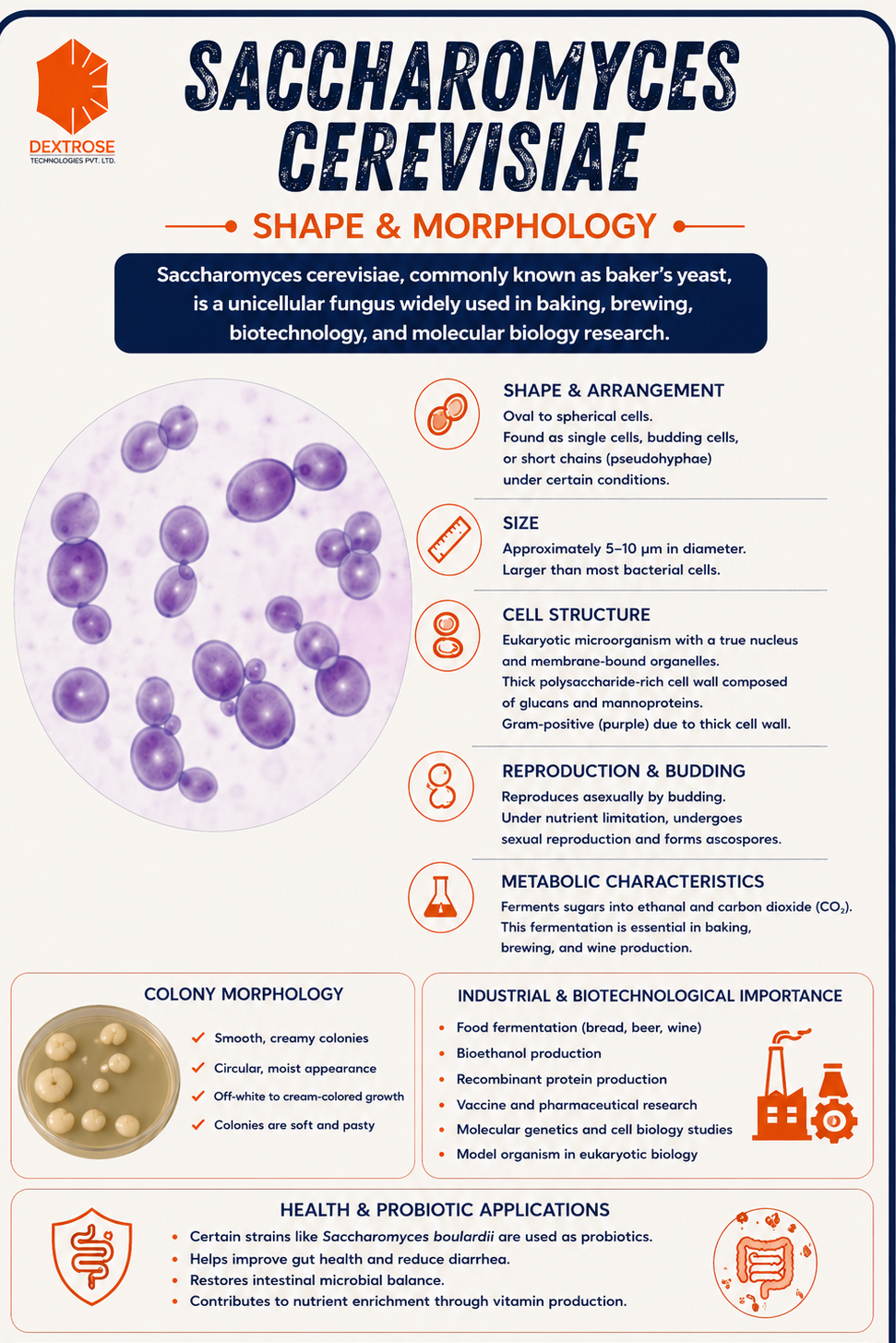
Saccharomyces cerevisiae, commonly known as baker’s yeast, is a unicellular fungus widely used in baking, brewing, biotechnology, and molecular biology research. It is one of the most extensively studied eukaryotic microorganisms due to its simple cultivation, rapid growth, and genetic similarity to higher organisms.
>> Shape and Arrangement
Saccharomyces cerevisiae cells are typically oval to spherical in shape. The cells usually occur as:
Single cells
Budding cells
Short chains called pseudohyphae under certain growth conditions
Its budding pattern is one of the key identifying characteristics of this yeast.
>> Size
The cells generally measure around 5–10 µm in diameter, making them larger than most bacterial cells. Their relatively larger size allows easy visualization under light microscopy.
>> Cell Structure and Staining Characteristics
S. cerevisiae is a eukaryotic microorganism, possessing:
A true nucleus
Membrane-bound organelles
Thick polysaccharide-rich cell wall composed mainly of glucans and mannoproteins
Under Gram staining, yeast cells often appear Gram-positive (purple) due to their thick cell wall structure.
>> Reproduction and Budding
The primary mode of reproduction is asexual budding, where a small daughter cell develops from the parent cell and eventually separates. Under favorable conditions, the yeast reproduces rapidly through continuous budding.
Under nutrient limitation, S. cerevisiae can also undergo sexual reproduction and form ascospores.
>> Metabolic Characteristics
A defining feature of Saccharomyces cerevisiae is its ability to ferment sugars into:
Ethanol
Carbon dioxide (CO₂)
This fermentation capability makes it essential in:
🍞 Bread making
🍺 Beer brewing
🍷 Wine production
The CO₂ produced helps dough rise, while ethanol is important in alcoholic beverage production.
>> Colony Morphology
On culture media, S. cerevisiae typically forms:
✔️ Smooth, creamy colonies
✔️ Circular, moist appearance
✔️ Off-white to cream-colored growth
Colonies are generally soft and pasty due to yeast cell texture.
>> Industrial and Biotechnological Importance
Saccharomyces cerevisiae is highly important in:
Food fermentation industries
Bioethanol production
Recombinant protein production
Vaccine and pharmaceutical research
Molecular genetics and cell biology studies
It is considered a model organism in eukaryotic biology.
>> Health and Probiotic Applications
Certain strains, such as Saccharomyces boulardii, are used as probiotics to:
✅ Improve gut health
✅ Reduce diarrhea
✅ Restore intestinal microbial balance
Yeasts also contribute to nutrient enrichment through vitamin production.