Bangalore
08042753298
+919686928701

Items tagged with 'energy disperssion x ray spectroscopy'

68179d65be22ee500d53ff54 Card 2

product image
Imaging & Characterization

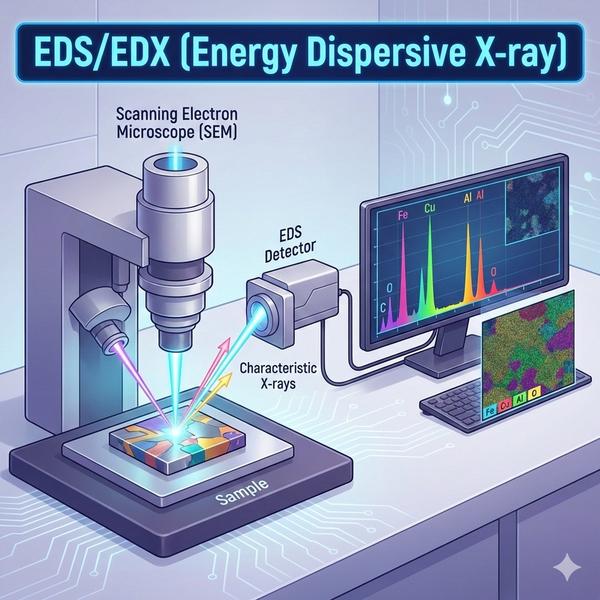
At Dextrose Technologies Pvt. Ltd., we provide EDS/EDX (Energy Dispersive X-ray Analysis)—typically integrated with SEM—to deliver elemental composition and spatial mapping of materials. EDX helps identify what elements are present, where they are located, and how they are distributed, making it highly effective for contamination investigations, impurity localization, and surface/cross-sectional studies. Elemental composition and mapping We perform spot/area analysis and elemental mapping to understand composition and distribution trends across regions of interest. Contaminant and impurity localization EDX is ideal for identifying foreign particles, inclusions, deposits, corrosion products, and process contaminants by pinpointing elemental signatures at the defect site. Surface and cross-sectional analysis We support surface and cross-sectional evaluation (sample-prep dependent) to assess coatings, layers, diffusion regions, and interface contamination. Deliverables * Elemental spectra with identified peaks * Quant summary (wt%/at% as applicable) * Elemental maps and/or line scans (as required) * Clear observations and interpretation notes linked to images Get started Share your sample type, suspected contaminant (if any), and whether you need spot analysis, mapping, or cross-section review. We’ll recommend the best SEM-EDX workflow.

68179d65be22ee500d53ff54 Card 2

product image
Elemental Analysis

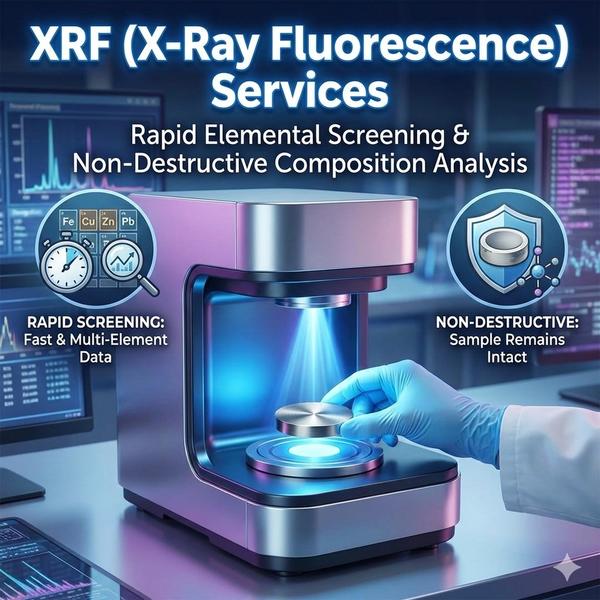
At Dextrose Technologies Pvt. Ltd., we offer XRF (X-Ray Fluorescence Spectroscopy) for fast, non-destructive elemental screening and material composition evaluation. XRF is ideal for solid and powder samples where you need quick elemental insight without complex wet chemistry. It supports raw material verification, contamination checks, and batch comparison through clear, report-ready elemental profiles. Rapid elemental screening We screen for major and minor elements and provide an elemental overview to support quick decisions and follow-up testing plans. Non-destructive material composition analysis XRF analyzes samples without dissolving or destroying them, making it useful for routine checks and investigations where sample preservation matters. Solid and powder sample evaluation We evaluate powders, pellets, solids, and other compatible materials (scope-dependent) and report results in a structured format. Deliverables * Elemental composition summary (as applicable to method and matrix) * Spectra/measurement notes and sample identifiers * Comparative summary across samples/batches * Recommendations for confirmatory testing when required (e.g., ICP-OES/ICP-MS) Get started Share your sample type (powder/solid), expected elements of interest, and whether you need screening or quantitative reporting. We’ll recommend the right XRF workflow.

68179d65be22ee500d53ff54 Card 2

product image
Imaging & Characterization

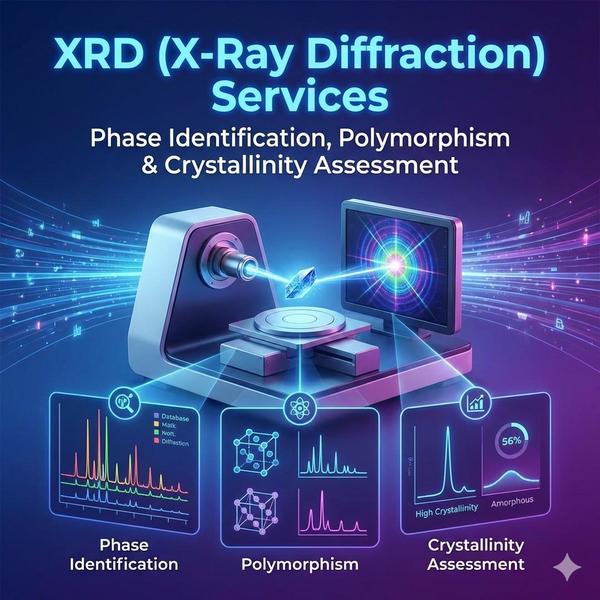
At Dextrose Technologies Pvt. Ltd., we provide XRD (X-Ray Diffraction) for reliable crystalline phase identification and solid-state characterization. XRD is the gold-standard technique to identify crystalline materials, differentiate polymorphs, and assess crystallinity trends—supporting materials science, pharmaceuticals, chemicals, and R&D/QC investigations. Crystalline phase identification We match diffraction patterns to identify crystalline phases and support material verification, contamination checks, and batch comparison. Polymorphism and solid-state characterization We evaluate polymorphic differences and solid-state changes that can impact stability and performance, supporting formulation development and material selection. Crystallinity assessment We assess overall crystallinity trends (semi-quantitative/quantitative as per scope and data quality), useful for comparing processing conditions, heat treatment, or formulation effects. Deliverables * XRD diffractograms with peak list (2θ/intensity) * Phase identification summary (where applicable) * Crystallinity/trend assessment (as applicable) * Interpretation notes and recommendations for follow-up confirmation if required Get started Share your sample type (powder/film/solid), expected phases (if any), and objective (phase ID, polymorph, crystallinity). We’ll recommend the right scan parameters and reporting format.

68179d65be22ee500d53ff54 Card 2

product image
Elemental Analysis

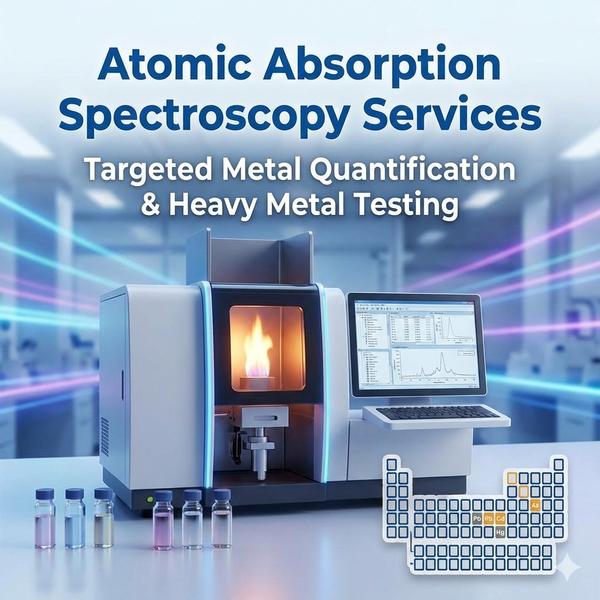
At Dextrose Technologies Pvt. Ltd., we offer Atomic Absorption Spectroscopy (AAS) for accurate, targeted metal quantification in APIs, excipients, formulations, and raw materials. AAS is well suited when you need focused testing of specific metals with dependable calibration-based reporting. We support heavy metal testing and routine elemental checks for quality, troubleshooting, and compliance-focused workflows (scope and limits defined by your requirement). Targeted metal quantification We quantify selected metals based on your target list and matrix, with results reported in clear units (ppm/ppb or mg/L as required). Heavy metal testing in APIs, excipients, and formulations We test for heavy metals in pharmaceutical and formulation samples to support QC decisions and risk evaluation, with clean documentation and structured reporting. Deliverables * Metal-wise concentration results with units * Method notes and sample preparation basis (as applicable) * Calibration approach and QC checks (as agreed) * Summary interpretation highlighting any outliers Get started Share your sample type, target metal list, required limits, and reporting units. We’ll recommend the most suitable AAS workflow.

68179d65be22ee500d53ff54 Card 2

product image
Molecular Characterization

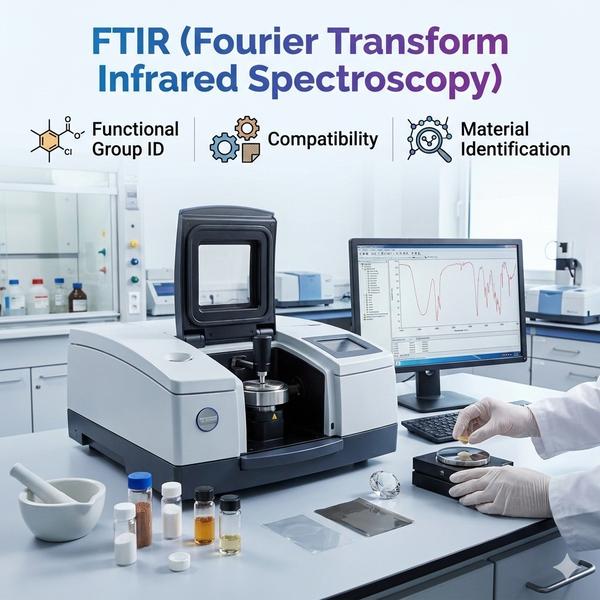
At Dextrose Technologies Pvt. Ltd., we offer FTIR (Fourier Transform Infrared Spectroscopy) for rapid functional group identification and material fingerprinting. FTIR is a reliable first-line tool for confirming raw materials, comparing formulations, and investigating unknowns by identifying characteristic IR absorption bands. It is widely used for polymers, excipients, organics, and contaminant screening, with clear interpretation and documentation. Functional Group Identification We identify key functional groups (e.g., O–H, N–H, C=O, C–O, C–H, aromatic bands) to support compound confirmation, comparison, and troubleshooting. Raw Material and Formulation Compatibility Studies We compare spectra of raw materials, excipients, APIs, and blends to detect spectral changes that may indicate interaction or incompatibility—useful during formulation development and material selection. Polymer, Excipient, and Contaminant Identification FTIR is effective for polymer and excipient fingerprinting and for initial contaminant identification (e.g., unknown residues, particles, films), supporting root-cause investigations and corrective actions. Deliverables * FTIR spectra with peak highlights * Sample-to-sample comparison summary (overlay interpretation) * Identification/interpretation notes aligned to your objective * Recommendations for confirmatory testing if required (e.g., GCMS/LCMS/SEM-EDX) Get started Share your sample type (solid/liquid/powder/film), objective (ID/compatibility/contaminant), and sample count. We’ll recommend the best FTIR approach and reporting format.

68179d65be22ee500d53ff54 Card 2

product image
Sample Preparations

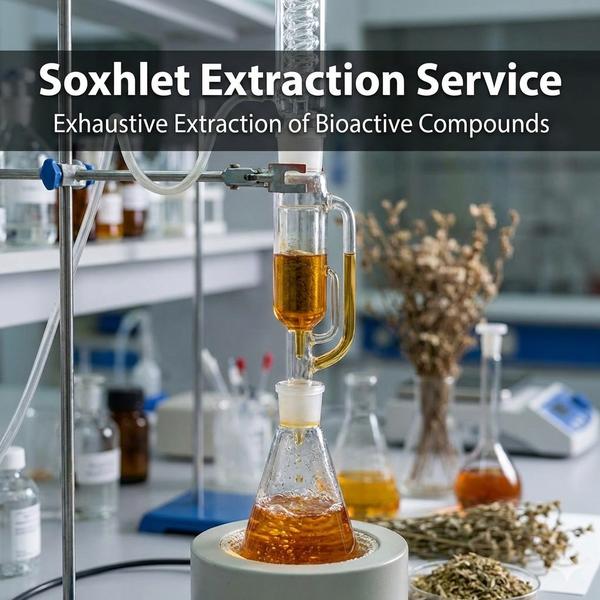
At Dextrose Technologies Pvt. Ltd., we offer Soxhlet Extraction for exhaustive extraction of bioactive compounds from solid matrices such as plant materials, powders, biomass, and formulated solids. Soxhlet enables continuous solvent reflux and repeated washing of the sample, delivering efficient recovery of solvent-soluble constituents for natural product research, fraction preparation, and downstream analytical testing. What Soxhlet extraction is used for Recovery of bioactive fractions from herbs, botanicals, and biomass Extraction of lipids, oils, and non-polar to mid-polar compounds (solvent-dependent) Preparation of concentrated extracts for GCMS, LCMS, HPLC, or bioactivity screening Comparative extraction studies across batches or raw materials How we execute Solvent selection and extraction conditions are set based on your target (non-polar/polar fraction) Controlled extraction time to ensure exhaustive recovery Filtration and solvent removal/concentration support (scope-dependent) Clear labeling and sample traceability Deliverables Extract (concentrated or crude, as agreed) Process notes (solvent used, duration, sample weight, yield %) Optional: guidance for storage and next-step analysis (GCMS/LCMS/HPLC) Get started Share your sample type, target compound class (oil/alkaloids/phenolics etc.), preferred solvent (if any), and the intended downstream analysis.

68179d65be22ee500d53ff54 Card 2

product image
Elemental Analysis

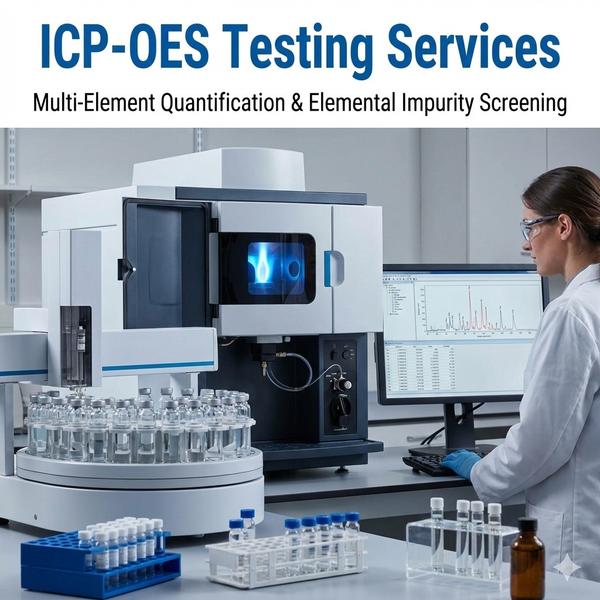
At Dextrose Technologies Pvt. Ltd., we provide ICP-OES (Inductively Coupled Plasma – Optical Emission Spectroscopy) for reliable multi-element quantitative analysis across raw materials, intermediates, and finished products. ICP-OES is well suited for routine elemental profiling and screening where you need accurate concentrations across multiple metals and minerals in a single run (scope depends on matrix and required limits). Multi-Element Quantitative Analysis We quantify multiple elements in one method, generating concentration results in clear units (ppm/ppb or mg/L as required) with calibration-based reporting. Heavy Metal and Elemental Impurity Screening We support screening for heavy metals and elemental impurities to help identify contamination risks, support QC decisions, and enable batch comparison. (For ICH Q3D-aligned programs, scope and limits are finalized based on your requirements and standards provided.) Raw Material and Finished Product Analysis We analyze a wide range of matrices—raw materials, powders, liquids, digests, and finished products—based on suitable sample preparation and digestion approach. Deliverables * Results table with element-wise concentrations * Method notes (sample prep/digestion basis as applicable) * Calibration approach and QC checks (as agreed) * Summary interpretation and flags for outliers/trends Get started Share your sample type, target element list, required limits, and reporting units. We’ll recommend the right ICP-OES workflow and sample preparation plan.

68179d65be22ee500d53ff54 Card 2

product image
Molecular Characterization

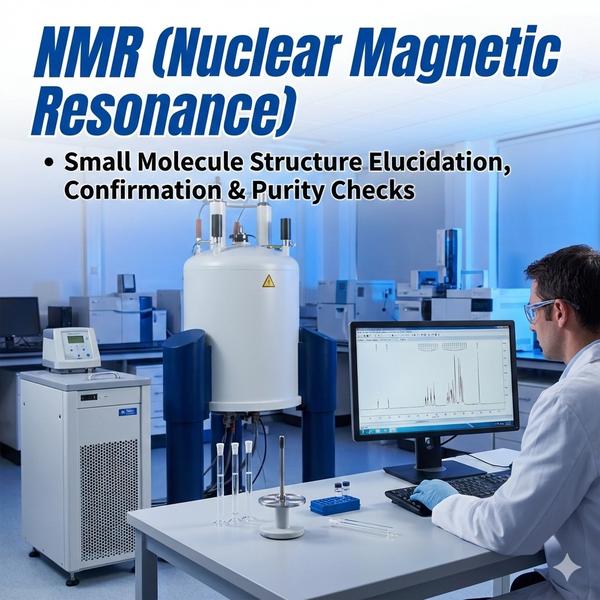
At Dextrose Technologies Pvt. Ltd., we provide NMR (Nuclear Magnetic Resonance) spectroscopy support for structural elucidation and confirmation of small molecules, helping R&D teams validate synthesis outcomes and verify compound identity with high confidence. NMR is widely used for structure verification, purity assessment, and reaction monitoring by confirming key functional environments and structural connectivity (scope dependent on sample and experiment type). Structural Elucidation of Small Molecules We support structure elucidation using NMR data interpretation to assign key signals and confirm molecular framework, supporting research, synthesis, and impurity investigations. Compound Confirmation and Purity Assessment We use NMR to confirm compound identity and assess purity trends by checking for unexpected signals and comparing against expected spectral patterns. Reaction Monitoring and Structural Verification We support reaction progress and structural verification by comparing NMR profiles across stages or fractions, helping you confirm completion and product formation. Deliverables * NMR spectra files and key peak/signal summary * Interpretation notes and assignments (scope-dependent) * Purity/impurity observations based on spectral review * Clear conclusion and recommendations for follow-up confirmation if needed Get started Share the compound type, expected molecular weight, solvent preference, sample amount/concentration, and whether you need ¹H, ¹³C, or 2D experiments. We’ll recommend the most suitable NMR plan and reporting format.

68179d65be22ee500d53ff54 Card 2

product image
Scientific Assistance Services

At Dextrose Technologies Pvt. Ltd., we provide Plagiarism/Similarity and AI-content screening to help researchers and organizations ensure documents are submission-ready, original, and compliant with journal/university expectations. Our service focuses on identifying risk areas early and improving writing quality through ethical corrections—without compromising scientific meaning. What we do Plagiarism / Similarity Screening: Identify high-similarity sections, source overlap patterns, and citation gaps. AI-Content Screening (as applicable): Flag sections that may be interpreted as AI-generated or overly generic, and recommend improvements for authenticity and clarity. Citation & Paraphrasing Review: Improve attribution, strengthen paraphrasing, and reduce accidental similarity while preserving technical accuracy. Submission-Readiness Guidance: Provide a clear action list to align with your target journal/university policies. What you receive * Similarity screening summary (overall + section-wise risk highlights) * Marked-up document notes (problem paragraphs and recommended fixes) * Ethical rewrite guidance (clarity + originality improvements) * Final readiness checklist for submission Compliance note This service is intended for academic and publishing integrity. We do not support bypassing detection systems or misrepresenting authorship.

Still searching for
energy disperssion x ray spectroscopy?