Bangalore
08042753298
+919686928701

Items tagged with 'sem'

68179d65be22ee500d53ff54 Card 2

product image
Imaging & Characterization

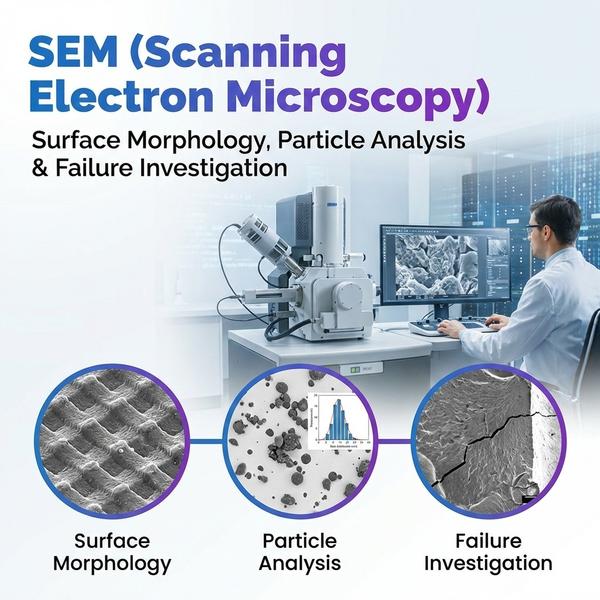
At Dextrose Technologies Pvt. Ltd., we provide SEM (Scanning Electron Microscopy) for high-resolution imaging and detailed surface characterization of materials and biological samples (as applicable). SEM helps you visualize surface morphology, topography, particles, and defects with clarity—supporting R&D, quality investigations, and failure analysis. Surface morphology and topographical analysis We capture high-magnification images to evaluate surface texture, porosity, cracks, coatings, and microstructural features. SEM is ideal for comparing batches, processing conditions, and material finishes. Particle shape and size evaluation We image particles to assess shape, agglomeration, and size distribution trends (image-based), supporting powders, pigments, fillers, nanomaterials (where applicable), and formulation studies. Failure and defect analysis We support root-cause investigations for defects such as fractures, delamination, inclusions, corrosion features, and surface contamination—providing image evidence and interpretation notes to guide corrective actions. Deliverables * High-resolution SEM images (multiple magnifications) * Observation summary highlighting key morphological features * Optional: EDX elemental mapping/spot analysis (if required) * Report-ready documentation for R&D or QC investigations Get started Share your sample type, objective (morphology/particles/failure), and preferred magnification range. We’ll recommend the best SEM imaging plan and deliverables.

68179d65be22ee500d53ff54 Card 2

product image
Imaging & Characterization

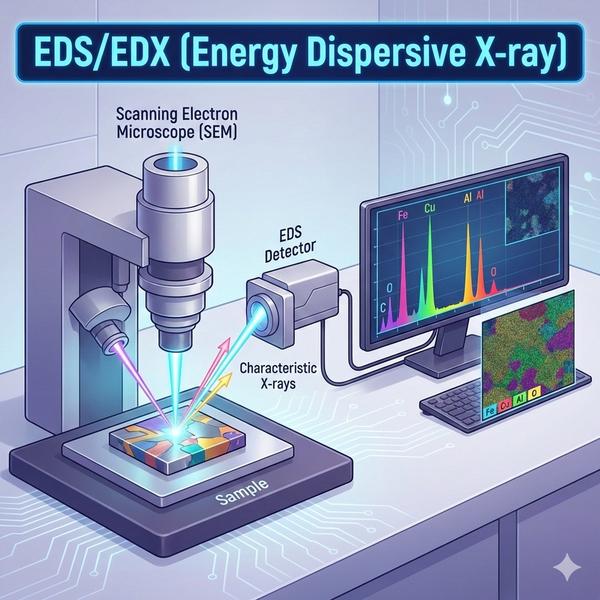
At Dextrose Technologies Pvt. Ltd., we provide EDS/EDX (Energy Dispersive X-ray Analysis)—typically integrated with SEM—to deliver elemental composition and spatial mapping of materials. EDX helps identify what elements are present, where they are located, and how they are distributed, making it highly effective for contamination investigations, impurity localization, and surface/cross-sectional studies. Elemental composition and mapping We perform spot/area analysis and elemental mapping to understand composition and distribution trends across regions of interest. Contaminant and impurity localization EDX is ideal for identifying foreign particles, inclusions, deposits, corrosion products, and process contaminants by pinpointing elemental signatures at the defect site. Surface and cross-sectional analysis We support surface and cross-sectional evaluation (sample-prep dependent) to assess coatings, layers, diffusion regions, and interface contamination. Deliverables * Elemental spectra with identified peaks * Quant summary (wt%/at% as applicable) * Elemental maps and/or line scans (as required) * Clear observations and interpretation notes linked to images Get started Share your sample type, suspected contaminant (if any), and whether you need spot analysis, mapping, or cross-section review. We’ll recommend the best SEM-EDX workflow.

68179d65be22ee500d53ff54 Card 2

product image
Imaging & Characterization

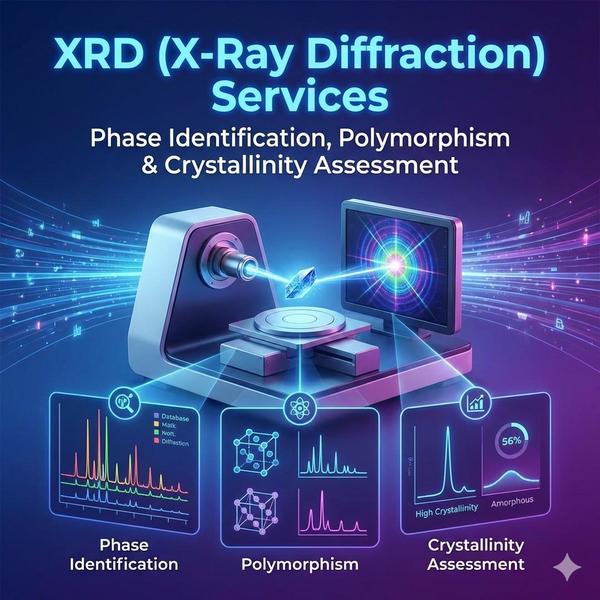
At Dextrose Technologies Pvt. Ltd., we provide XRD (X-Ray Diffraction) for reliable crystalline phase identification and solid-state characterization. XRD is the gold-standard technique to identify crystalline materials, differentiate polymorphs, and assess crystallinity trends—supporting materials science, pharmaceuticals, chemicals, and R&D/QC investigations. Crystalline phase identification We match diffraction patterns to identify crystalline phases and support material verification, contamination checks, and batch comparison. Polymorphism and solid-state characterization We evaluate polymorphic differences and solid-state changes that can impact stability and performance, supporting formulation development and material selection. Crystallinity assessment We assess overall crystallinity trends (semi-quantitative/quantitative as per scope and data quality), useful for comparing processing conditions, heat treatment, or formulation effects. Deliverables * XRD diffractograms with peak list (2θ/intensity) * Phase identification summary (where applicable) * Crystallinity/trend assessment (as applicable) * Interpretation notes and recommendations for follow-up confirmation if required Get started Share your sample type (powder/film/solid), expected phases (if any), and objective (phase ID, polymorph, crystallinity). We’ll recommend the right scan parameters and reporting format.

68179d65be22ee500d53ff54 Card 2

product image
Imaging & Characterization

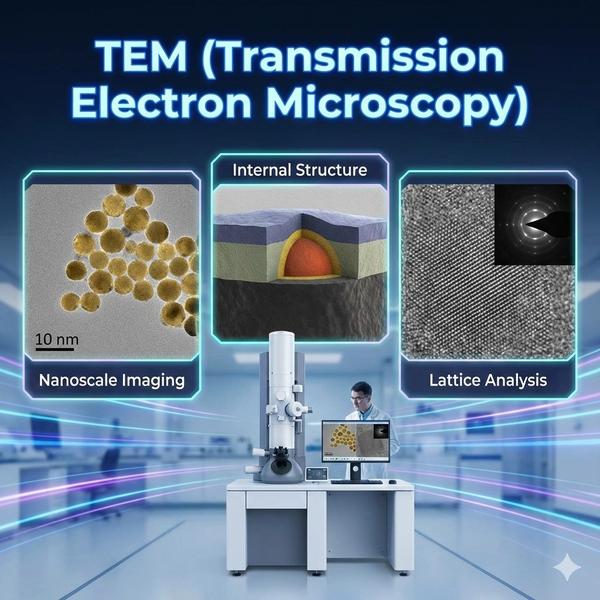
At Dextrose Technologies Pvt. Ltd., we provide TEM (Transmission Electron Microscopy) to visualize internal structure at the nanoscale, enabling detailed analysis of nanoparticles, fine particulates, thin films, and advanced materials. TEM is ideal when SEM is not sufficient and you need high-resolution insight into particle dispersion, internal morphology, and lattice-level features (scope dependent on sample and preparation feasibility). Internal structure and nanoscale imaging TEM allows direct imaging of internal morphology, particle boundaries, and nanoscale features that drive material performance. We support comparative analysis across batches and processing conditions. Particle dispersion and lattice structure analysis We assess particle dispersion and aggregation trends, and support lattice-level analysis where applicable (e.g., lattice fringes / crystallographic features), helping you understand crystallinity and structural uniformity. Deliverables * TEM images at multiple magnifications * Dispersion/aggregation observations (image-based) * Lattice/structural notes where applicable * Report-ready documentation for R&D and characterization Get started Share your sample type (nanoparticles/thin film/powder), expected size range, and objective (dispersion, internal structure, lattice). We’ll recommend feasibility, sample prep approach, and deliverables.

68179d65be22ee500d53ff54 Card 2

product image
Molecular Characterization

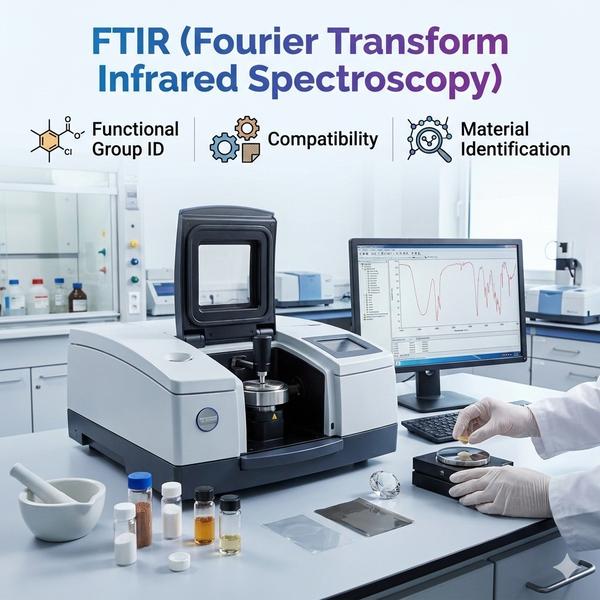
At Dextrose Technologies Pvt. Ltd., we offer FTIR (Fourier Transform Infrared Spectroscopy) for rapid functional group identification and material fingerprinting. FTIR is a reliable first-line tool for confirming raw materials, comparing formulations, and investigating unknowns by identifying characteristic IR absorption bands. It is widely used for polymers, excipients, organics, and contaminant screening, with clear interpretation and documentation. Functional Group Identification We identify key functional groups (e.g., O–H, N–H, C=O, C–O, C–H, aromatic bands) to support compound confirmation, comparison, and troubleshooting. Raw Material and Formulation Compatibility Studies We compare spectra of raw materials, excipients, APIs, and blends to detect spectral changes that may indicate interaction or incompatibility—useful during formulation development and material selection. Polymer, Excipient, and Contaminant Identification FTIR is effective for polymer and excipient fingerprinting and for initial contaminant identification (e.g., unknown residues, particles, films), supporting root-cause investigations and corrective actions. Deliverables * FTIR spectra with peak highlights * Sample-to-sample comparison summary (overlay interpretation) * Identification/interpretation notes aligned to your objective * Recommendations for confirmatory testing if required (e.g., GCMS/LCMS/SEM-EDX) Get started Share your sample type (solid/liquid/powder/film), objective (ID/compatibility/contaminant), and sample count. We’ll recommend the best FTIR approach and reporting format.

68179d65be22ee500d53ff54 Card 2

product image
Thermal Analysis & Characterization

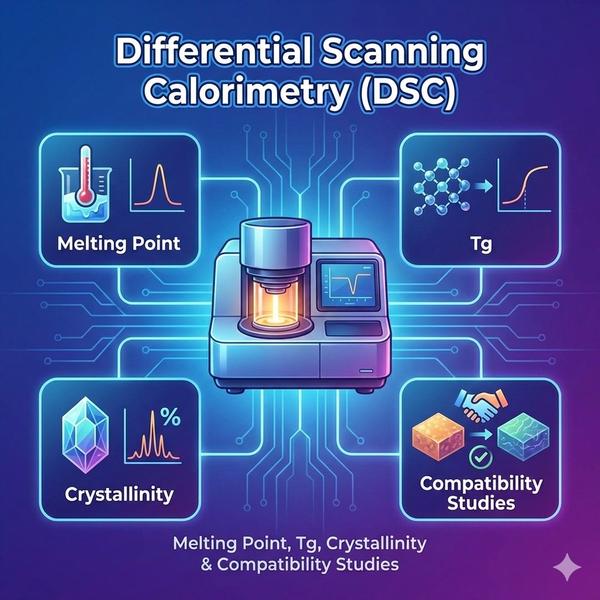
At Dextrose Technologies Pvt. Ltd., we provide Differential Scanning Calorimetry (DSC) for thermal and physicochemical characterization of solids and liquids. DSC measures heat flow associated with thermal transitions, enabling you to evaluate melting behavior, glass transition (Tg), crystallinity/polymorphism trends, and compatibility—useful for R&D, formulation work, and quality investigations. Differential Scanning Calorimetry – Solids & Liquids We analyze a wide range of materials to understand thermal transitions and compare batches, formulations, or processing conditions. Melting Point Determination We determine melting onset/peak behavior and compare thermal profiles to support identity checks, batch consistency, and impurity indications. Glass Transition Temperature (Tg) Analysis We identify Tg for amorphous or semi-amorphous materials and evaluate changes due to moisture, formulation, or processing. Crystallinity and Polymorphism Assessment We assess thermal signatures to support crystallinity trends and polymorphic differences (DSC-supported assessment; confirmatory tools may be recommended if needed). Drug–Excipient Compatibility Studies We compare DSC thermograms of APIs, excipients, and blends to flag potential interactions and compatibility risks during formulation development. Purity Assessment (Thermal Behavior) We use thermal behavior as a supportive indicator of purity and consistency (e.g., peak broadening/shift), aligned to project needs. Deliverables * DSC thermograms with key transition temperatures (onset/peak/Tg) * Comparative summary across samples/batches * Interpretation notes and recommendations for follow-up testing if required Get started Share your material type (solid/liquid), expected transition range, sample count, and objective (Tg, melting, compatibility, crystallinity). We’ll recommend the right DSC conditions and reporting format.

68179d65be22ee500d53ff54 Card 2

product image
Chromatography services

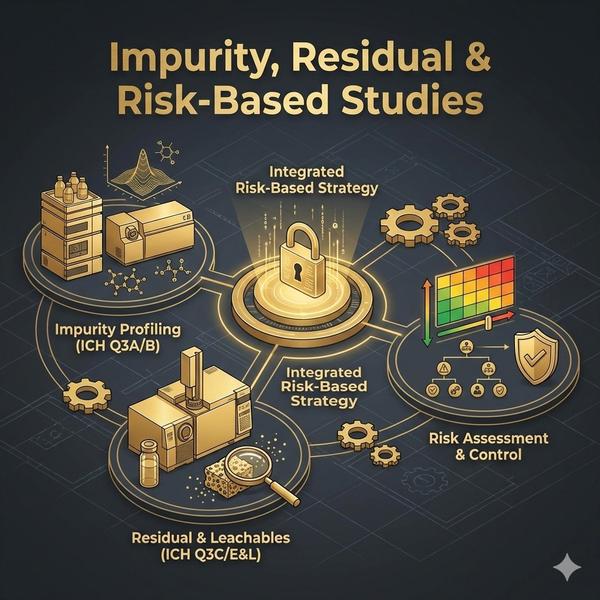
At Dextrose Technologies Pvt. Ltd., we provide impurity, residual, and risk-based analytical studies to help teams mitigate regulatory risk and build a clear control strategy. Our work supports ICH-oriented impurity profiling and residual solvent analysis, unknown impurity identification using MS tools, and screening studies that strengthen development decisions and documentation. ICH Q3A/Q3B-Oriented Impurity Profiling We support impurity and related substances profiling aligned to ICH Q3A/Q3B intent, using HPLC/RP-HPLC (and LCMS where required) to generate clear impurity visibility and trend-ready outputs. ICH Q3C-Oriented Residual Solvent Analysis We perform residual solvent testing using GC-FID or Headspace GCMS with an ICH Q3C-oriented approach, reporting results in clear units and against the target solvent list/limits you define. Unknown Impurity Identification (LCMS / GCMS) We investigate unknown peaks using LCMS (non-volatile/polar) and GCMS (volatile/semi-volatile) to support impurity identification, root-cause analysis, and next-step planning. Extractables & Leachables Screening (GCMS) We offer screening-level extractables/leachables (E&L) studies by GCMS to evaluate potential risks from packaging or contact materials (scope-dependent, intended for early risk assessment unless a specific standard is agreed). Cross-contamination Risk Assessment Support We provide analytical inputs that support cross-contamination risk assessments—such as targeted carryover checks, comparative profiling, and data packaging for internal QA review (scope-dependent). Outcome you can expect * Reduced regulatory risk through early impurity/residual visibility * Clear impurity control strategy supported by structured analytical data Get started Share your product type, target analytes/solvents, reporting limits, and whether you need profiling only or profiling + unknown ID. We’ll recommend the most efficient plan.

68179d65be22ee500d53ff54 Card 2

product image
Chromatography services

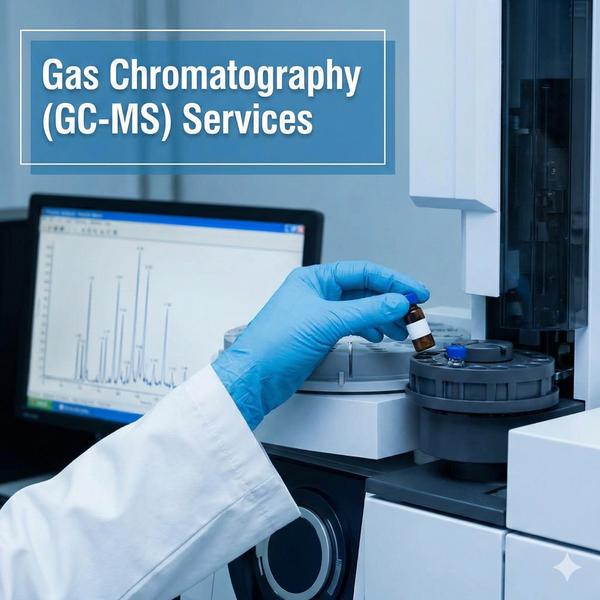
At Dextrose Technologies Pvt. Ltd., we provide Gas Chromatography–Mass Spectrometry (GCMS / GC–MS) services for identification and profiling of volatile and semi-volatile compounds in complex samples. GCMS combines strong chromatographic separation with mass spectral confirmation to support unknown peak identification, impurity profiling, and screening studies for R&D and industrial applications. Volatile and Semi-Volatile Compound Identification We identify volatile and semi-volatile compounds using GC separation and MS-based spectral interpretation, supporting troubleshooting, screening, and confirmation workflows. Impurity Profiling We detect and profile impurities and unknown peaks to support batch comparison, contamination investigations, and process optimization. Extractables and Leachables (Screening) We offer screening-level E&L studies to evaluate potential extractable/leachable compounds from packaging, plastics, tubing, or contact materials (scope-dependent, non-regulatory screening unless specified). Flavor and Fragrance Component Analysis We can support fragrance/flavor component analysis only when identification is feasible within our available spectral resources and project scope. (If a dedicated fragrance library is required, we will clarify feasibility upfront.) Environmental and Industrial Sample Analysis We analyze VOC/SVOC profiles in environmental and industrial samples (water/soil/air extracts, process samples, materials) for screening, comparison, and investigation needs. Deliverables * Chromatograms + peak tables * Mass spectra and ID summary for identified peaks (where applicable) * Impurity/profile interpretation notes * Quantification support when standards and reporting limits are defined Get started Share your sample type, target analytes (if known), expected concentration range, and whether you need identification only or identification + quantification.

68179d65be22ee500d53ff54 Card 2

product image
Bio-analytical services

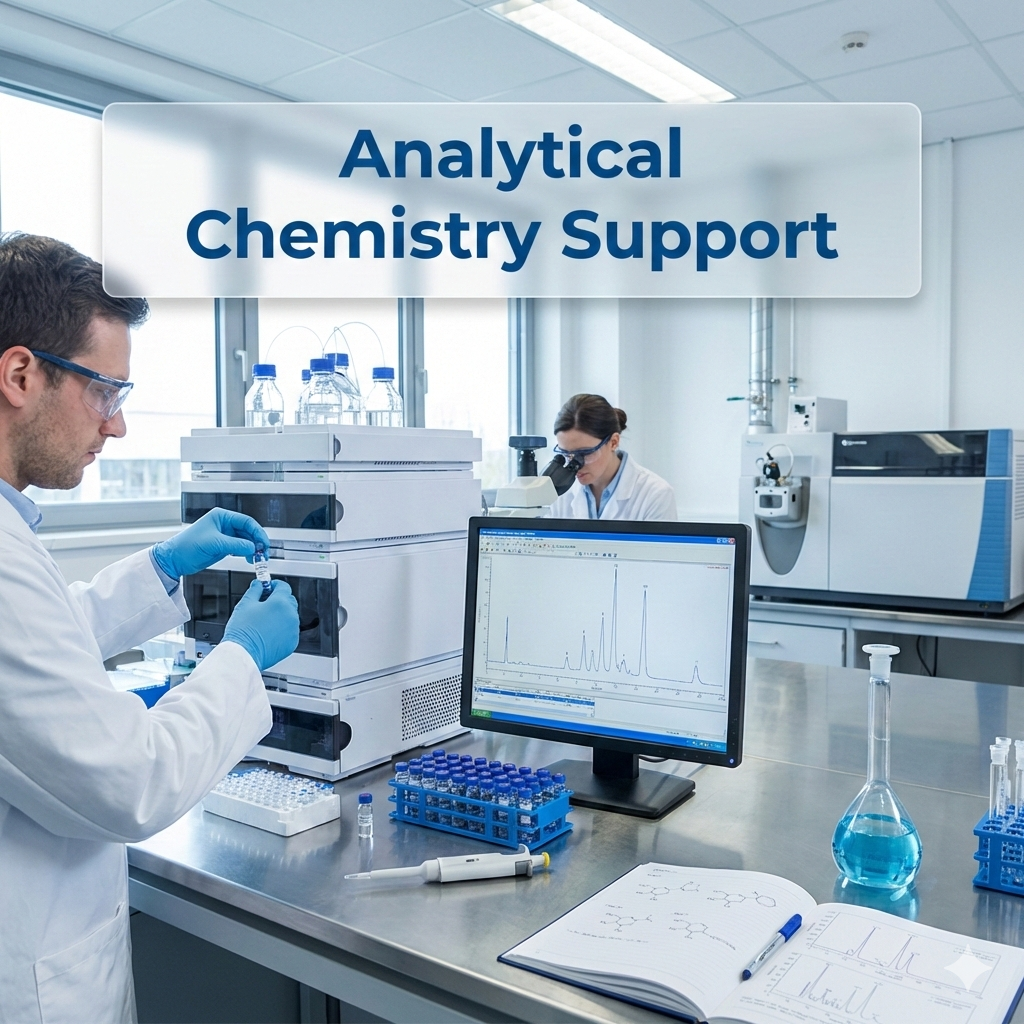
At Dextrose Technologies Pvt. Ltd., we provide Analytical Chemistry Support for R&D teams, academic labs, and industrial clients who need clear, reliable answers from complex samples. Our services cover compound identification, impurity profiling, and quantitative estimation using validated workflows and decision-ready reporting. GCMS Analysis – Compound identification and profiling GCMS is used for volatile and semi-volatile compound profiling, screening unknown peaks, and supporting contamination/impurity investigations. We deliver chromatograms, mass spectral confirmation (where applicable), and clear interpretation aligned to your objective. LCMS Analysis – Molecular mass and impurity analysis LCMS is ideal for non-volatile, polar, and thermally sensitive compounds. We support molecular mass confirmation, impurity/degradation profiling, and targeted quantification (project scope dependent), with strong selectivity and sensitivity. HPLC / GC-FID Analysis – Quantitative estimation and purity assessment For routine QC and batch comparisons, HPLC and GC-FID provide reliable calibration-based quantification, assay/purity testing, and impurity monitoring. We report chromatograms, peak tables, and concentration results in clear units based on your requirement. Deliverables * Chromatograms + peak tables (RT/area/area%) * Quantitative results (ppm, %, mg/mL—based on requirement) * Method notes and observation summary * Optional: recommendations for confirmatory testing where needed Get started Share your sample type, target analytes (if known), concentration range, and reporting format. We’ll recommend the most efficient technique and workflow.

Still searching for
sem?