Bangalore
08042753298
+919686928701

Items tagged with 'structural features'

68179d65be22ee500d53ff54 Card 2

product image
Imaging & Characterization

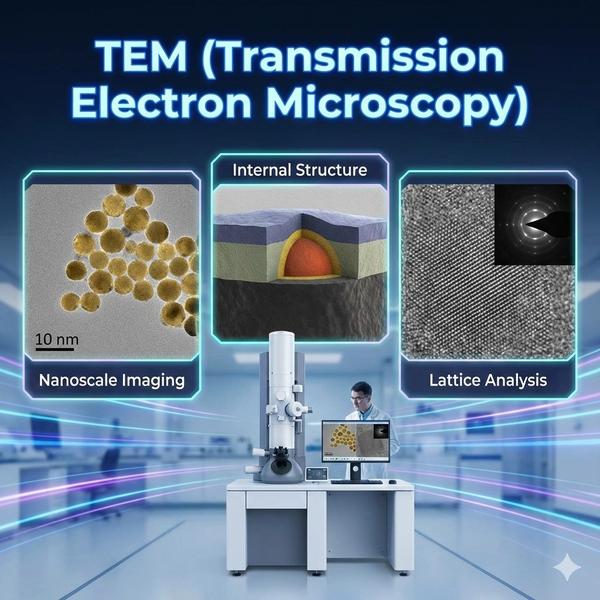
At Dextrose Technologies Pvt. Ltd., we provide TEM (Transmission Electron Microscopy) to visualize internal structure at the nanoscale, enabling detailed analysis of nanoparticles, fine particulates, thin films, and advanced materials. TEM is ideal when SEM is not sufficient and you need high-resolution insight into particle dispersion, internal morphology, and lattice-level features (scope dependent on sample and preparation feasibility). Internal structure and nanoscale imaging TEM allows direct imaging of internal morphology, particle boundaries, and nanoscale features that drive material performance. We support comparative analysis across batches and processing conditions. Particle dispersion and lattice structure analysis We assess particle dispersion and aggregation trends, and support lattice-level analysis where applicable (e.g., lattice fringes / crystallographic features), helping you understand crystallinity and structural uniformity. Deliverables * TEM images at multiple magnifications * Dispersion/aggregation observations (image-based) * Lattice/structural notes where applicable * Report-ready documentation for R&D and characterization Get started Share your sample type (nanoparticles/thin film/powder), expected size range, and objective (dispersion, internal structure, lattice). We’ll recommend feasibility, sample prep approach, and deliverables.

68179d65be22ee500d53ff54 Card 2

product image
Imaging & Characterization

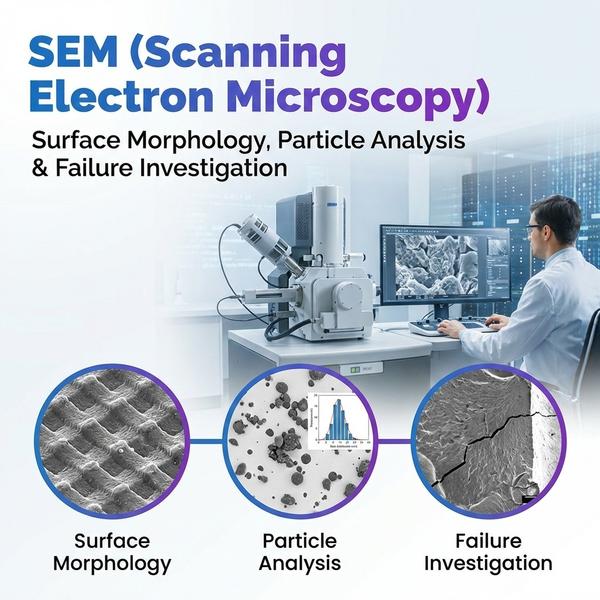
At Dextrose Technologies Pvt. Ltd., we provide SEM (Scanning Electron Microscopy) for high-resolution imaging and detailed surface characterization of materials and biological samples (as applicable). SEM helps you visualize surface morphology, topography, particles, and defects with clarity—supporting R&D, quality investigations, and failure analysis. Surface morphology and topographical analysis We capture high-magnification images to evaluate surface texture, porosity, cracks, coatings, and microstructural features. SEM is ideal for comparing batches, processing conditions, and material finishes. Particle shape and size evaluation We image particles to assess shape, agglomeration, and size distribution trends (image-based), supporting powders, pigments, fillers, nanomaterials (where applicable), and formulation studies. Failure and defect analysis We support root-cause investigations for defects such as fractures, delamination, inclusions, corrosion features, and surface contamination—providing image evidence and interpretation notes to guide corrective actions. Deliverables * High-resolution SEM images (multiple magnifications) * Observation summary highlighting key morphological features * Optional: EDX elemental mapping/spot analysis (if required) * Report-ready documentation for R&D or QC investigations Get started Share your sample type, objective (morphology/particles/failure), and preferred magnification range. We’ll recommend the best SEM imaging plan and deliverables.

68179d65be22ee500d53ff54 Card 2

product image
Material Characterization

At Dextrose Technologies Pvt. Ltd., we provide UTM (Universal Testing Machine) services for mechanical characterization of materials through tensile, compression, and flexural testing. UTM testing helps quantify strength, stiffness, ductility, and durability, enabling material selection, batch comparison, product validation, and failure investigations across polymers, composites, metals, and engineered materials (test feasibility depends on specimen geometry and standard followed). Tensile Testing We measure tensile properties such as ultimate tensile strength, yield behavior, elongation, and modulus, supporting performance benchmarking and quality checks. Compression Testing We evaluate compressive strength and deformation behavior for materials used in structural, packaging, and functional applications. Flexural (Bending) Testing We assess flexural strength and flexural modulus to understand resistance to bending loads, especially relevant for plastics, composites, and brittle materials. Mechanical strength and durability assessment We support comparative testing across batches and conditions to evaluate durability trends and performance consistency. Deliverables * Force–displacement and/or stress–strain data (as applicable) * Key mechanical parameters (strength, modulus, elongation, etc.) * Test conditions and specimen details (as provided/standardized) * Summary interpretation for material performance evaluation Get started Share your material type, specimen dimensions/standard (if any), number of samples, and required test (tensile/compression/flexural). We’ll recommend the right setup and reporting format.

68179d65be22ee500d53ff54 Card 2

product image
Molecular Characterization

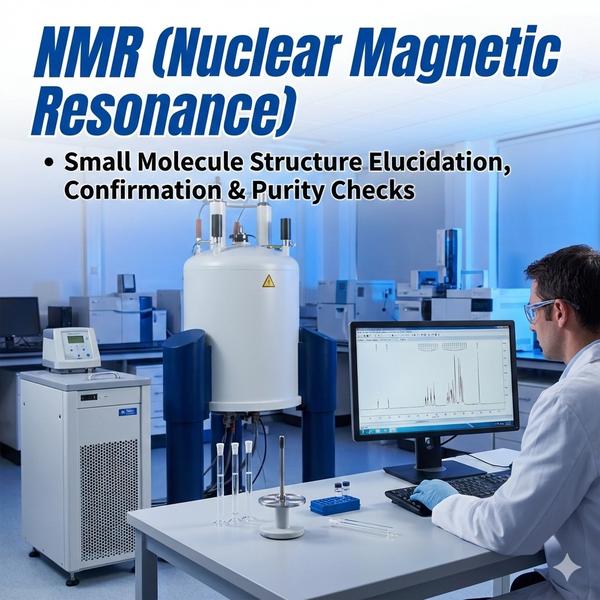
At Dextrose Technologies Pvt. Ltd., we provide NMR (Nuclear Magnetic Resonance) spectroscopy support for structural elucidation and confirmation of small molecules, helping R&D teams validate synthesis outcomes and verify compound identity with high confidence. NMR is widely used for structure verification, purity assessment, and reaction monitoring by confirming key functional environments and structural connectivity (scope dependent on sample and experiment type). Structural Elucidation of Small Molecules We support structure elucidation using NMR data interpretation to assign key signals and confirm molecular framework, supporting research, synthesis, and impurity investigations. Compound Confirmation and Purity Assessment We use NMR to confirm compound identity and assess purity trends by checking for unexpected signals and comparing against expected spectral patterns. Reaction Monitoring and Structural Verification We support reaction progress and structural verification by comparing NMR profiles across stages or fractions, helping you confirm completion and product formation. Deliverables * NMR spectra files and key peak/signal summary * Interpretation notes and assignments (scope-dependent) * Purity/impurity observations based on spectral review * Clear conclusion and recommendations for follow-up confirmation if needed Get started Share the compound type, expected molecular weight, solvent preference, sample amount/concentration, and whether you need ¹H, ¹³C, or 2D experiments. We’ll recommend the most suitable NMR plan and reporting format.

68179d65be22ee500d53ff54 Card 2

product image
Chromatography services

At Dextrose Technologies Pvt. Ltd., our R&D Analytical Support helps teams move faster from idea to data with the right analytical strategy and clear, decision-ready reporting. We support method development, compound understanding, reaction tracking, and early impurity/degradation visibility—so you can shorten development cycles and reduce trial-and-error. HPLC / RP-HPLC Method Development & Optimization We develop and optimize chromatography methods (column, mobile phase, gradient, flow, detection) to achieve strong resolution, repeatability, and robustness for your sample type. Assay Method Development for APIs & Formulations Calibration-based assay methods for APIs, intermediates, and formulations with clear reporting units and suitability checks as applicable. LCMS-Based Molecular Weight Confirmation Mass confirmation for non-volatile compounds to support identity verification, batch comparison, and early-stage characterization. Structural Elucidation (Small Molecules) Support for small-molecule structural understanding using MS-based interpretation (scope-dependent), with clear notes and next-step recommendations when needed. Impurity and Degradation Product Identification We profile impurities and degradation products to provide early visibility into risks and to guide method refinement and process decisions. Reaction Monitoring (HPLC / TLC) Fast reaction tracking to support endpoint decisions and process optimization, reported in a structured and easy-to-interpret format. Peptide & Small Molecule LCMS Analysis LCMS analysis for peptides and small molecules (scope-dependent), supporting mass confirmation and profiling. Exploratory Bioanalytical LCMS (Non-GLP) Exploratory analysis for R&D (non-GLP) with workflows tailored to matrix complexity and required sensitivity. Outcome you can expect * Robust analytical methods suitable for R&D progression * Early impurity and degradation visibility * Faster development cycles with clearer decisions Get started Share your compound class, sample matrix, development stage, and goal (method development, impurity ID, reaction monitoring). We’ll propose the fastest, most reliable plan.

68179d65be22ee500d53ff54 Card 2

product image
Microbiology Services

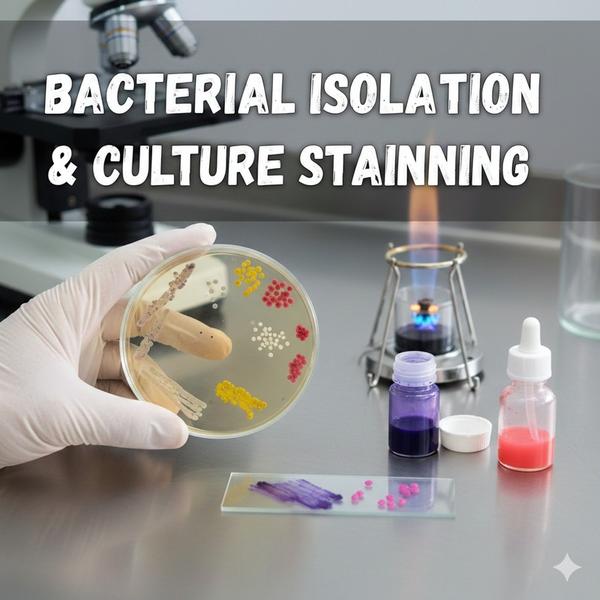
At Dextrose Technologies Pvt. Ltd., we offer Microbial Isolation & Identification services to support research, quality testing, and industrial microbiology. Using sterile, standardized workflows, we isolate microbes from diverse samples, establish pure cultures, apply differential staining, and perform morphology/biochemical-based characterization to generate reliable identification support and clear documentation. Bacterial Isolation and Pure Culture Establishment We perform culture enrichment, streaking, and colony purification to obtain pure bacterial cultures with contamination control and growth documentation. Fungal Isolation and Identification We isolate fungi using appropriate media and incubation conditions, followed by macroscopic and microscopic assessment for identification support. Microbial Staining Techniques We provide staining-based visualization for differentiation and purity checks, including: * Gram staining – Gram reaction and bacterial morphology * Spore staining – endospore detection and differentiation * Acid-fast staining – detection of acid-fast organisms (where applicable) Morphological and Biochemical Characterization We document colony characteristics and microscopic features and perform basic biochemical characterization as per scope, enabling practical classification support for R&D and QC needs. Deliverables * Culture observations (growth pattern, colony morphology) * Staining results with interpretation notes * Microscopy images (where applicable) * Summary report with clear conclusions and next-step recommendations if needed Get started Share your sample type, objective (screening/QC/troubleshooting), and number of samples—we’ll propose the right isolation and identification workflow.

Still searching for
structural features?