Bangalore
08042753298
+919686928701

Items tagged with 'thin layer chromatography'

68179d65be22ee500d53ff54 Card 2

product image
Chromatography services

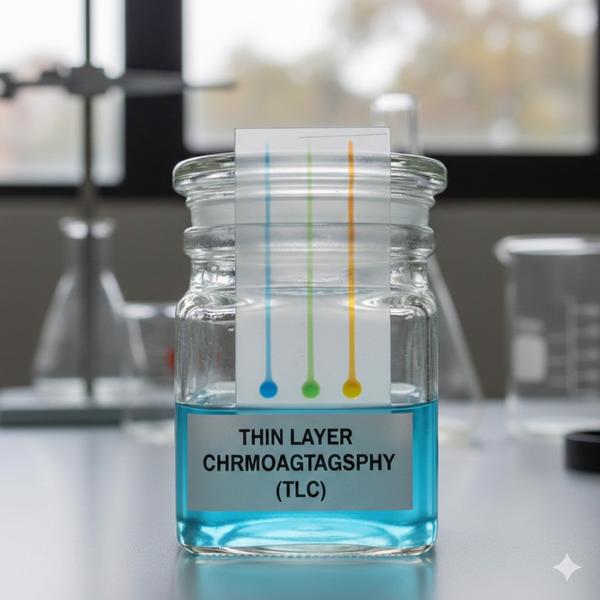
At Dextrose Technologies Pvt. Ltd., we offer Thin Layer Chromatography (TLC) services for rapid, cost-effective qualitative analysis of compounds and mixtures. TLC is ideal for reaction monitoring, quick purity checks, and herbal/phytochemical screening before moving to advanced techniques like HPLC, LCMS, or GCMS. We deliver clear plate documentation and interpretation to support fast decisions in R&D and QC workflows. Qualitative Compound Identification We support qualitative identification using Rf values and spot visualization under appropriate detection conditions, enabling quick comparison against references or known samples (when provided). Reaction Monitoring We monitor chemical reactions and process steps by tracking the appearance/disappearance of spots over time, helping you decide end-point completion and optimize conditions. Purity Checks We perform quick purity checks to detect major impurities or multiple components in a sample, supporting batch comparison and early-stage QC screening. Herbal and Phytochemical Screening We use TLC for preliminary screening of herbal extracts and phytochemical fractions to guide fractionation, method development, or targeted analysis. Deliverables * TLC plate images/documentation * Rf values and observation summary * Interpretation notes aligned to your objective * Optional recommendation for confirmatory HPLC/LCMS/GCMS when needed Get started Share your sample type, solvent system preference (if any), and objective (ID/reaction monitoring/purity/herbal screening). We’ll recommend an efficient TLC workflow.

68179d65be22ee500d53ff54 Card 2

product image
Chromatography services

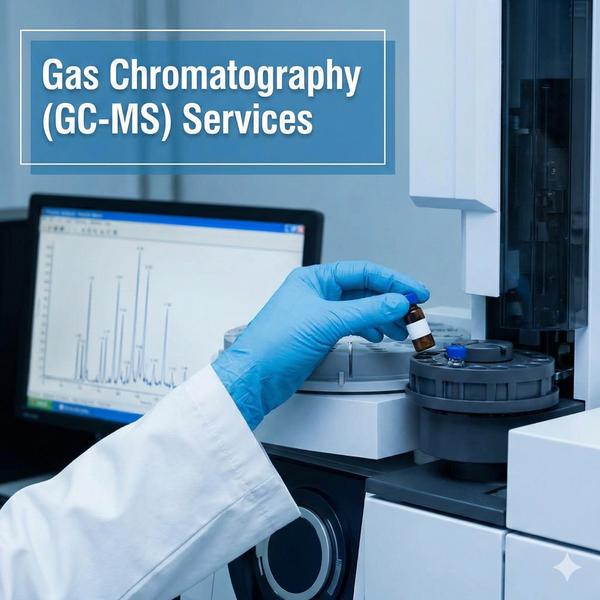
At Dextrose Technologies Pvt. Ltd., we provide Gas Chromatography–Mass Spectrometry (GCMS / GC–MS) services for identification and profiling of volatile and semi-volatile compounds in complex samples. GCMS combines strong chromatographic separation with mass spectral confirmation to support unknown peak identification, impurity profiling, and screening studies for R&D and industrial applications. Volatile and Semi-Volatile Compound Identification We identify volatile and semi-volatile compounds using GC separation and MS-based spectral interpretation, supporting troubleshooting, screening, and confirmation workflows. Impurity Profiling We detect and profile impurities and unknown peaks to support batch comparison, contamination investigations, and process optimization. Extractables and Leachables (Screening) We offer screening-level E&L studies to evaluate potential extractable/leachable compounds from packaging, plastics, tubing, or contact materials (scope-dependent, non-regulatory screening unless specified). Flavor and Fragrance Component Analysis We can support fragrance/flavor component analysis only when identification is feasible within our available spectral resources and project scope. (If a dedicated fragrance library is required, we will clarify feasibility upfront.) Environmental and Industrial Sample Analysis We analyze VOC/SVOC profiles in environmental and industrial samples (water/soil/air extracts, process samples, materials) for screening, comparison, and investigation needs. Deliverables * Chromatograms + peak tables * Mass spectra and ID summary for identified peaks (where applicable) * Impurity/profile interpretation notes * Quantification support when standards and reporting limits are defined Get started Share your sample type, target analytes (if known), expected concentration range, and whether you need identification only or identification + quantification.

68179d65be22ee500d53ff54 Card 2

product image
Chromatography services

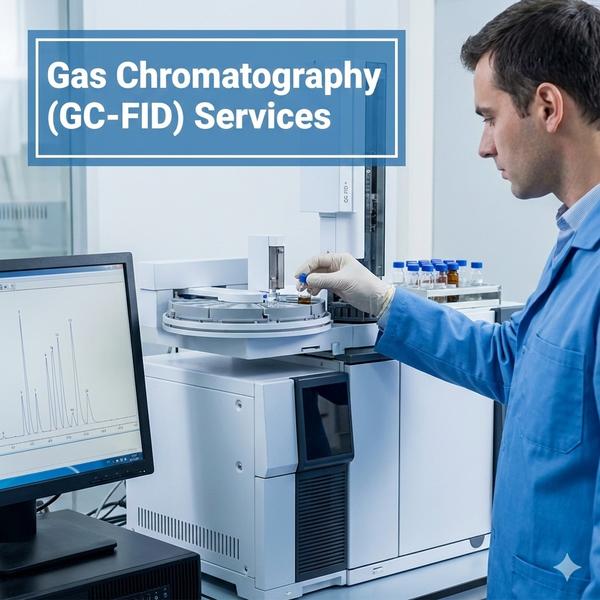
At Dextrose Technologies Pvt. Ltd., we provide Gas Chromatography with Flame Ionization Detection (GC-FID) for accurate, repeatable quantification of volatile organic compounds (VOCs) and residual solvents. GC-FID is ideal for routine QC and batch comparisons where calibration-based quantification, stable detector response, and clear peak reporting are required. Residual Solvent Analysis We quantify residual solvents in raw materials, intermediates, and finished products using method conditions aligned to your target solvents and required limits. Volatile Organic Compound (VOC) Analysis We perform VOC quantification for industrial, R&D, and quality investigations, generating clean chromatograms and concentration outputs for decision-making. Alcohol and Solvent Quantification We quantify common alcohols and solvents (as per scope) with suitable calibration and reporting formats (ppm, %, mg/L—based on requirement). PURITY Assessment of Volatile Compounds We support purity assessment by reporting chromatographic peak profiles, area%, and impurity trends for volatile samples and solvent blends. Deliverables * Chromatograms + peak table (RT/area/area%) * Quantitative results with calibration approach (as applicable) * Method notes and observation summary * Optional: recommendation for confirmatory GCMS when identity confirmation is required Get started Share your sample type, target solvent/VOC list, and required reporting units. We’ll recommend the best GC-FID workflow and turnaround plan.

68179d65be22ee500d53ff54 Card 2

product image
Chromatography services

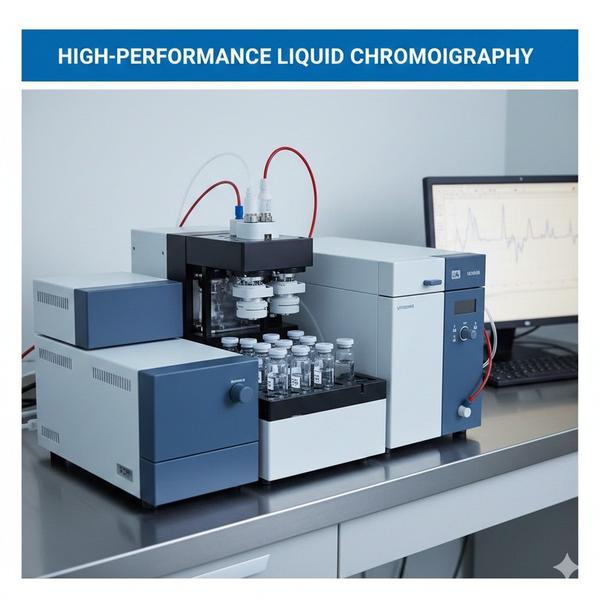
At Dextrose Technologies Pvt. Ltd., we provide Liquid Chromatography (HPLC / RP-HPLC) services for accurate separation and quantification of compounds in complex matrices. We support both R&D and routine QC with method development, impurity profiling, stability studies, and compliance-focused testing—delivered with clear documentation and decision-ready reports. Method Development and Optimization We develop and optimize HPLC/RP-HPLC methods by selecting suitable columns, mobile phases, gradients, flow, and detection conditions to achieve strong resolution, reproducibility, and robustness for your sample type. Assay Method Development We build assay methods for accurate content estimation of APIs, intermediates, excipients, or key markers, using calibration-based quantification and suitability checks as applicable. Impurity Profiling and Related Substances Analysis We separate and monitor impurities and related substances to support batch comparison, troubleshooting, and product quality assessment. Stability-Indicating Method Development We design methods that can distinguish the main compound from degradation products, supporting stability studies and shelf-life evaluation. Dissolution Sample Analysis We analyze dissolution samples to quantify release profiles and compare formulations or process batches. Content Uniformity Testing We support content uniformity analysis to evaluate dosage consistency across units, reported clearly in a structured format. Degradation and Forced Degradation Studies We perform controlled degradation studies to understand breakdown pathways and to support stability-indicating method development. Cleaning Validation Sample Analysis We analyze swab/rinse samples by HPLC to support cleaning validation programs with sensitive, trace-level quantification (scope-dependent). Deliverables * Chromatograms + peak tables (RT/area/area%) * Quantitative results (%, ppm, mg/mL—based on requirement) * Method conditions and key observations (system suitability notes where applicable) * Summary interpretation with clear conclusions and next-step recommendations Get started Share your analyte list, sample matrix, target limits, and intended use (R&D/QC/validation). We’ll recommend the best HPLC/RP-HPLC workflow and reporting format.

68179d65be22ee500d53ff54 Card 2

product image
Imaging & Characterization

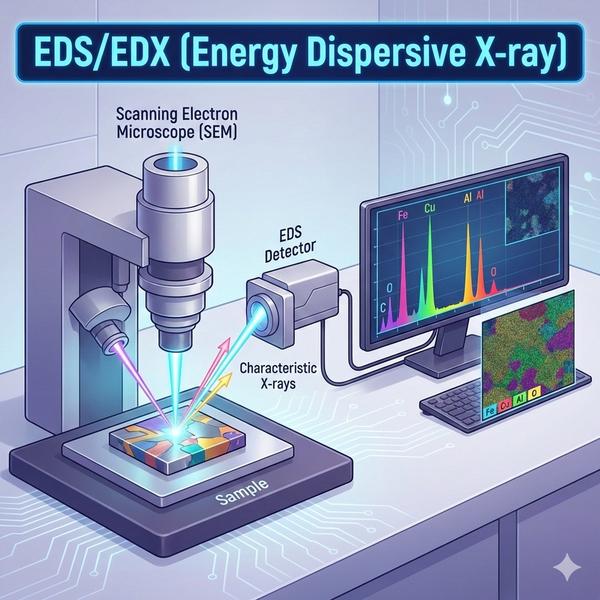
At Dextrose Technologies Pvt. Ltd., we provide EDS/EDX (Energy Dispersive X-ray Analysis)—typically integrated with SEM—to deliver elemental composition and spatial mapping of materials. EDX helps identify what elements are present, where they are located, and how they are distributed, making it highly effective for contamination investigations, impurity localization, and surface/cross-sectional studies. Elemental composition and mapping We perform spot/area analysis and elemental mapping to understand composition and distribution trends across regions of interest. Contaminant and impurity localization EDX is ideal for identifying foreign particles, inclusions, deposits, corrosion products, and process contaminants by pinpointing elemental signatures at the defect site. Surface and cross-sectional analysis We support surface and cross-sectional evaluation (sample-prep dependent) to assess coatings, layers, diffusion regions, and interface contamination. Deliverables * Elemental spectra with identified peaks * Quant summary (wt%/at% as applicable) * Elemental maps and/or line scans (as required) * Clear observations and interpretation notes linked to images Get started Share your sample type, suspected contaminant (if any), and whether you need spot analysis, mapping, or cross-section review. We’ll recommend the best SEM-EDX workflow.

68179d65be22ee500d53ff54 Card 2

product image
Imaging & Characterization

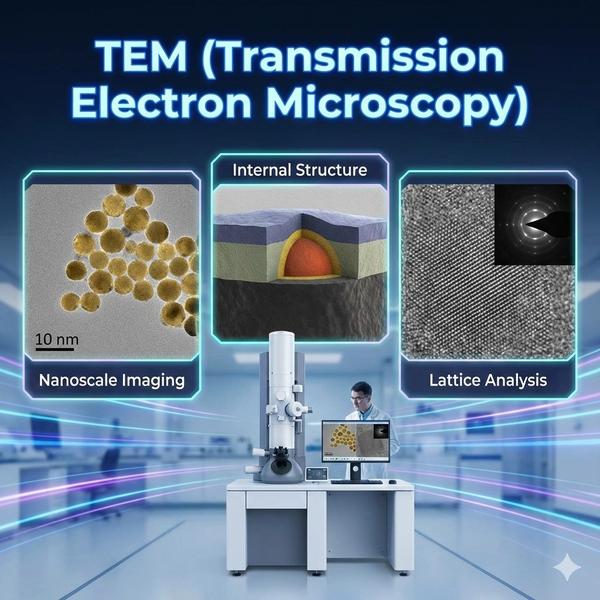
At Dextrose Technologies Pvt. Ltd., we provide TEM (Transmission Electron Microscopy) to visualize internal structure at the nanoscale, enabling detailed analysis of nanoparticles, fine particulates, thin films, and advanced materials. TEM is ideal when SEM is not sufficient and you need high-resolution insight into particle dispersion, internal morphology, and lattice-level features (scope dependent on sample and preparation feasibility). Internal structure and nanoscale imaging TEM allows direct imaging of internal morphology, particle boundaries, and nanoscale features that drive material performance. We support comparative analysis across batches and processing conditions. Particle dispersion and lattice structure analysis We assess particle dispersion and aggregation trends, and support lattice-level analysis where applicable (e.g., lattice fringes / crystallographic features), helping you understand crystallinity and structural uniformity. Deliverables * TEM images at multiple magnifications * Dispersion/aggregation observations (image-based) * Lattice/structural notes where applicable * Report-ready documentation for R&D and characterization Get started Share your sample type (nanoparticles/thin film/powder), expected size range, and objective (dispersion, internal structure, lattice). We’ll recommend feasibility, sample prep approach, and deliverables.

68179d65be22ee500d53ff54 Card 2

product image
Chromatography services

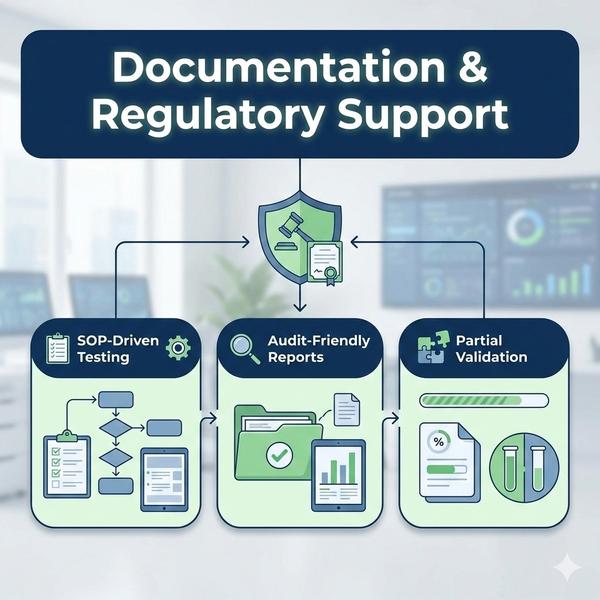
At Dextrose Technologies Pvt. Ltd., we provide Documentation & Regulatory Support to deliver inspection-ready analytical outputs for R&D and QC programs. Our focus is SOP-driven execution, clean data presentation, and structured reporting that speeds up internal QA review and client submissions. We support chromatography and mass spectrometry workflows (HPLC/RP-HPLC, GC-FID, HS-GCMS, GCMS, LCMS—scope dependent) with consistent documentation and clear interpretation. SOP-Driven Testing Testing is performed using controlled workflows with documented sample handling, instrument conditions, and batch execution notes for traceability. Regulatory-Style Analytical Reports We provide structured reports with sample identifiers, method conditions, chromatograms/spectra (as applicable), results tables, calculation basis, and clear conclusions—formatted for review and submission support. Partial Method Validation Support We support partial validation for defined scope parameters such as accuracy, precision, and linearity, with summary tables and acceptance criteria where agreed. Data Review & Interpretation We review chromatograms/spectra to highlight key findings, trends, and anomalies, and provide practical interpretation notes aligned to your decision goal. Client-Specific Reporting Formats If you have internal templates or required sections, we can align reporting to your preferred format for smoother approvals and submissions. Outcome you can expect * Audit-friendly documentation with clear traceability * Faster client submissions supported by structured reporting Get started Share your method, analytes, sample count, and preferred report template. We’ll propose the best documentation package for your workflow.

68179d65be22ee500d53ff54 Card 2

product image
Chromatography services

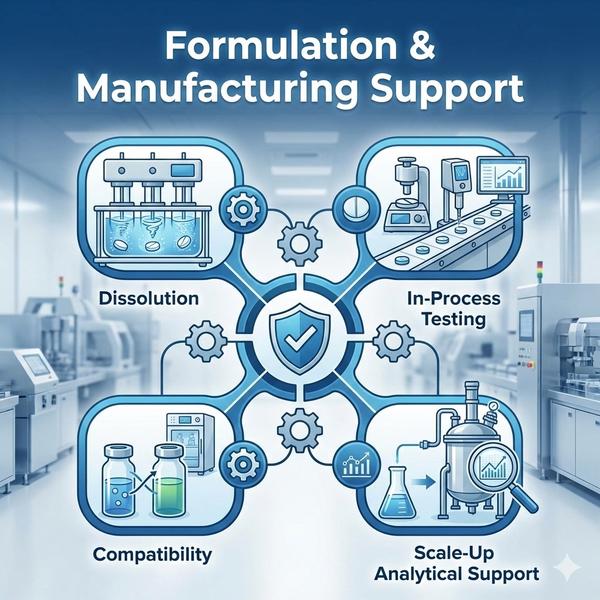
At Dextrose Technologies Pvt. Ltd., we provide Formulation & Manufacturing Support to strengthen process control and improve formulation robustness. Our chromatography-led testing helps teams monitor in-process quality, compare batches, identify variability early, and support smoother scale-up and technology transfer with clear, trend-ready reporting. Dissolution Sample Analysis (HPLC) We analyze dissolution samples by HPLC to quantify release profiles across timepoints, supporting formulation optimization and batch-to-batch comparison. In-Process Sample Testing We test in-process samples to support process control—helping teams catch deviations early and maintain consistent quality during manufacturing. Excipient Compatibility Studies We evaluate compatibility between APIs and excipients to flag potential interactions or instability risks and guide formulation decisions. Batch Comparison and Trend Analysis We generate structured data for batch comparison and trending (assay, impurities, key markers), enabling faster root-cause analysis and more confident release decisions. Scale-Up and Tech Transfer Analytical Support We support scale-up and method transfer activities by aligning analytical conditions, confirming method performance, and packaging results into clean, review-ready reports. Outcome you can expect * Stronger process consistency and reduced variability * Faster troubleshooting with trend-ready outputs * Smoother scale-up and technology transfer Get started Share your product type, sampling points, analytes, expected ranges, and timeline. We’ll propose an efficient testing plan and reporting format.

68179d65be22ee500d53ff54 Card 2

product image
Chromatography services

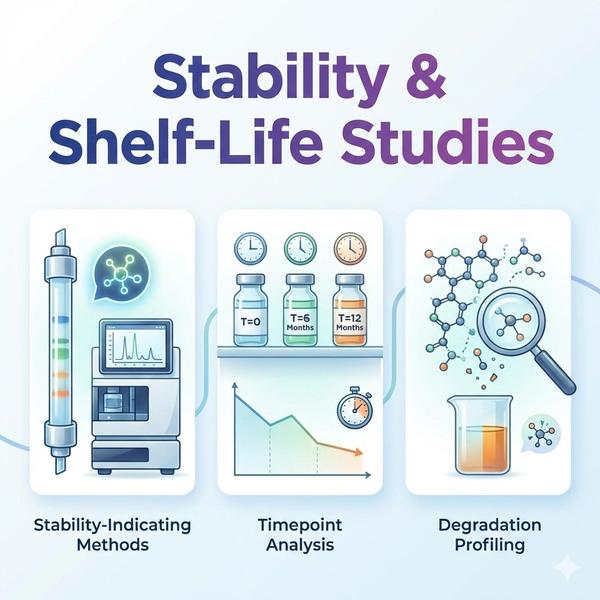
At Dextrose Technologies Pvt. Ltd., we support Stability & Shelf-Life Studies to help you justify shelf-life, understand degradation pathways, and generate clear, trend-ready data for internal QA and development decisions. Our services cover stability-indicating method development, long-term and accelerated timepoint analysis, degradation profiling, and packaging interaction screening using chromatography and mass spectrometry. Stability-Indicating Method Development We develop methods that can clearly separate the main compound from degradation products, enabling accurate stability assessment and cleaner decision-making. Long-Term & Accelerated Stability Sample Analysis We analyze stability samples across planned timepoints for long-term and accelerated studies, reporting assay/impurity trends in structured formats. Degradation Product Profiling (HPLC / LCMS) We profile degradation products using HPLC and support identification/confirmation with LCMS where required (scope-dependent), helping you understand what is forming and when. Volatile Degradation Monitoring (HS-GCMS) For volatile components or residual solvents, we monitor changes over time using Headspace GCMS, enabling sensitive tracking with reduced matrix interference. Packaging Interaction Screening Screening studies to evaluate potential packaging-contact interactions that may impact product quality, supporting packaging selection and early risk assessment. Trend Analysis Across Stability Time Points We provide trend-ready tables and summaries across timepoints to support faster reviews and clearer shelf-life justification. Outcome you can expect * Strong stability-indicating methods and timepoint-ready workflows * Clear degradation visibility (non-volatile and volatile) * Structured trend data to support shelf-life justification Get started Share your product type, analyte(s), planned timepoints, storage conditions, and reporting expectations. We’ll recommend the most efficient stability workflow.

Still searching for
thin layer chromatography?