Bangalore
08042753298
+919686928701

Items tagged with 'unani products sterility testing'

68179d65be22ee500d53ff54 Card 2

product image
Elemental Analysis

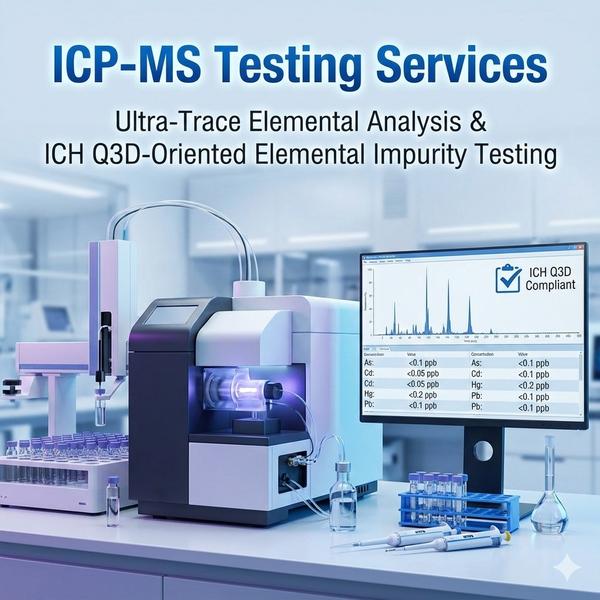
At Dextrose Technologies Pvt. Ltd., we provide ICP-MS (Inductively Coupled Plasma – Mass Spectrometry) for ultra-trace elemental analysis and sensitive toxic metal screening. ICP-MS is ideal when you need ppb-level detection, strong selectivity, and multi-element quantification in challenging matrices. We support ICH Q3D-oriented elemental impurity testing for development and QC programs, with scope and limits defined by your product type and regulatory requirement. Ultra-trace elemental analysis We quantify multiple elements at trace and ultra-trace levels with calibration-based reporting and clear units (ppb/ppm or µg/L as required). ICH Q3D-oriented elemental impurity testing We support Q3D-oriented workflows by testing target elemental impurities, documenting method conditions, and reporting results in a structured, review-ready format aligned to your defined specification limits. Toxic metal screening at ppb levels We screen and quantify toxic metals at ppb levels (scope-dependent), helping identify contamination risk in raw materials, intermediates, and finished products. Deliverables * Element-wise concentration table with units and detection notes * Method and sample preparation notes (digestion basis as applicable) * QC checks/calibration summary (as agreed) * Interpretation notes highlighting outliers and trends Get started Share your sample type, matrix details, target element list, and required limits/specification. We’ll recommend the right ICP-MS workflow and reporting format.

68179d65be22ee500d53ff54 Card 2

product image
Bio-analytical services

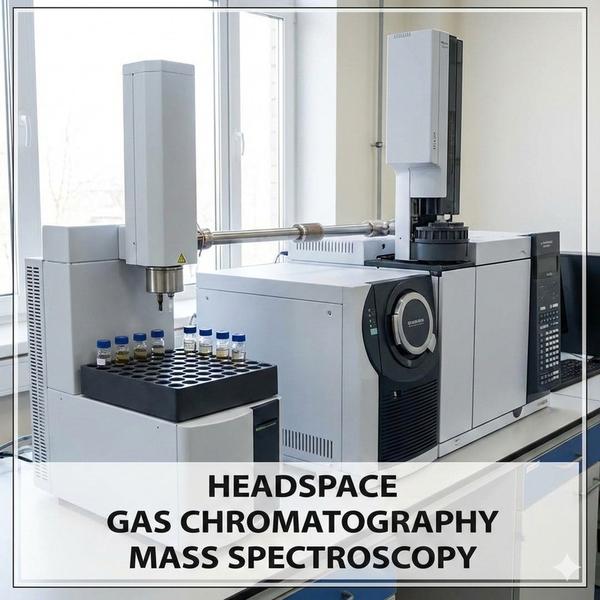
At Dextrose Technologies Pvt. Ltd., we offer Headspace GCMS (HS-GCMS) testing for reliable analysis of volatile organic compounds (VOCs) and residual solvents from complex samples. Headspace sampling focuses on the vapor phase above the sample, reducing matrix interference and improving repeatability for volatile testing. HS-GCMS is ideal when you need sensitive detection and confident identification using mass spectral confirmation. What we test using HS-GCMS * Residual solvents in raw materials, intermediates, and finished products (project-specific scope) * VOC profiling and volatile impurity screening * Unknown volatile peak identification using mass spectra * Support for R&D, troubleshooting, and routine QC requirements How the workflow runs Sample review and headspace condition selection (temperature/time/transfer line) GC separation with optimized method conditions for clean resolution MS detection for confident identification and confirmation Reporting with chromatograms, spectra, and clear conclusions Deliverables * Headspace GCMS chromatograms and peak table (RT/area) * Mass spectra for identified peaks (where applicable) * Quant results with calibration details (ppm/ppb or as required) * Summary interpretation and next-step recommendations if needed Why Dextrose Technologies * SOP-driven execution and clean documentation * Suitable for challenging matrices where direct injection is difficult * Service coverage across major Indian cities through streamlined logistics

68179d65be22ee500d53ff54 Card 2

product image
Bio-analytical services

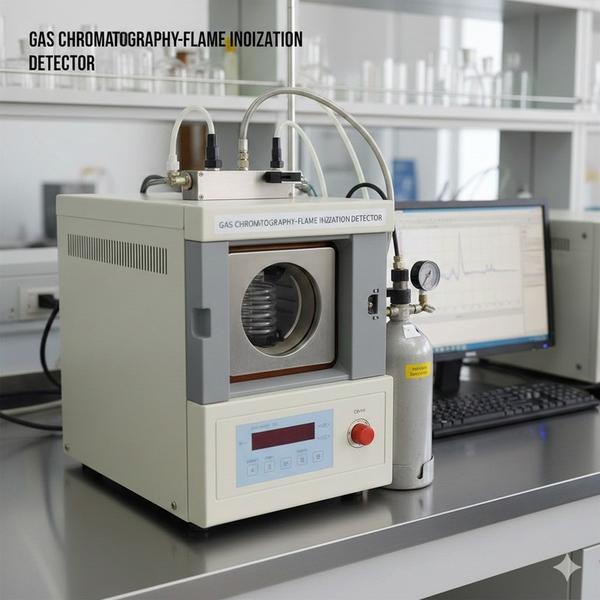
At Dextrose Technologies Pvt. Ltd., we provide GC-FID (Gas Chromatography–Flame Ionization Detector) testing for accurate, repeatable quantification of volatile organic compounds (VOCs) and residual solvents. GC-FID is ideal for routine solvent profiling and batch release support because it delivers stable responses for many organic compounds and supports precise calibration-based reporting. What we use GC-FID for * Residual solvent testing for raw materials, intermediates, and finished products (as per project requirements) * VOC/volatile compounds quantification in industrial, research, and QC samples * Method setup and optimization based on analyte list, matrix, and required limits How the workflow runs Sample review + recommended injection approach (liquid injection / headspace where applicable) Method selection and run conditions optimized for resolution and repeatability Quantification using standards (single/multi-level calibration as needed) Clear reporting with chromatograms, retention times, and concentration results Deliverables * Chromatograms with peak table (RT/area/area%) * Quantitative results (e.g., ppm / % / mg/L as applicable) * Method notes, calibration details, and observation summary * Optional: recommendations for confirmatory GC-MS when identity confirmation is required Why Dextrose Technologies * SOP-driven testing, clean documentation, and decision-ready reports * Practical support for R&D and industrial QC workflows * Pan-India support with service coverage across major cities

68179d65be22ee500d53ff54 Card 2

product image
Formulation Development & Support

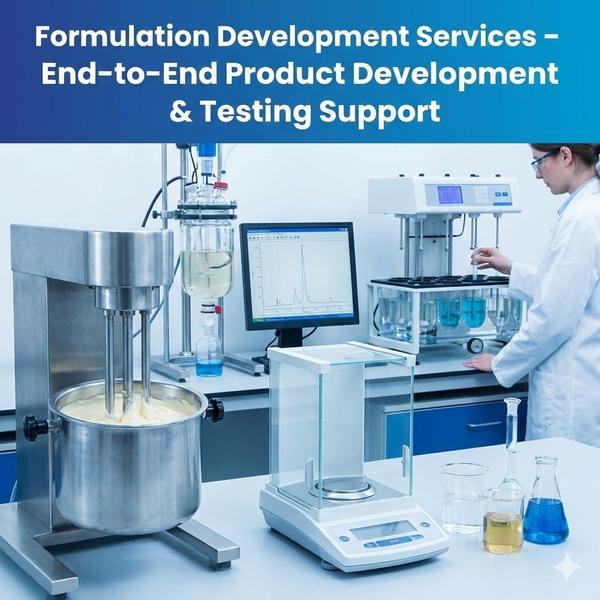
At Dextrose Technologies Pvt. Ltd., we provide end-to-end formulation and product development support for pharmaceuticals, nutraceuticals, cosmetics, and research-driven products. Our services are built for early-stage R&D, proof-of-concept development, and pilot-scale readiness, helping you move from concept to a stable, testable prototype with clear documentation. Our Formulation Capabilities Custom formulation development based on client requirements and target product profile Excipient selection and compatibility assessment to reduce instability and performance risk Lab-scale prototype development for rapid iteration and proof-of-concept Optimization of composition, stability, and performance through structured experiments Product Testing & Evaluation Physicochemical characterization of formulations (as applicable to product type) Stability and compatibility studies for shelf-life and robustness insight Performance and comparative testing across formulations/batches Analytical testing support using advanced instrumentation (HPLC/GC/LCMS, particle sizing, thermal, etc. – scope dependent) Documentation & Reporting Technical and development reports with clear conclusions Data interpretation and result summaries for faster decision-making Client-specific report formats for internal R&D and QA review Support documentation for regulatory-style and academic use (scope dependent) Applications Pharmaceutical formulations, nutraceutical products, cosmetic formulations, research prototypes, and specialty chemical products.

68179d65be22ee500d53ff54 Card 2

product image
Material Characterization

At Dextrose Technologies Pvt. Ltd., we provide UTM (Universal Testing Machine) services for mechanical characterization of materials through tensile, compression, and flexural testing. UTM testing helps quantify strength, stiffness, ductility, and durability, enabling material selection, batch comparison, product validation, and failure investigations across polymers, composites, metals, and engineered materials (test feasibility depends on specimen geometry and standard followed). Tensile Testing We measure tensile properties such as ultimate tensile strength, yield behavior, elongation, and modulus, supporting performance benchmarking and quality checks. Compression Testing We evaluate compressive strength and deformation behavior for materials used in structural, packaging, and functional applications. Flexural (Bending) Testing We assess flexural strength and flexural modulus to understand resistance to bending loads, especially relevant for plastics, composites, and brittle materials. Mechanical strength and durability assessment We support comparative testing across batches and conditions to evaluate durability trends and performance consistency. Deliverables * Force–displacement and/or stress–strain data (as applicable) * Key mechanical parameters (strength, modulus, elongation, etc.) * Test conditions and specimen details (as provided/standardized) * Summary interpretation for material performance evaluation Get started Share your material type, specimen dimensions/standard (if any), number of samples, and required test (tensile/compression/flexural). We’ll recommend the right setup and reporting format.

68179d65be22ee500d53ff54 Card 2

product image
Elemental Analysis

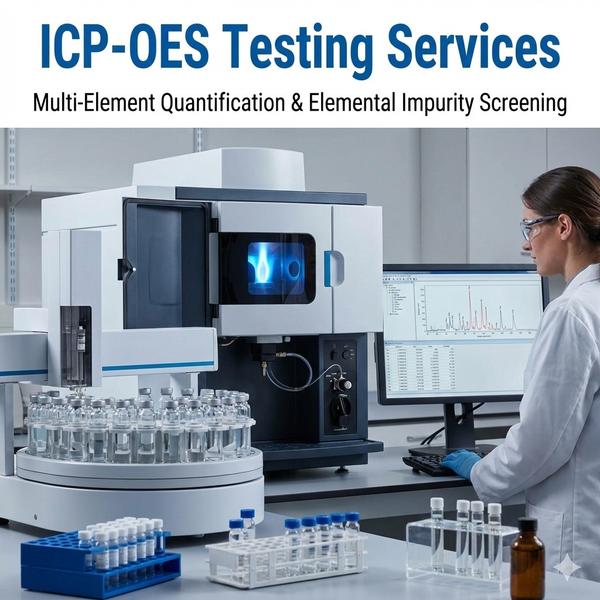
At Dextrose Technologies Pvt. Ltd., we provide ICP-OES (Inductively Coupled Plasma – Optical Emission Spectroscopy) for reliable multi-element quantitative analysis across raw materials, intermediates, and finished products. ICP-OES is well suited for routine elemental profiling and screening where you need accurate concentrations across multiple metals and minerals in a single run (scope depends on matrix and required limits). Multi-Element Quantitative Analysis We quantify multiple elements in one method, generating concentration results in clear units (ppm/ppb or mg/L as required) with calibration-based reporting. Heavy Metal and Elemental Impurity Screening We support screening for heavy metals and elemental impurities to help identify contamination risks, support QC decisions, and enable batch comparison. (For ICH Q3D-aligned programs, scope and limits are finalized based on your requirements and standards provided.) Raw Material and Finished Product Analysis We analyze a wide range of matrices—raw materials, powders, liquids, digests, and finished products—based on suitable sample preparation and digestion approach. Deliverables * Results table with element-wise concentrations * Method notes (sample prep/digestion basis as applicable) * Calibration approach and QC checks (as agreed) * Summary interpretation and flags for outliers/trends Get started Share your sample type, target element list, required limits, and reporting units. We’ll recommend the right ICP-OES workflow and sample preparation plan.

68179d65be22ee500d53ff54 Card 2

product image
Chromatography services

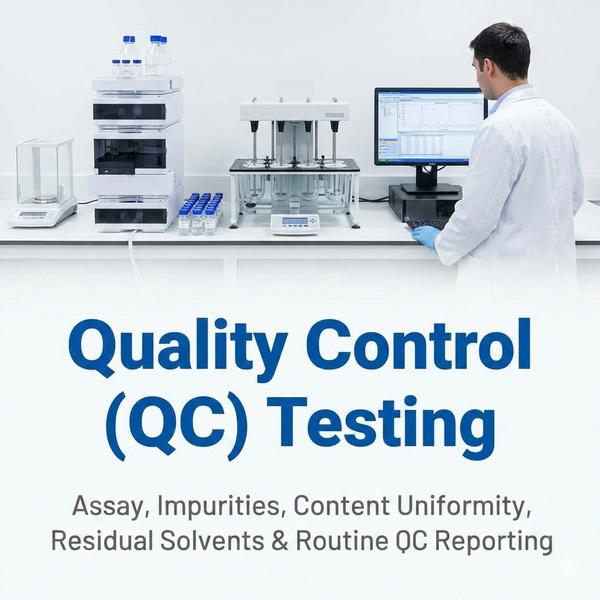
At Dextrose Technologies Pvt. Ltd., we provide Quality Control (QC) Testing to support batch release, routine compliance, and in-process control. Our chromatography-based QC services deliver consistent, calibration-based results with clear documentation and regulatory-aligned reporting. We help you reduce batch risk, maintain trendable quality metrics, and move faster through internal QA review. Assay Testing (HPLC / RP-HPLC) Accurate content estimation for APIs, intermediates, and formulations using validated/optimized chromatographic methods and standards-based quantification. Related Substances / Impurity Profiling Separation and monitoring of related substances and impurities to support batch comparison, process control, and product quality assessment. Content Uniformity Testing Testing to evaluate dosage consistency across units with structured reporting for easy review and trending. Residual Solvent Analysis (GC-FID / HS-GCMS) Residual solvent quantification using GC-FID or Headspace GCMS, based on target solvent list, matrix, and required limits (ICH Q3C-oriented where applicable). Volatile Impurity Testing Volatile impurity profiling for troubleshooting and routine QC checks using GC techniques suited to your sample type. System Suitability & Routine QC Analysis System suitability testing (SST) and routine batch analysis with documented acceptance checks and clean reporting. Cleaning Validation Sample Analysis HPLC/GC-based analysis of swab/rinse samples for trace residues to support cleaning validation programs (scope-dependent). Outcome you can expect * Batch release readiness with consistent analytical outputs * Ongoing quality monitoring with trend-ready results * Clear, regulatory-aligned reporting for internal QA and client documentation Get started Share your product type, analyte list, specifications/limits, and sample count. We’ll recommend the most efficient QC

68179d65be22ee500d53ff54 Card 2

product image
Chromatography services

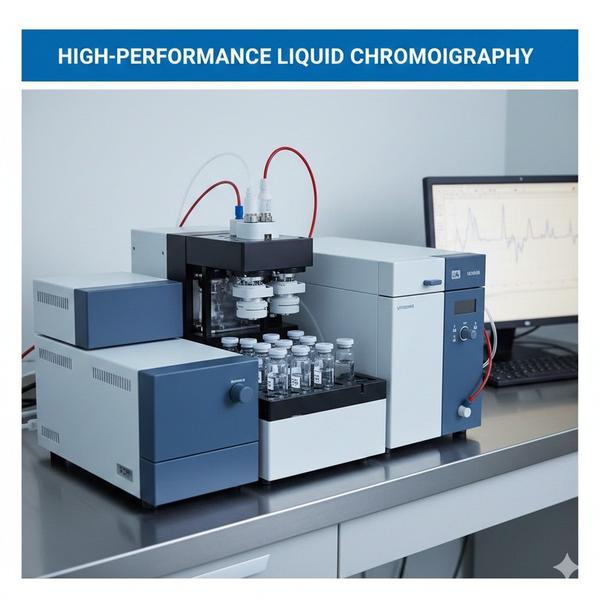
At Dextrose Technologies Pvt. Ltd., we provide Liquid Chromatography (HPLC / RP-HPLC) services for accurate separation and quantification of compounds in complex matrices. We support both R&D and routine QC with method development, impurity profiling, stability studies, and compliance-focused testing—delivered with clear documentation and decision-ready reports. Method Development and Optimization We develop and optimize HPLC/RP-HPLC methods by selecting suitable columns, mobile phases, gradients, flow, and detection conditions to achieve strong resolution, reproducibility, and robustness for your sample type. Assay Method Development We build assay methods for accurate content estimation of APIs, intermediates, excipients, or key markers, using calibration-based quantification and suitability checks as applicable. Impurity Profiling and Related Substances Analysis We separate and monitor impurities and related substances to support batch comparison, troubleshooting, and product quality assessment. Stability-Indicating Method Development We design methods that can distinguish the main compound from degradation products, supporting stability studies and shelf-life evaluation. Dissolution Sample Analysis We analyze dissolution samples to quantify release profiles and compare formulations or process batches. Content Uniformity Testing We support content uniformity analysis to evaluate dosage consistency across units, reported clearly in a structured format. Degradation and Forced Degradation Studies We perform controlled degradation studies to understand breakdown pathways and to support stability-indicating method development. Cleaning Validation Sample Analysis We analyze swab/rinse samples by HPLC to support cleaning validation programs with sensitive, trace-level quantification (scope-dependent). Deliverables * Chromatograms + peak tables (RT/area/area%) * Quantitative results (%, ppm, mg/mL—based on requirement) * Method conditions and key observations (system suitability notes where applicable) * Summary interpretation with clear conclusions and next-step recommendations Get started Share your analyte list, sample matrix, target limits, and intended use (R&D/QC/validation). We’ll recommend the best HPLC/RP-HPLC workflow and reporting format.

68179d65be22ee500d53ff54 Card 2

product image
Microbiology Services

At Dextrose Technologies Pvt. Ltd., we provide microbial load and quality control (QC) testing to help you monitor hygiene, process control, and product quality across research and industrial environments. Our services include Total Aerobic Microbial Count (TAMC), Total Yeast and Mold Count (TYMC), and environmental monitoring for water, surfaces, and air—delivered with clear reporting and documented test conditions. Total Aerobic Microbial Count (TAMC) We quantify overall aerobic bacterial load using validated plate-count approaches, providing CFU-based results to support QC and trending. Total Yeast and Mold Count (TYMC) We quantify yeast and mold load for hygiene monitoring and product/process quality assessment, reported as CFU with observation notes. Environmental and Water Microbial Testing We assess microbial contamination in water and environmental samples (swabs, rinse samples, site samples) to support routine monitoring and troubleshooting. Surface and Air Microbial Monitoring We support microbial monitoring of work areas using surface sampling (swabs/contact plates where applicable) and air monitoring approaches (as per scope), enabling facility hygiene assessment and trend tracking. Deliverables * Results report with CFU counts and sample-wise summary * Method notes (media, incubation conditions, and dilution approach) * Observation notes and trend-ready format for repeated monitoring * Optional: follow-up isolation/identification support if abnormal counts are detected Get started Share your sample type (product/water/swab/air), number of samples, and monitoring frequency. We’ll propose a practical QC testing plan and reporting format.

Still searching for
unani products sterility testing?