
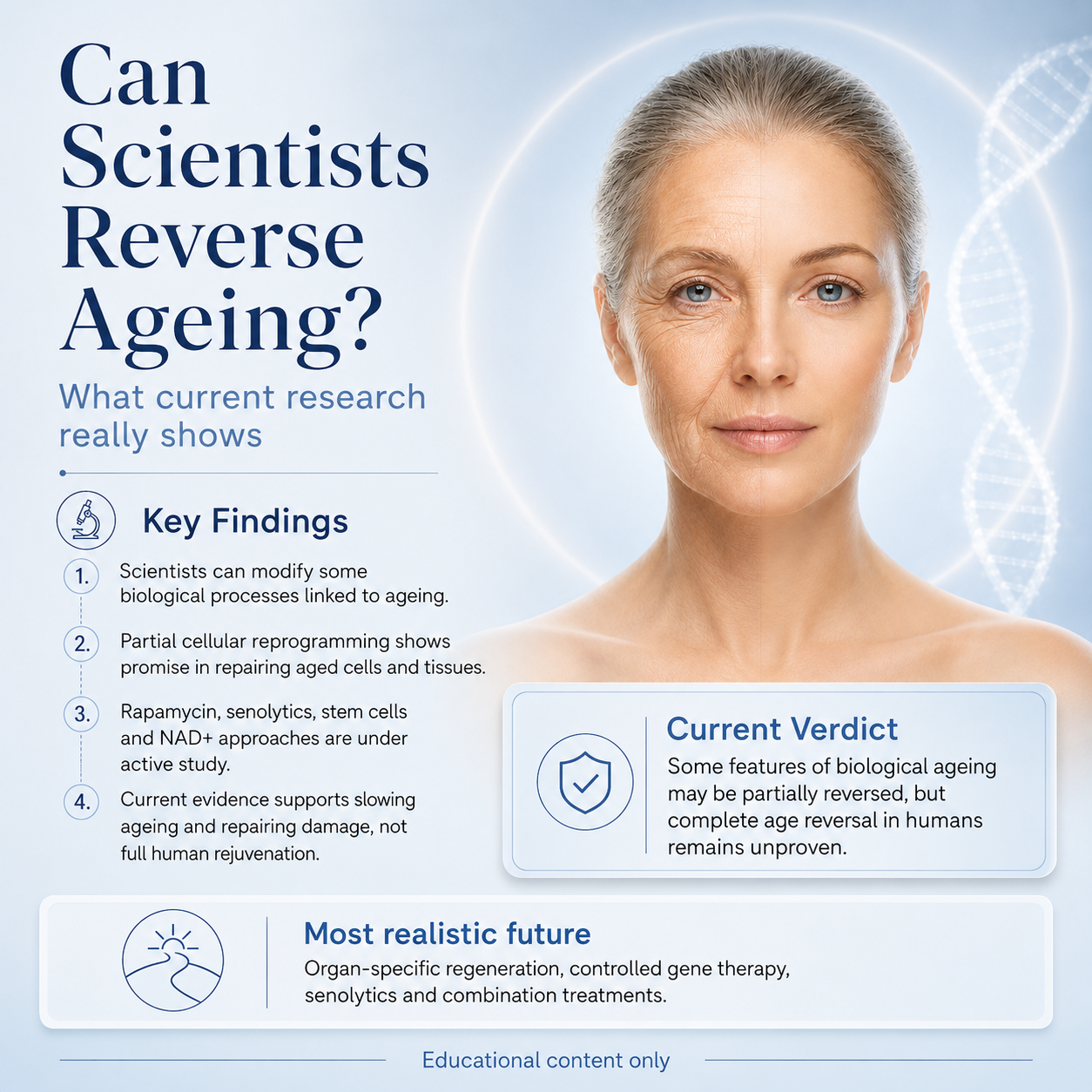
Scientists can now influence several biological processes associated with ageing. Laboratory studies have shown that old cells can develop younger molecular patterns, damaged tissues can regain some function and animal lifespan can be extended.
However, no treatment has been proven to safely reverse whole-body ageing in humans. Current evidence suggests that some features of biological ageing may be modified or partially reversed, while complete human rejuvenation remains unproven.
>> What Does Age Reversal Mean?
Chronological age is the number of years a person has lived and cannot be reversed. Biological age refers to the condition and performance of the body.
A treatment may be described as age-reversing when it:
Makes ageing biomarkers appear younger
Restores youthful cellular behaviour
Improves aged tissue function
Reduces frailty or disease
Extends healthy lifespan
The strongest evidence currently applies to cells and individual tissues rather than the entire human body.
>> Why Do We Age?
Ageing develops through several interconnected processes:
DNA damage
Epigenetic changes
Telomere shortening
Mitochondrial dysfunction
Chronic inflammation
Senescent-cell accumulation
Stem-cell exhaustion
Altered nutrient sensing
Because these mechanisms interact, a single drug is unlikely to reverse the complete ageing process.
>> Partial Cellular Reprogramming
Partial cellular reprogramming is one of the most promising research areas. Yamanaka factors—OCT4, SOX2, KLF4 and c-MYC—can return mature cells to a stem-cell-like state.
Full reprogramming may cause cells to lose their identity and increase the risk of abnormal growth or tumours. Partial reprogramming activates selected factors temporarily to restore younger cellular behaviour without completely changing cell identity.
Animal studies have reported improvements in gene expression, DNA methylation, mitochondrial activity, tissue regeneration and inflammatory signalling.
Early human studies are focusing on local treatments for optic-nerve damage and glaucoma. These trials primarily assess safety and tissue repair rather than whole-body rejuvenation.
Rapamycin and Senolytics
Rapamycin inhibits mTOR, a pathway involved in growth, metabolism, autophagy and immune regulation. It has extended lifespan in animals, but no major trial has shown that it reverses human ageing.
Possible side effects include immune suppression, infections, poor wound healing, abnormal glucose levels and organ toxicity.
Senolytics aim to remove senescent cells that release inflammatory substances. Treatments being investigated include dasatinib with quercetin, fisetin and navitoclax.
Human evidence remains preliminary. Removing too many senescent cells may also interfere with wound healing and cancer protection.
>> Calorie Restriction and NAD⁺ Supplements
Calorie restriction may improve blood pressure, insulin sensitivity and cholesterol while modestly slowing some biological-age markers. However, severe restriction can cause muscle loss, nutritional deficiencies and reduced bone density.
NAD⁺ supplements may increase NAD-related molecules in the blood, but evidence for improvements in strength, cognition, metabolism or lifespan remains inconsistent.
>> Stem Cells and Biological-Age Tests
Stem-cell therapies may restore function in specific tissues, including the retina, nervous system, muscles and blood. Organ-specific regeneration is more likely to become practical before whole-body rejuvenation.
Biological-age tests measure factors such as DNA methylation, proteins, metabolites and inflammation. A younger score does not necessarily prove organ regeneration, reduced disease risk or longer lifespan.
>> Final Verdict
Scientists have not completely reversed human ageing. Research supports slowing ageing, resetting selected cellular features and repairing specific tissues.
Future treatments may combine controlled gene therapy, stem cells, senolytics and drugs targeting several ageing pathways. Until large human trials confirm lasting safety, improved function and longer healthy lifespan, claims of proven human age reversal should be treated cautiously.
Medical Disclaimer: This content is for educational purposes only. Experimental anti-ageing treatments should not be used without qualified medical supervision.