
>> 1. Introduction
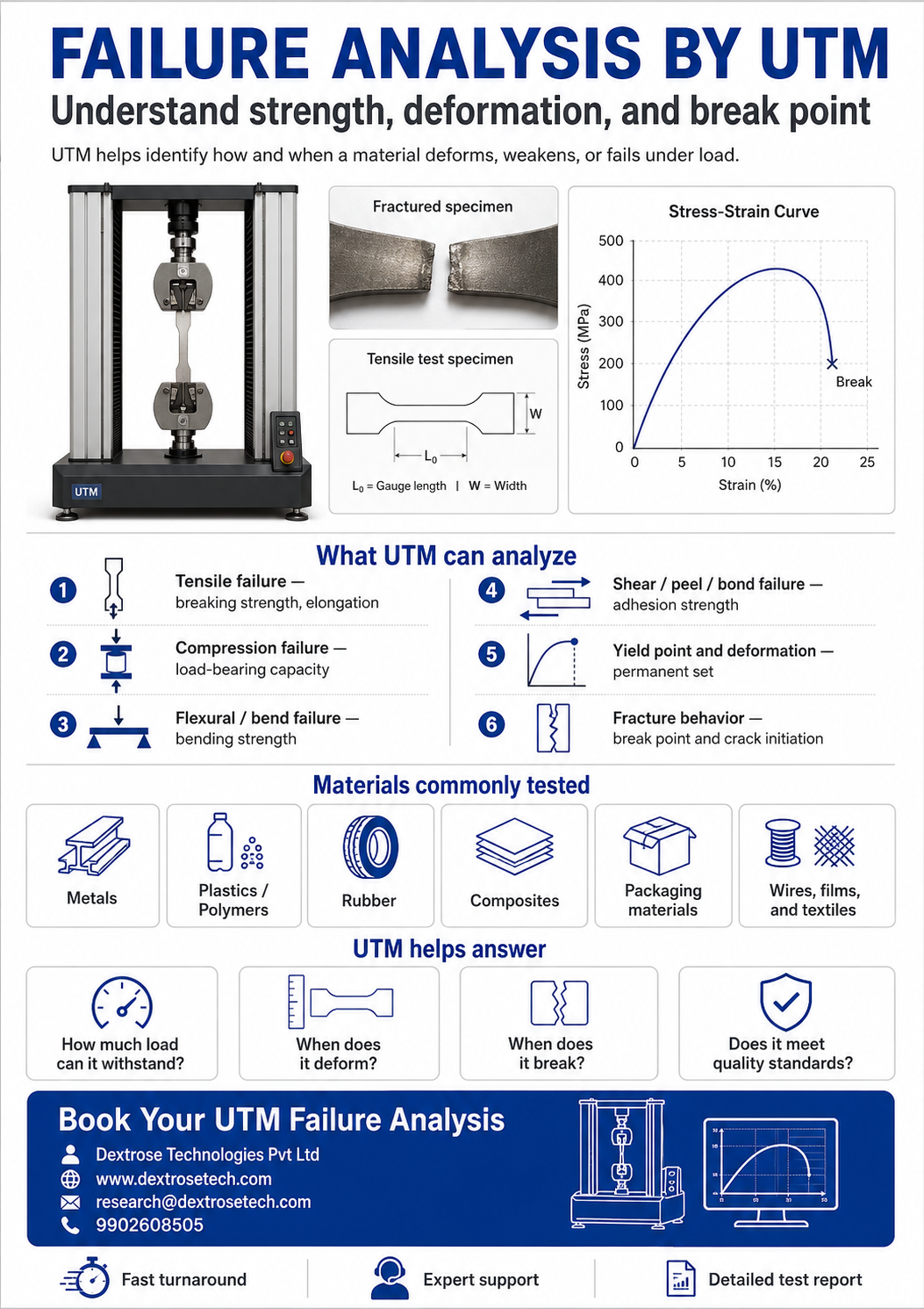
A Universal Testing Machine is used to evaluate the mechanical strength and failure behavior of materials under controlled loading conditions. Failure analysis helps identify how and why a material fails when subjected to tensile, compressive, or bending forces.
This analysis is important for understanding material performance, quality control, product development, and prevention of structural failure.
>> 2. Objective
The objective of this study is to analyze the failure behavior of the test specimen using UTM data and fracture observations.
Key aims:
Determine maximum load-bearing capacity
Evaluate tensile or compressive strength
Identify failure mode
Study stress-strain behavior
Relate fracture appearance to material behavior
>> 3. Principle of UTM Testing
The Universal Testing Machine applies a gradually increasing load to a specimen until deformation or failure occurs. During the test, force and displacement are recorded.
From the data, mechanical properties such as stress, strain, ultimate tensile strength, yield strength, elongation, and modulus can be calculated.
>> 4. Materials and Method
Material tested:
Mention sample name/material here
Test type:
Tensile / Compression / Flexural test
Specimen type:
Dog-bone specimen / cylindrical sample / rectangular sample
Testing equipment:
Universal Testing Machine
Test procedure:
The specimen was prepared according to the required dimensions.
Initial dimensions were measured.
The specimen was fixed between UTM grips/fixtures.
Load was applied at a constant crosshead speed.
Load and displacement data were recorded.
Testing continued until specimen failure.
The fractured specimen was observed visually.
>> 5. Failure Analysis
The failure behavior was analyzed based on the load-displacement curve, stress-strain curve, and fractured specimen appearance.
Common failure observations:
Observation Interpretation
Necking before failure Ductile behavior
Sudden fracture without elongation Brittle failure
Angled fracture surface Shear failure
Layer separation Delamination
Crack propagation from edge Stress concentration
Low strength value Material defect or poor processing
>> 6. Discussion
The UTM results indicate the mechanical response of the specimen under applied load. A ductile material shows plastic deformation before failure, while a brittle material fails suddenly with limited deformation.
The maximum load and ultimate strength show the load-bearing capacity of the material. The fracture pattern provides additional information about the failure mechanism, such as tensile rupture, shear failure, brittle cracking, or internal defects.
Any irregularities in the graph may indicate slippage, improper gripping, specimen defects, or non-uniform loading.
>> 7. Conclusion
The Universal Testing Machine successfully evaluated the mechanical performance and failure characteristics of the specimen. The failure analysis helped identify the strength, deformation behavior, and probable failure mode of the material.
This information is useful for material selection, quality inspection, design improvement, and prevention of mechanical failure.