
>> Overview
Rhizopus species are fast-growing filamentous fungi commonly known as bread molds. They belong to the group Zygomycetes and are widely found in soil, decaying organic matter, fruits, vegetables, and stored food products. These fungi play an important role in decomposition and industrial fermentation, while some species can also cause opportunistic infections.
>> Shape and Structure
Rhizopus spp. grow as:
Filamentous fungal hyphae
Cottony mycelial networks spreading rapidly on surfaces
The hyphae are:
✔️ Broad
✔️ Non-septate (aseptate/coenocytic)
✔️ Fast spreading
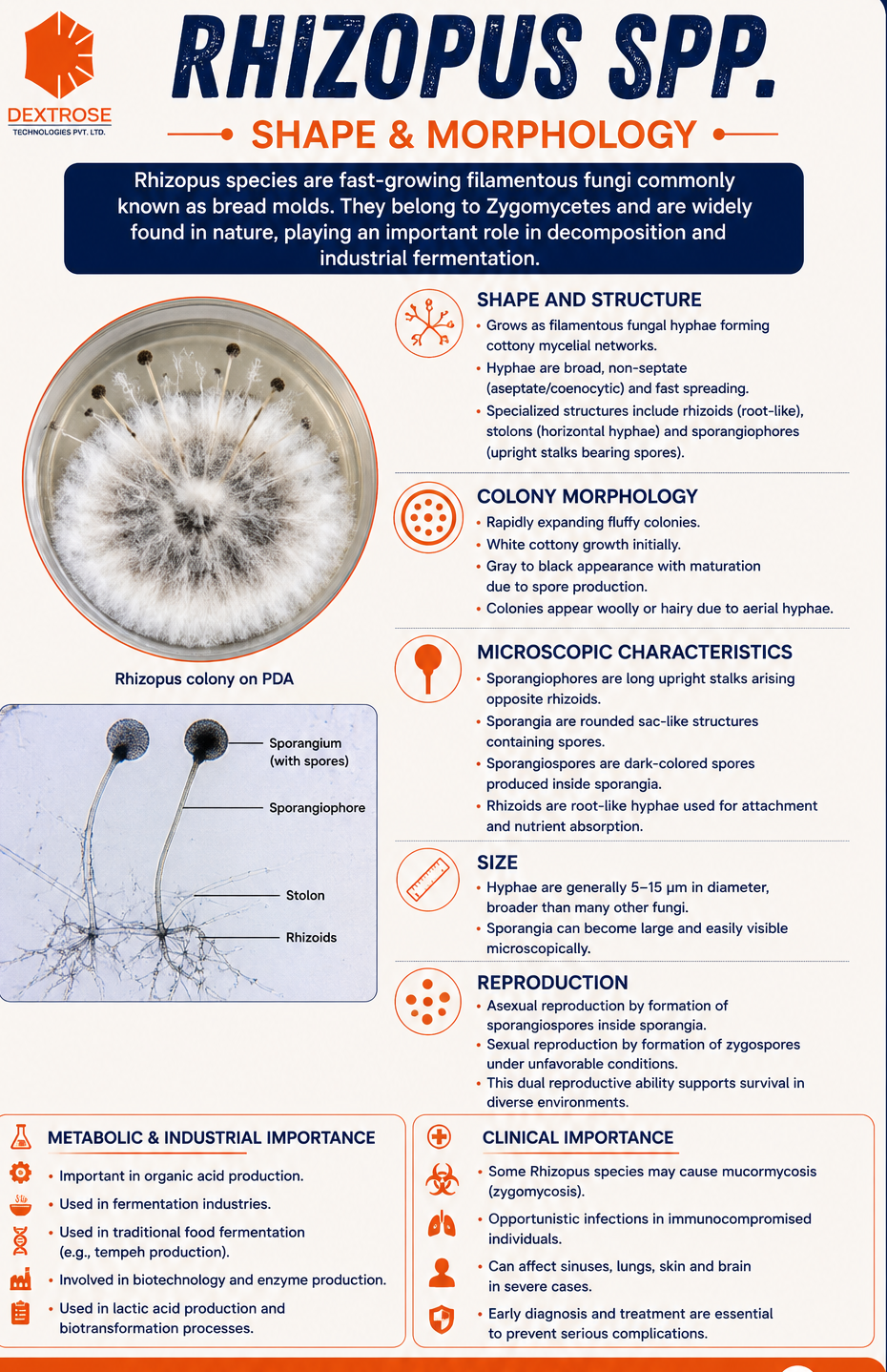
>> Specialized structures include:
Rhizoids → root-like anchoring structures
Stolons → horizontal hyphal extensions
Sporangiophores → upright stalks bearing spores
>> Colony Morphology
On culture media, Rhizopus typically forms:
✔️ Rapidly expanding fluffy colonies
✔️ White cottony growth initially
✔️ Gray to black appearance with maturation due to spore production
The colonies often appear woolly or hairy because of aerial hyphae.
>> Microscopic Characteristics
🔹 Sporangiophores
Long upright stalks arising opposite rhizoids
🔹 Sporangia
Rounded sac-like structures containing spores
🔹 Sporangiospores
Dark-colored spores produced inside sporangia
🔹 Rhizoids
Root-like hyphae used for attachment and nutrient absorption
These structures are key identifying features of Rhizopus species.
>> Size
The hyphae are generally:
Around 5–15 µm in diameter, broader than many other fungi
Sporangia can become large and easily visible microscopically.
>> Reproduction
Rhizopus spp. reproduce through:
✔️ Asexual reproduction
By formation of sporangiospores inside sporangia
✔️ Sexual reproduction
By formation of zygospores under unfavorable conditions
This dual reproductive ability supports survival in diverse environments.
>> Metabolic and Industrial Importance
Rhizopus species are important in:
🧪 Organic acid production
🧪 Fermentation industries
🍶 Traditional food fermentation
🧬 Biotechnology and enzyme production
>> Certain species are used in:
Tempeh fermentation
Lactic acid production
Biotransformation processes
Clinical Importance
Some Rhizopus species may cause:
⚠️ Mucormycosis (zygomycosis)
⚠️ Opportunistic infections in immunocompromised individuals
>> These infections can affect:
Sinuses
Lungs
Skin
Brain in severe cases
>> Habitat
Rhizopus spp. are commonly found in:
🍞 Bread and bakery products
🌱 Soil and compost
🍎 Fruits and vegetables
🌾 Decaying organic matter
Their spores spread rapidly through air and contaminated surfaces.
>> Key Insight
Due to their rapid growth, broad aseptate hyphae, and industrial fermentation importance, Rhizopus species are significant fungi in food microbiology, biotechnology, and medical mycology.