

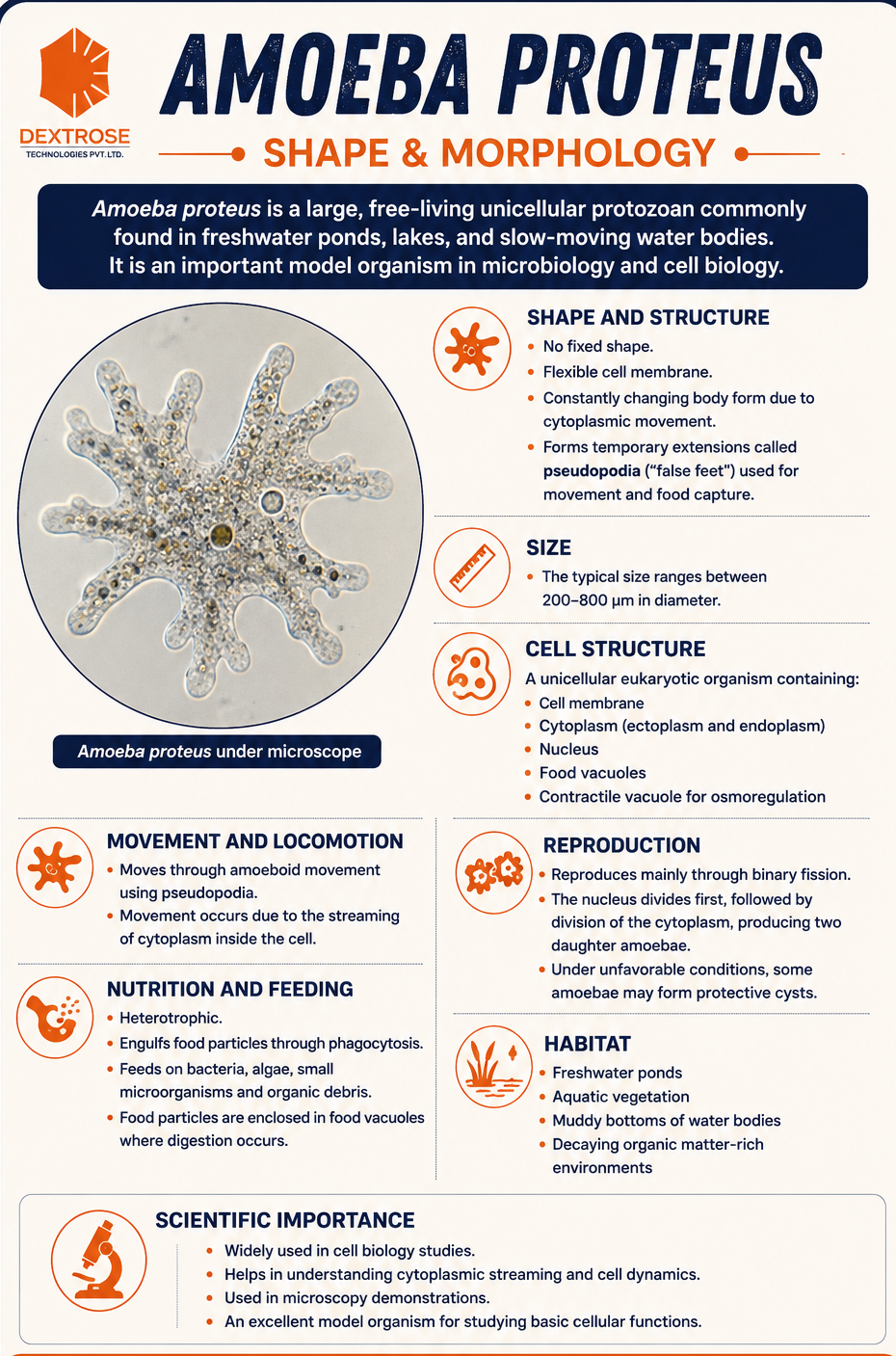
>> Overview
Amoeba proteus is a large, free-living unicellular protozoan commonly found in freshwater ponds, lakes, and slow-moving water bodies. It is one of the most well-known organisms studied in microbiology and cell biology because of its simple structure, unique movement, and feeding behavior.
>> Shape and Structure
Amoeba proteus has:
✔️ No fixed shape
✔️ Flexible cell membrane
✔️ Constantly changing body form due to cytoplasmic movement
The organism forms temporary extensions called pseudopodia (“false feet”), which are used for movement and food capture.
>> Size
The typical size ranges between:
200–800 µm in diameter
It is one of the larger protozoans visible under a light microscope.
>> Cell Structure
Amoeba proteus is a unicellular eukaryotic organism containing:
🔹 Cell membrane
🔹 Cytoplasm divided into ectoplasm and endoplasm
🔹 Nucleus
🔹 Food vacuoles
🔹 Contractile vacuole for osmoregulation
The contractile vacuole helps remove excess water from the cell.
>> Movement and Locomotion
The amoeba moves through:
✔️ Amoeboid movement using pseudopodia
This movement occurs due to the streaming of cytoplasm inside the cell.
>> Nutrition and Feeding
Amoeba proteus is:
Heterotrophic
Engulfs food particles through phagocytosis
It feeds on:
🦠 Bacteria
🌿 Algae
🧫 Small microorganisms and organic debris
Food particles are enclosed inside food vacuoles where digestion occurs.
>> Reproduction
Amoeba proteus reproduces mainly through:
✔️ Binary fission
During reproduction:
The nucleus divides first
Followed by division of the cytoplasm
Producing two daughter amoebae
Under unfavorable conditions, some amoebae may form protective cysts.
>> Habitat
Amoeba proteus is commonly found in:
💧 Freshwater ponds
🌱 Aquatic vegetation
🪨 Muddy bottoms of water bodies
🍂 Decaying organic matter-rich environments
It thrives in moist habitats with abundant microorganisms.
>> Scientific Importance
Amoeba proteus is widely used in:
🧪 Cell biology studies
🧬 Cytoplasmic streaming research
🔬 Microscopy demonstrations
📚 Educational microbiology laboratories
It serves as an excellent model organism for studying basic cellular functions.
>> Key Insight
Due to its shape-changing ability, pseudopodial movement, and simple unicellular organization, Amoeba proteus remains one of the most important protozoans in biological education and research.