
In material research, surface characteristics strongly influence properties such as adsorption, catalytic activity, reaction efficiency, dissolution behavior, gas storage, and overall material performance.
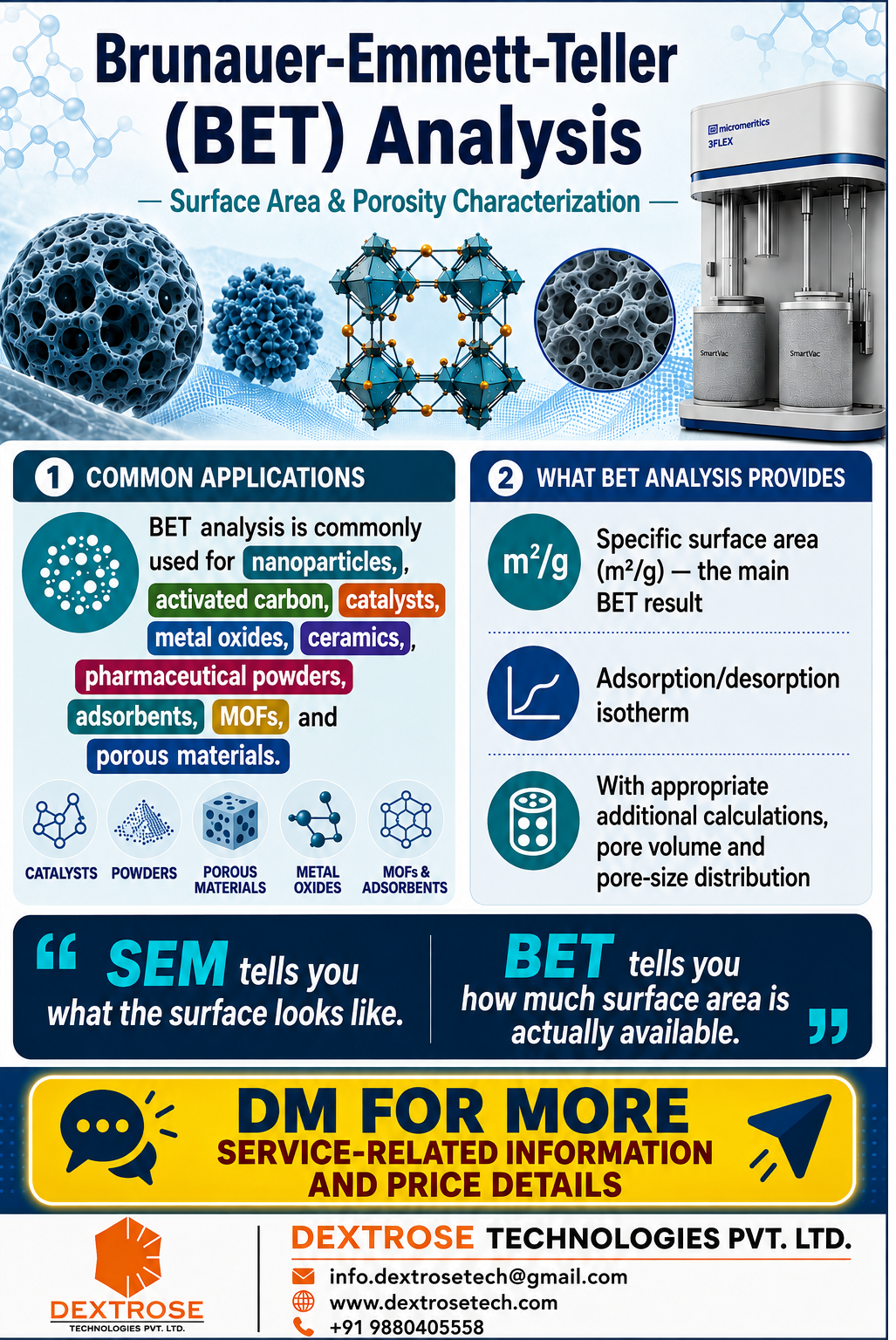
While imaging techniques like SEM help visualize surface morphology, BET analysis provides quantitative information about the surface area that is actually available for interaction.
Using gas adsorption principles, BET analysis can provide:
✅ Specific surface area (m²/g) – one of the most important parameters for porous and particulate materials
✅ Adsorption–desorption isotherms – useful for understanding how gases interact with the material surface
✅ Total pore volume
✅ Pore-size distribution through suitable additional calculations
✅ Valuable insight into the porous structure and surface accessibility of a sample
BET characterization is especially useful for:
• Nanoparticles and nanomaterials
• Activated carbon and biochar
• Catalysts and catalyst supports
• Metal oxides
• Ceramics
• Pharmaceutical powders
• MOFs and porous frameworks
• Adsorbents
• Battery and energy-storage materials
• Other porous and high-surface-area materials
📌 Why does surface area matter?
Two materials with similar composition may perform very differently if their surface area and pore structure are different. Higher accessible surface area can influence adsorption capacity, catalytic efficiency, reaction kinetics, dissolution, and interaction with surrounding molecules.
This is why combining techniques can provide a much stronger understanding of your material:
🔍 SEM tells you what the surface looks like.
📊 BET tells you how much surface area is actually available.
If you are working on material development, nanotechnology, adsorption studies, catalysis, pharmaceuticals, energy materials, or porous materials, BET analysis can provide important quantitative data for your research.
📩 DM us for sample requirements, testing details, turnaround time and pricing.
🌐 www.dextrosetech.com
📧 info.dextrosetech@gmail.com