

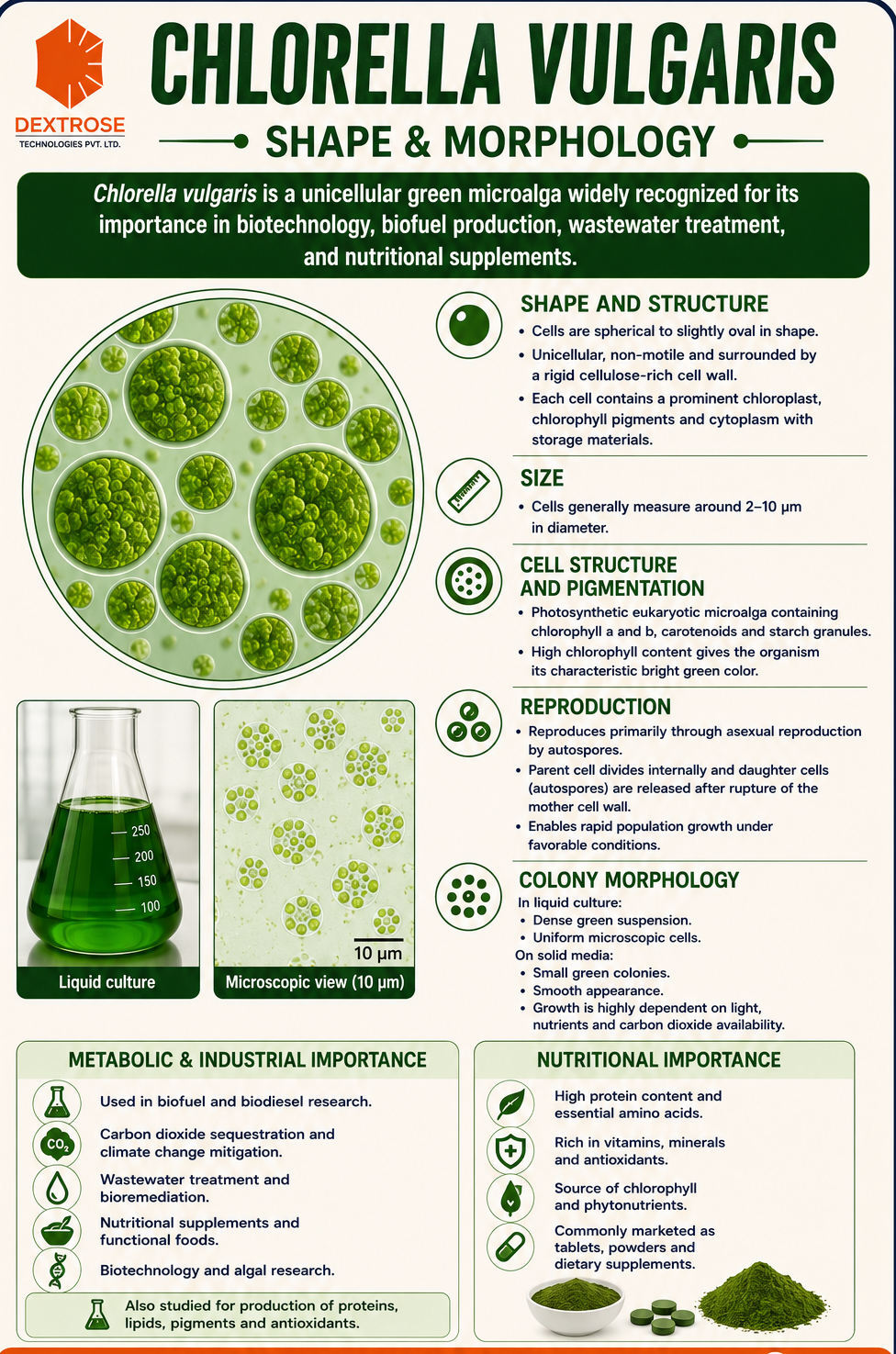
>> Overview
Chlorella vulgaris is a unicellular green microalga widely recognized for its importance in biotechnology, biofuel production, wastewater treatment, and nutritional supplements. It is rich in proteins, chlorophyll, vitamins, and antioxidants, making it highly valuable in food, pharmaceutical, and environmental applications.
>> Shape and Structure
Chlorella vulgaris cells are:
✔️ Spherical to slightly oval in shape
✔️ Unicellular and non-motile
✔️ Surrounded by a rigid cellulose-rich cell wall
>> Each cell contains:
A prominent chloroplast
Chlorophyll pigments for photosynthesis
Cytoplasm with storage materials
The cells occur individually and do not form complex multicellular structures.
>> Size
The cells generally measure around:
2–10 µm in diameter
Their microscopic size allows rapid growth and efficient nutrient uptake in aquatic environments.
>> Cell Structure and Pigmentation
Chlorella vulgaris is a photosynthetic eukaryotic microalga containing:
🌿 Chlorophyll a and b
🌿 Carotenoids
🌿 Starch granules
The high chlorophyll content gives the organism its characteristic bright green color.
>> Reproduction
Chlorella vulgaris reproduces primarily through:
✔️ Asexual reproduction by autospores
>> During reproduction:
The parent cell divides internally
Daughter cells (autospores) are released after rupture of the mother cell wall
This allows rapid population growth under favorable conditions.
>> Colony Morphology
In liquid culture, Chlorella appears as:
✔️ Dense green suspension
✔️ Uniform microscopic cells
On solid media:
✔️ Small green colonies
✔️ Smooth appearance
Growth is highly dependent on light, nutrients, and carbon dioxide availability.
>> Metabolic and Industrial Importance
Chlorella vulgaris is widely used in:
🧪 Biofuel and biodiesel research
🌱 Carbon dioxide sequestration
💧 Wastewater treatment
🥗 Nutritional supplements and functional foods
🧬 Biotechnology and algal research
It is also studied for its ability to produce:
Proteins
Lipids
Pigments
Antioxidants
Nutritional Importance
Chlorella vulgaris is considered a superfood microalga because it contains:
✅ High protein content
✅ Essential amino acids
✅ Vitamins and minerals
✅ Chlorophyll and antioxidants
It is commonly marketed as:
Tablets
Powders
Dietary supplements
Environmental Importance
This microalga contributes significantly to:
🌍 Oxygen production
🌍 Carbon fixation
🌍 Removal of pollutants and heavy metals from wastewater
Its rapid growth makes it useful in sustainable environmental technologies.
>> Key Insight
Due to its high nutritional value, photosynthetic efficiency, and industrial versatility, Chlorella vulgaris is one of the most important microalgae in biotechnology and environmental research.