

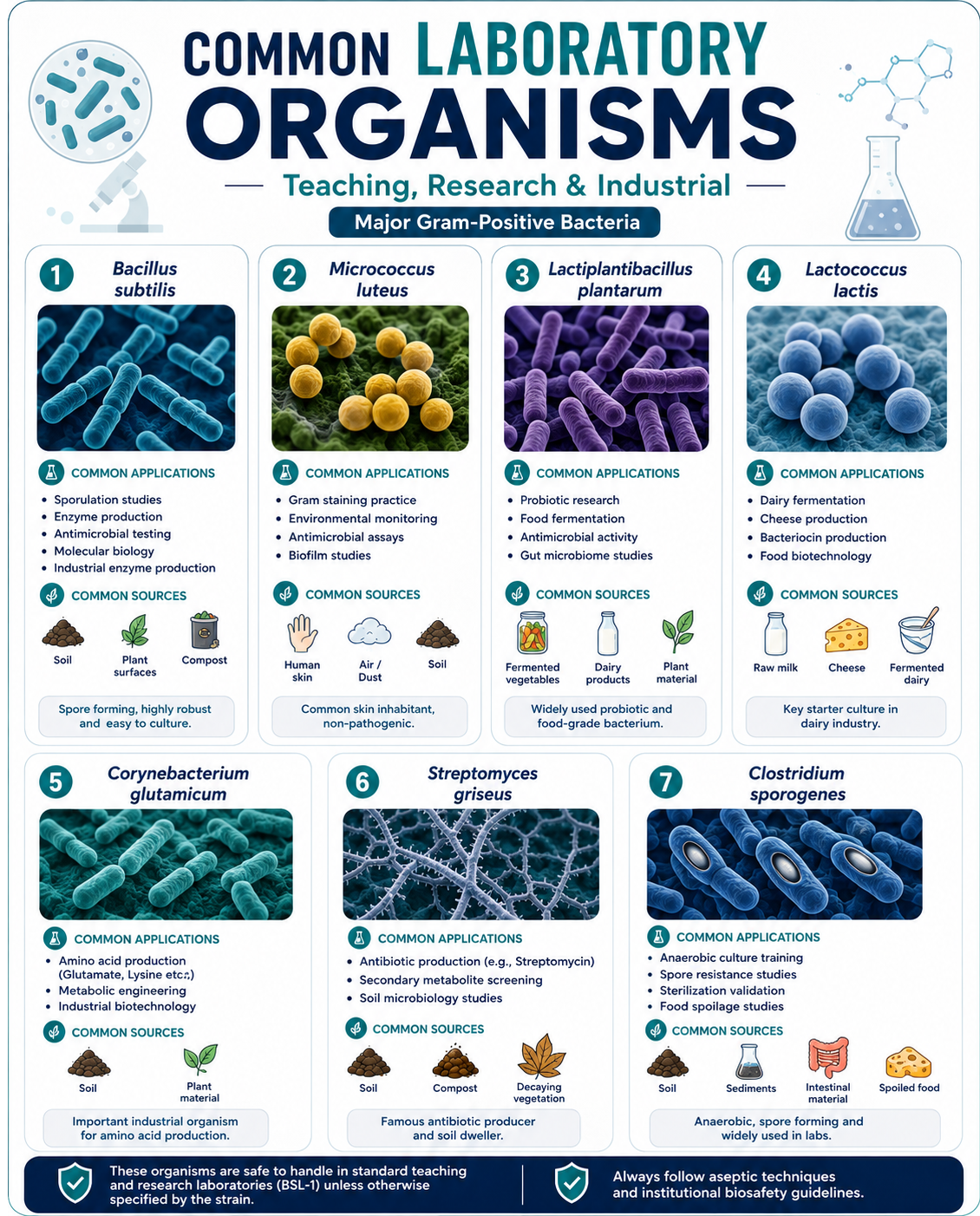
Gram-positive bacteria are widely used in teaching, research, food biotechnology and industrial microbiology. Their thick peptidoglycan cell wall, diverse metabolic capabilities and ease of cultivation make them valuable for studying microbial physiology, fermentation, antimicrobial activity, enzyme production and biotechnology applications.
1. Bacillus subtilis
Bacillus subtilis is a spore-forming bacterium commonly found in soil, compost and plant-associated environments. It is frequently used as a model organism because it grows rapidly and can tolerate changing environmental conditions.
Common applications
Sporulation and germination studies
Enzyme production
Antimicrobial testing
Molecular biology research
Industrial biotechnology
Its ability to produce enzymes such as proteases and amylases makes it especially important in food, detergent and pharmaceutical industries.
2. Micrococcus luteus
Micrococcus luteus is a Gram-positive, spherical bacterium commonly found on human skin, in soil, air and dust. It is generally non-pathogenic and is often used in basic microbiology training.
Common applications
Gram-staining practice
Environmental monitoring
Antimicrobial susceptibility assays
Biofilm research
Microbial contamination studies
Its characteristic yellow-pigmented colonies make it easy to identify during laboratory demonstrations.
3. Lactiplantibacillus plantarum
Lactiplantibacillus plantarum is a beneficial lactic acid bacterium found in fermented vegetables, dairy products and plant materials. It is widely studied for its probiotic properties and role in food preservation.
Common applications
Probiotic research
Food fermentation
Antimicrobial activity studies
Gut microbiome research
Development of functional foods
The organism produces lactic acid and other antimicrobial compounds that can help control spoilage and pathogenic microorganisms.
4. Lactococcus lactis
Lactococcus lactis is an important starter culture used in dairy fermentation. It is naturally associated with raw milk, cheese and other fermented dairy products.
Common applications
Dairy fermentation
Cheese production
Bacteriocin production
Food biotechnology
Starter-culture development
Some strains produce nisin, a natural antimicrobial peptide widely used in food preservation.
5. Corynebacterium glutamicum
Corynebacterium glutamicum is a non-spore-forming bacterium commonly associated with soil and plant materials. It is one of the most important industrial microorganisms used for large-scale amino acid production.
Common applications
Production of glutamate and lysine
Metabolic engineering
Fermentation process development
Industrial biotechnology
Production of bio-based chemicals
Its efficient metabolism and established genetic tools make it highly suitable for industrial strain improvement.
6. Streptomyces griseus
Streptomyces griseus is a filamentous soil bacterium commonly found in soil, compost and decaying vegetation. Members of the genus Streptomyces are well known for producing antibiotics and other biologically active compounds.
Common applications
Antibiotic production
Secondary metabolite screening
Soil microbiology studies
Natural-product research
Enzyme discovery
Streptomyces griseus is historically important as a producer of streptomycin, an aminoglycoside antibiotic.
7. Clostridium sporogenes
Clostridium sporogenes is an anaerobic, spore-forming bacterium found in soil, sediments, intestinal environments and spoiled foods. It is frequently used in controlled microbiology and sterilisation studies.
Common applications
Anaerobic culture training
Spore-resistance studies
Sterilisation validation
Food-spoilage research
Evaluation of decontamination processes
Because it forms highly resistant spores, it is useful for assessing sterilisation and microbial-control procedures.
>> Why These Organisms Are Important
These Gram-positive bacteria represent different microbial characteristics, including spore formation, fermentation, antibiotic production, probiotic activity and industrial metabolite production. Studying them helps students and researchers understand microbial diversity while supporting practical applications in food technology, healthcare, agriculture and industrial biotechnology.
>> Laboratory Safety
Laboratory strains must be handled according to their individual biosafety classification. Appropriate personal protective equipment, aseptic techniques, waste-disposal procedures and institutional biosafety guidelines should always be followed. Strain identity and risk classification must be confirmed before beginning any laboratory work.