
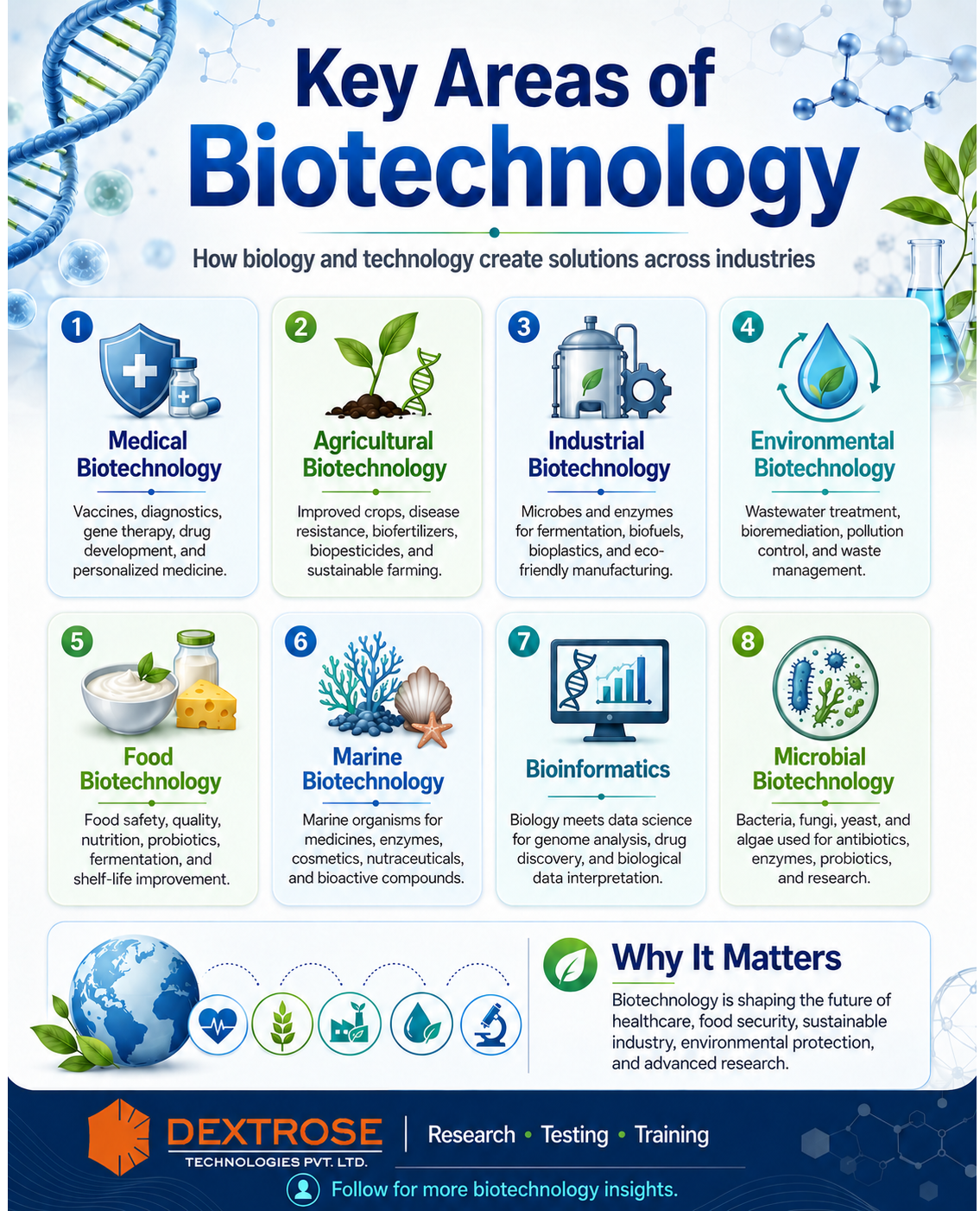
Biotechnology is a broad and fast-growing field that uses living organisms, cells, enzymes, and biological systems to develop useful products, processes, and technologies. Its applications extend across healthcare, agriculture, industry, environment, food, and research. Each area of biotechnology plays a unique role in solving real-world challenges and improving the quality of life.
>> Medical Biotechnology
Medical biotechnology focuses on improving human health through advanced biological research and technology. It includes the development of vaccines, antibiotics, diagnostic kits, gene therapy, regenerative medicine, molecular testing, and targeted drug delivery systems. Techniques such as PCR, DNA sequencing, recombinant DNA technology, and cell culture have transformed disease diagnosis, treatment, and prevention. This area plays a major role in modern healthcare by enabling early detection, personalized medicine, and innovative therapies.
>> Agricultural Biotechnology
Agricultural biotechnology applies biological tools to improve crop productivity, resistance, and nutritional quality. It helps in developing disease-resistant plants, drought-tolerant crops, biofertilizers, biopesticides, and improved seed varieties. Through plant tissue culture, genetic improvement, and microbial-based solutions, agricultural biotechnology supports sustainable farming and helps reduce dependency on chemical fertilizers and pesticides.
>> Industrial Biotechnology
Industrial biotechnology uses microorganisms, enzymes, and biological processes for large-scale production of valuable products. It is widely used in fermentation, enzyme production, biofuels, bioplastics, pharmaceuticals, textiles, detergents, and food processing. This area helps industries create cleaner, more efficient, and eco-friendly manufacturing processes by replacing harsh chemicals with biological alternatives.
>> Environmental Biotechnology
Environmental biotechnology focuses on protecting and restoring the environment using biological systems. It includes wastewater treatment, bioremediation, composting, biodegradation of pollutants, microbial waste management, and bioenergy production. Microorganisms play a key role in breaking down harmful substances and converting waste into useful resources. This area is highly important for pollution control, sustainability, and environmental conservation.
>> Food Biotechnology
Food biotechnology improves food quality, safety, nutrition, and shelf life using biological methods. It includes fermentation, probiotics, enzyme-based food processing, food testing, preservation, and development of functional foods. Traditional products such as curd, cheese, bread, and vinegar are based on microbial biotechnology. Modern food biotechnology also supports quality control, contamination detection, and safer food production.
>> Marine Biotechnology
Marine biotechnology explores biological resources from oceans, seas, and aquatic environments. Marine organisms such as algae, bacteria, fungi, and marine animals are studied for their potential in medicine, cosmetics, nutraceuticals, biofuels, and industrial products. This area is gaining importance because marine biodiversity offers unique compounds with antimicrobial, anticancer, antioxidant, and enzyme-based applications.
>> Bioinformatics and Computational Biotechnology
Bioinformatics combines biology, computer science, and data analysis to understand complex biological information. It is used in genome analysis, protein structure prediction, drug discovery, molecular docking, evolutionary studies, and large-scale biological data interpretation. With the rise of genomics and artificial intelligence, bioinformatics has become essential for modern biotechnology research and precision medicine.
>> Molecular Biotechnology
Molecular biotechnology works at the level of DNA, RNA, proteins, and genes. It includes genetic engineering, cloning, recombinant protein production, gene expression analysis, CRISPR-based technologies, and molecular diagnostics. This area forms the foundation of many advanced applications in medicine, agriculture, forensic science, and research.
>> Microbial Biotechnology
Microbial biotechnology uses bacteria, fungi, yeast, and algae for beneficial applications. Microorganisms are used in antibiotic production, enzyme manufacturing, fermentation, biofertilizers, probiotics, bioremediation, and industrial product development. Because microbes grow quickly and can be modified for specific purposes, they are valuable tools in both research and industry.
>> Future Scope of Biotechnology
The future of biotechnology is strongly connected to sustainability, healthcare innovation, food security, and industrial development. Emerging areas such as synthetic biology, genetic engineering, personalized medicine, stem cell technology, biomaterials, and AI-driven biological research are opening new opportunities.