
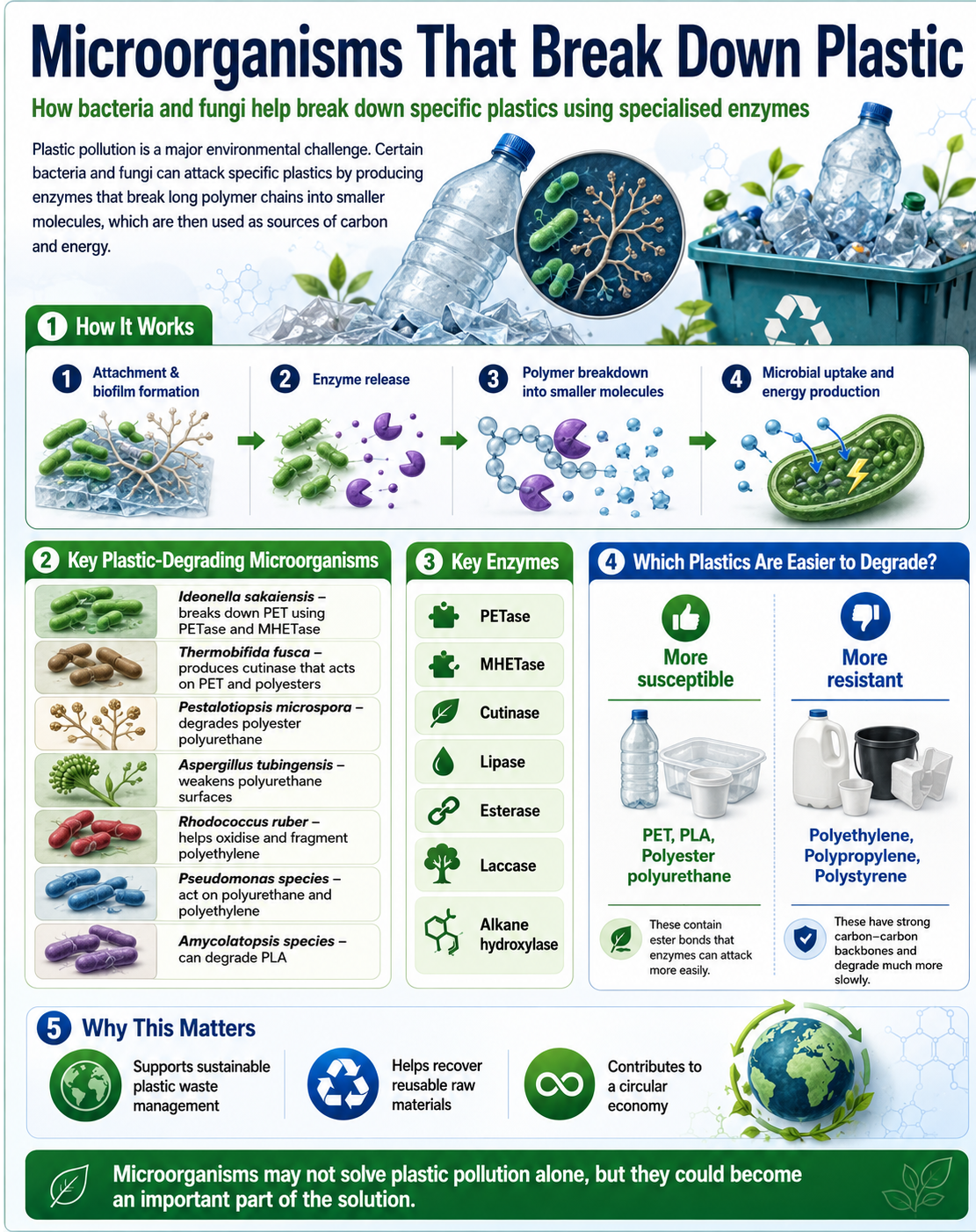
Plastic pollution has become one of the most serious environmental challenges worldwide. Most conventional plastics remain in the environment for decades because their chemical structure is highly resistant to natural degradation. However, certain bacteria and fungi can attack specific types of plastic by producing specialised enzymes that break long polymer chains into smaller, usable compounds.
>> How Microorganisms Break Down Plastic
Microbial plastic degradation usually begins when microorganisms attach to the plastic surface and form a thin biofilm. This biofilm helps the microbes remain in close contact with the material. They then release enzymes that weaken or break the chemical bonds within the plastic.
The plastic is gradually converted into smaller molecules such as oligomers, monomers and organic acids. These compounds can then be absorbed by microbial cells and used as sources of carbon and energy. Under suitable conditions, complete biodegradation may produce carbon dioxide, water and microbial biomass.
>> Ideonella sakaiensis and PET Plastic
One of the best-known plastic-degrading bacteria is Ideonella sakaiensis. It can break down polyethylene terephthalate, commonly known as PET, which is widely used in beverage bottles, food containers and polyester fabrics.
This bacterium produces two important enzymes called PETase and MHETase. PETase first breaks PET into smaller intermediate compounds. MHETase then converts these compounds into terephthalic acid and ethylene glycol, which can be absorbed and metabolised by the bacterium.
>> Thermobifida fusca
Thermobifida fusca is a heat-tolerant bacterium known to produce cutinase enzymes. These enzymes can attack the ester bonds present in PET and other polyester materials.
Because its enzymes remain active at relatively high temperatures, this microorganism is considered useful for the development of industrial plastic-recycling technologies.
>> Pestalotiopsis microspora
Pestalotiopsis microspora is a fungus capable of degrading polyester polyurethane, a plastic commonly used in foams, coatings, adhesives and synthetic materials.
The fungus produces enzymes such as esterases, lipases and proteases, which break the polyurethane structure into smaller compounds. Some studies have shown that this fungus can continue degrading polyurethane even under low-oxygen conditions.
>> Aspergillus tubingensis
Aspergillus tubingensis is another fungus that can grow on polyurethane surfaces. Its fungal filaments penetrate and weaken the plastic structure while releasing enzymes that damage the polymer chains.
Over time, this activity can cause surface cracks, pits, loss of strength and structural deterioration.
>> Rhodococcus ruber
Rhodococcus ruber has shown the ability to colonise and partially degrade polyethylene, which is widely used in plastic bags, films and packaging materials.
The bacterium forms a strong biofilm on the plastic surface and produces oxidative enzymes. These enzymes introduce oxygen-containing groups into the polyethylene chain, making the material easier to break into smaller fragments.
>> Pseudomonas Species
Several Pseudomonas species have been studied for their ability to degrade polyethylene and polyurethane. They produce enzymes such as lipases, esterases, alkane hydroxylases and oxidases.
These enzymes either hydrolyse susceptible chemical bonds or oxidise the polymer surface. The resulting smaller compounds may then enter the bacterial metabolic pathways.
>> Bacillus Species
Different Bacillus species have demonstrated the ability to weaken polyethylene and degrade certain biodegradable plastics. They release enzymes such as lipases, esterases and oxidative enzymes.
Their activity can lead to surface erosion, reduced molecular weight and partial fragmentation of the plastic material.
>> Amycolatopsis Species
Amycolatopsis species are particularly effective against polylactic acid, or PLA, which is used in compostable packaging, disposable products and biomedical materials.
These bacteria produce protease-like and esterase enzymes that hydrolyse the ester bonds present in PLA, converting the polymer into smaller molecules that can be metabolised.
>> Why Some Plastics Degrade More Easily
Plastics such as PET, PLA and polyester polyurethane contain ester bonds that can be attacked by microbial enzymes. These plastics are therefore more susceptible to biological degradation.
In contrast, polyethylene, polypropylene and polystyrene contain strong carbon–carbon backbones. These materials are much more difficult for microorganisms to break down and often require pretreatment using heat, ultraviolet light, oxidation or mechanical processing.