Bangalore
08042753298
+919686928701

Items tagged with 'polyacrylamide gel matrix'

68179d65be22ee500d53ff54 Card 2

product image
Molecular Services

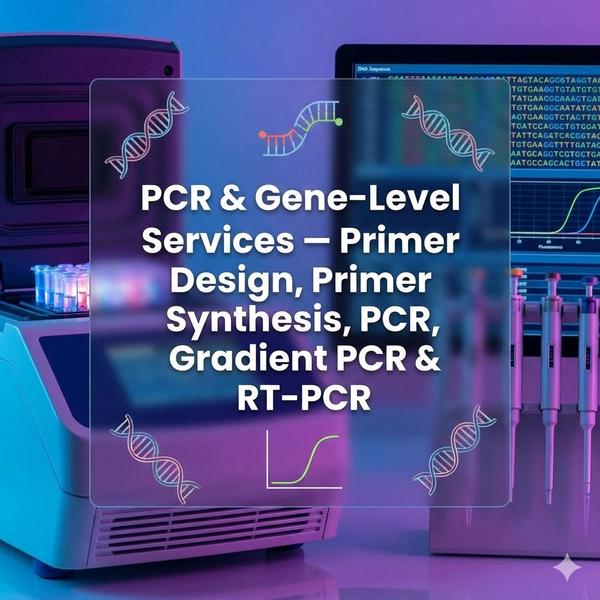
At Dextrose Technologies Pvt. Ltd., we provide PCR and gene-level services to support rapid detection, target confirmation, and research workflows. From target-specific primer design to PCR execution and reporting, we deliver clear, reproducible outputs for academic, industrial, and R&D applications. Primer Design (Target-Specific) We design primers based on your target gene/region and intended application (detection, confirmation, or expression studies). Designs are optimized for specificity, amplicon size, and assay conditions. Primer Synthesis (Research Grade) We support research-grade primer synthesis and coordinate delivery based on your required scale and format. PCR Services Conventional PCR: Target amplification for detection, confirmation, and downstream sequencing. Gradient PCR: Optimization of annealing temperature to improve specificity and yield, especially for new primer sets or challenging templates. RT-PCR (Gene Expression / Detection Studies) We support RT-PCR workflows for gene expression and detection studies (scope dependent on sample type and experimental design), with structured reporting aligned to your objective. Deliverables * Primer details and assay conditions (as applicable) * PCR/RT-PCR results summary with interpretation notes * Gel images (for conventional PCR) and run documentation * Recommendations for sequencing confirmation when required Get started Share your target gene/organism, sample type (DNA/cDNA), expected amplicon size, and objective (detection/confirmation/expression). We’ll recommend the most suitable workflow.

68179d65be22ee500d53ff54 Card 2

product image
Elemental Analysis

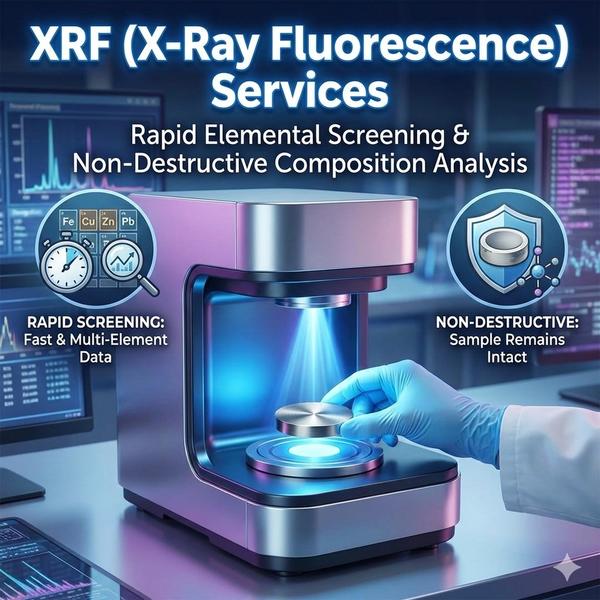
At Dextrose Technologies Pvt. Ltd., we offer XRF (X-Ray Fluorescence Spectroscopy) for fast, non-destructive elemental screening and material composition evaluation. XRF is ideal for solid and powder samples where you need quick elemental insight without complex wet chemistry. It supports raw material verification, contamination checks, and batch comparison through clear, report-ready elemental profiles. Rapid elemental screening We screen for major and minor elements and provide an elemental overview to support quick decisions and follow-up testing plans. Non-destructive material composition analysis XRF analyzes samples without dissolving or destroying them, making it useful for routine checks and investigations where sample preservation matters. Solid and powder sample evaluation We evaluate powders, pellets, solids, and other compatible materials (scope-dependent) and report results in a structured format. Deliverables * Elemental composition summary (as applicable to method and matrix) * Spectra/measurement notes and sample identifiers * Comparative summary across samples/batches * Recommendations for confirmatory testing when required (e.g., ICP-OES/ICP-MS) Get started Share your sample type (powder/solid), expected elements of interest, and whether you need screening or quantitative reporting. We’ll recommend the right XRF workflow.

68179d65be22ee500d53ff54 Card 2

product image
Elemental Analysis

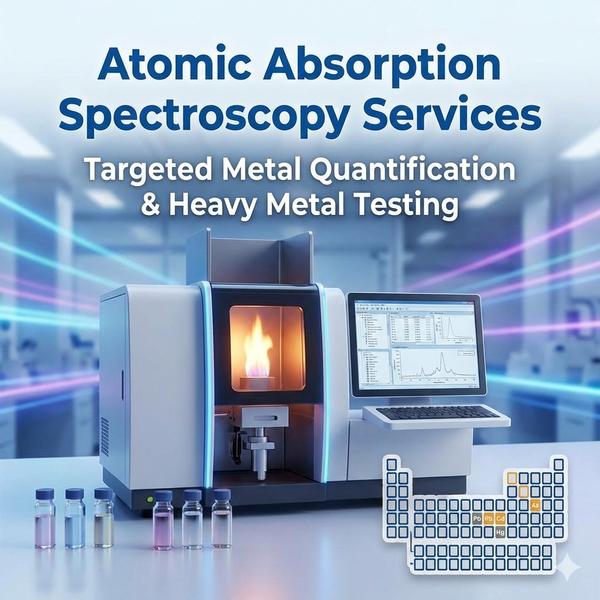
At Dextrose Technologies Pvt. Ltd., we offer Atomic Absorption Spectroscopy (AAS) for accurate, targeted metal quantification in APIs, excipients, formulations, and raw materials. AAS is well suited when you need focused testing of specific metals with dependable calibration-based reporting. We support heavy metal testing and routine elemental checks for quality, troubleshooting, and compliance-focused workflows (scope and limits defined by your requirement). Targeted metal quantification We quantify selected metals based on your target list and matrix, with results reported in clear units (ppm/ppb or mg/L as required). Heavy metal testing in APIs, excipients, and formulations We test for heavy metals in pharmaceutical and formulation samples to support QC decisions and risk evaluation, with clean documentation and structured reporting. Deliverables * Metal-wise concentration results with units * Method notes and sample preparation basis (as applicable) * Calibration approach and QC checks (as agreed) * Summary interpretation highlighting any outliers Get started Share your sample type, target metal list, required limits, and reporting units. We’ll recommend the most suitable AAS workflow.

68179d65be22ee500d53ff54 Card 2

product image
Elemental Analysis

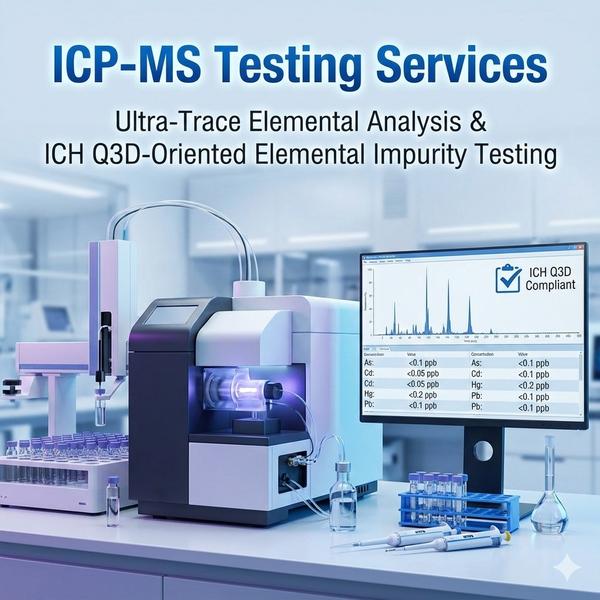
At Dextrose Technologies Pvt. Ltd., we provide ICP-MS (Inductively Coupled Plasma – Mass Spectrometry) for ultra-trace elemental analysis and sensitive toxic metal screening. ICP-MS is ideal when you need ppb-level detection, strong selectivity, and multi-element quantification in challenging matrices. We support ICH Q3D-oriented elemental impurity testing for development and QC programs, with scope and limits defined by your product type and regulatory requirement. Ultra-trace elemental analysis We quantify multiple elements at trace and ultra-trace levels with calibration-based reporting and clear units (ppb/ppm or µg/L as required). ICH Q3D-oriented elemental impurity testing We support Q3D-oriented workflows by testing target elemental impurities, documenting method conditions, and reporting results in a structured, review-ready format aligned to your defined specification limits. Toxic metal screening at ppb levels We screen and quantify toxic metals at ppb levels (scope-dependent), helping identify contamination risk in raw materials, intermediates, and finished products. Deliverables * Element-wise concentration table with units and detection notes * Method and sample preparation notes (digestion basis as applicable) * QC checks/calibration summary (as agreed) * Interpretation notes highlighting outliers and trends Get started Share your sample type, matrix details, target element list, and required limits/specification. We’ll recommend the right ICP-MS workflow and reporting format.

68179d65be22ee500d53ff54 Card 2

product image
Elemental Analysis

At Dextrose Technologies Pvt. Ltd., we provide ICP-OES (Inductively Coupled Plasma – Optical Emission Spectroscopy) for reliable multi-element quantitative analysis across raw materials, intermediates, and finished products. ICP-OES is well suited for routine elemental profiling and screening where you need accurate concentrations across multiple metals and minerals in a single run (scope depends on matrix and required limits). Multi-Element Quantitative Analysis We quantify multiple elements in one method, generating concentration results in clear units (ppm/ppb or mg/L as required) with calibration-based reporting. Heavy Metal and Elemental Impurity Screening We support screening for heavy metals and elemental impurities to help identify contamination risks, support QC decisions, and enable batch comparison. (For ICH Q3D-aligned programs, scope and limits are finalized based on your requirements and standards provided.) Raw Material and Finished Product Analysis We analyze a wide range of matrices—raw materials, powders, liquids, digests, and finished products—based on suitable sample preparation and digestion approach. Deliverables * Results table with element-wise concentrations * Method notes (sample prep/digestion basis as applicable) * Calibration approach and QC checks (as agreed) * Summary interpretation and flags for outliers/trends Get started Share your sample type, target element list, required limits, and reporting units. We’ll recommend the right ICP-OES workflow and sample preparation plan.

68179d65be22ee500d53ff54 Card 2

product image
Chromatography services

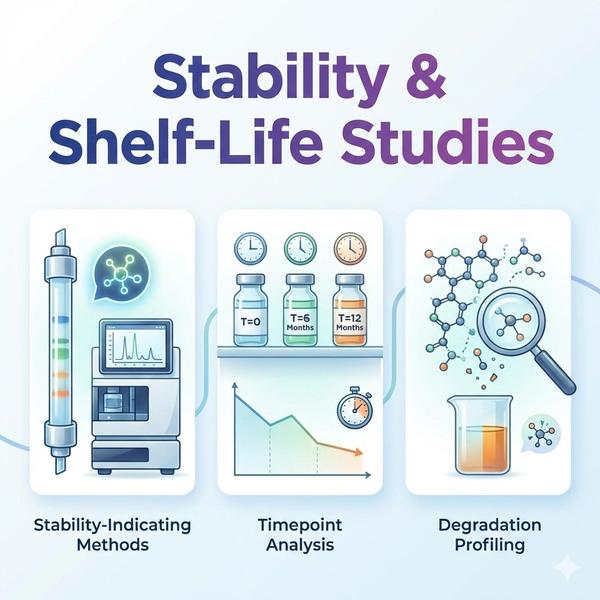
At Dextrose Technologies Pvt. Ltd., we support Stability & Shelf-Life Studies to help you justify shelf-life, understand degradation pathways, and generate clear, trend-ready data for internal QA and development decisions. Our services cover stability-indicating method development, long-term and accelerated timepoint analysis, degradation profiling, and packaging interaction screening using chromatography and mass spectrometry. Stability-Indicating Method Development We develop methods that can clearly separate the main compound from degradation products, enabling accurate stability assessment and cleaner decision-making. Long-Term & Accelerated Stability Sample Analysis We analyze stability samples across planned timepoints for long-term and accelerated studies, reporting assay/impurity trends in structured formats. Degradation Product Profiling (HPLC / LCMS) We profile degradation products using HPLC and support identification/confirmation with LCMS where required (scope-dependent), helping you understand what is forming and when. Volatile Degradation Monitoring (HS-GCMS) For volatile components or residual solvents, we monitor changes over time using Headspace GCMS, enabling sensitive tracking with reduced matrix interference. Packaging Interaction Screening Screening studies to evaluate potential packaging-contact interactions that may impact product quality, supporting packaging selection and early risk assessment. Trend Analysis Across Stability Time Points We provide trend-ready tables and summaries across timepoints to support faster reviews and clearer shelf-life justification. Outcome you can expect * Strong stability-indicating methods and timepoint-ready workflows * Clear degradation visibility (non-volatile and volatile) * Structured trend data to support shelf-life justification Get started Share your product type, analyte(s), planned timepoints, storage conditions, and reporting expectations. We’ll recommend the most efficient stability workflow.

68179d65be22ee500d53ff54 Card 2

product image
Chromatography services

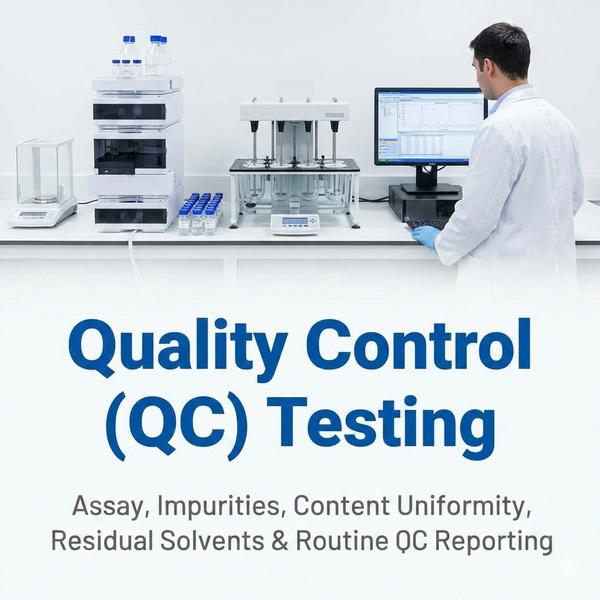
At Dextrose Technologies Pvt. Ltd., we provide Quality Control (QC) Testing to support batch release, routine compliance, and in-process control. Our chromatography-based QC services deliver consistent, calibration-based results with clear documentation and regulatory-aligned reporting. We help you reduce batch risk, maintain trendable quality metrics, and move faster through internal QA review. Assay Testing (HPLC / RP-HPLC) Accurate content estimation for APIs, intermediates, and formulations using validated/optimized chromatographic methods and standards-based quantification. Related Substances / Impurity Profiling Separation and monitoring of related substances and impurities to support batch comparison, process control, and product quality assessment. Content Uniformity Testing Testing to evaluate dosage consistency across units with structured reporting for easy review and trending. Residual Solvent Analysis (GC-FID / HS-GCMS) Residual solvent quantification using GC-FID or Headspace GCMS, based on target solvent list, matrix, and required limits (ICH Q3C-oriented where applicable). Volatile Impurity Testing Volatile impurity profiling for troubleshooting and routine QC checks using GC techniques suited to your sample type. System Suitability & Routine QC Analysis System suitability testing (SST) and routine batch analysis with documented acceptance checks and clean reporting. Cleaning Validation Sample Analysis HPLC/GC-based analysis of swab/rinse samples for trace residues to support cleaning validation programs (scope-dependent). Outcome you can expect * Batch release readiness with consistent analytical outputs * Ongoing quality monitoring with trend-ready results * Clear, regulatory-aligned reporting for internal QA and client documentation Get started Share your product type, analyte list, specifications/limits, and sample count. We’ll recommend the most efficient QC

68179d65be22ee500d53ff54 Card 2

product image
Chromatography services

At Dextrose Technologies Pvt. Ltd., our R&D Analytical Support helps teams move faster from idea to data with the right analytical strategy and clear, decision-ready reporting. We support method development, compound understanding, reaction tracking, and early impurity/degradation visibility—so you can shorten development cycles and reduce trial-and-error. HPLC / RP-HPLC Method Development & Optimization We develop and optimize chromatography methods (column, mobile phase, gradient, flow, detection) to achieve strong resolution, repeatability, and robustness for your sample type. Assay Method Development for APIs & Formulations Calibration-based assay methods for APIs, intermediates, and formulations with clear reporting units and suitability checks as applicable. LCMS-Based Molecular Weight Confirmation Mass confirmation for non-volatile compounds to support identity verification, batch comparison, and early-stage characterization. Structural Elucidation (Small Molecules) Support for small-molecule structural understanding using MS-based interpretation (scope-dependent), with clear notes and next-step recommendations when needed. Impurity and Degradation Product Identification We profile impurities and degradation products to provide early visibility into risks and to guide method refinement and process decisions. Reaction Monitoring (HPLC / TLC) Fast reaction tracking to support endpoint decisions and process optimization, reported in a structured and easy-to-interpret format. Peptide & Small Molecule LCMS Analysis LCMS analysis for peptides and small molecules (scope-dependent), supporting mass confirmation and profiling. Exploratory Bioanalytical LCMS (Non-GLP) Exploratory analysis for R&D (non-GLP) with workflows tailored to matrix complexity and required sensitivity. Outcome you can expect * Robust analytical methods suitable for R&D progression * Early impurity and degradation visibility * Faster development cycles with clearer decisions Get started Share your compound class, sample matrix, development stage, and goal (method development, impurity ID, reaction monitoring). We’ll propose the fastest, most reliable plan.

68179d65be22ee500d53ff54 Card 2

product image
Chromatography services

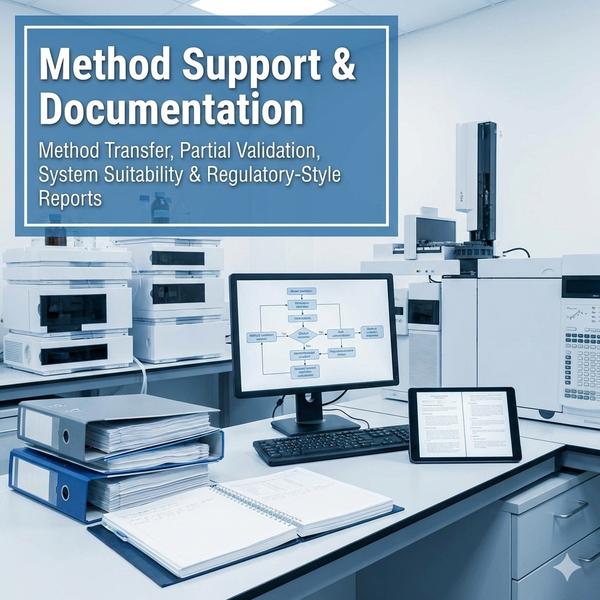
At Dextrose Technologies Pvt. Ltd., we provide method support and documentation to help teams generate reliable analytical results with clean, audit-ready reporting. We support analytical method transfer, partial method validation, system suitability checks, and stability sample analysis across chromatography platforms (HPLC/RP-HPLC, GC-FID, GCMS, HS-GCMS, LCMS—scope dependent). Our focus is on clear documentation, traceability, and decision-ready outputs. Analytical Method Transfer Support We help implement and verify your existing method by aligning instrument settings, sample prep, standards, and acceptance criteria. This supports consistent results when transitioning methods between teams, sites, or projects. Partial Method Validation (Accuracy, Precision, Linearity) We perform partial validation studies to demonstrate method performance for defined scopes, typically covering: * Accuracy (recovery) * Precision (repeatability / intermediate precision as applicable) * Linearity (calibration range and fit) Additional parameters can be added based on need. System Suitability Testing (SST) We run system suitability checks prior to sample batches to confirm method readiness and instrument performance, and document results against predefined criteria. Stability Sample Analysis We analyze stability samples across timepoints and provide trend-ready results to support R&D and product decisions. Regulatory-Style Test Reports We deliver structured reports with method details, sample identifiers, results tables, chromatograms, calculations basis, and clear conclusions—formatted for internal QA review and client documentation needs. Deliverables * Transfer/validation plan summary (scope + acceptance criteria) * Raw data summary + results tables + calculations basis * Chromatograms/spectra and SST outputs (as applicable) * Final report in a clean, regulatory-style format Get started Share the method, analyte list, matrix, target limits, and required parameters (accuracy/precision/linearity). We’ll propose a practical study plan and documentation package.

Still searching for
polyacrylamide gel matrix?