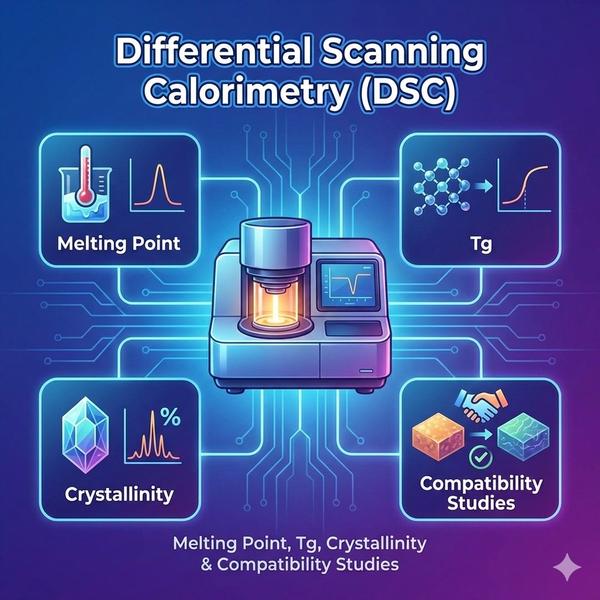
At Dextrose Technologies Pvt. Ltd., we provide Differential Scanning Calorimetry (DSC) for thermal and physicochemical characterization of solids and liquids. DSC measures heat flow associated with thermal transitions, enabling you to evaluate melting behavior, glass transition (Tg), crystallinity/polymorphism trends, and compatibility—useful for R&D, formulation work, and quality investigations. Differential Scanning Calorimetry – Solids & Liquids We analyze a wide range of materials to understand thermal transitions and compare batches, formulations, or processing conditions. Melting Point Determination We determine melting onset/peak behavior and compare thermal profiles to support identity checks, batch consistency, and impurity indications. Glass Transition Temperature (Tg) Analysis We identify Tg for amorphous or semi-amorphous materials and evaluate changes due to moisture, formulation, or processing. Crystallinity and Polymorphism Assessment We assess thermal signatures to support crystallinity trends and polymorphic differences (DSC-supported assessment; confirmatory tools may be recommended if needed). Drug–Excipient Compatibility Studies We compare DSC thermograms of APIs, excipients, and blends to flag potential interactions and compatibility risks during formulation development. Purity Assessment (Thermal Behavior) We use thermal behavior as a supportive indicator of purity and consistency (e.g., peak broadening/shift), aligned to project needs. Deliverables * DSC thermograms with key transition temperatures (onset/peak/Tg) * Comparative summary across samples/batches * Interpretation notes and recommendations for follow-up testing if required Get started Share your material type (solid/liquid), expected transition range, sample count, and objective (Tg, melting, compatibility, crystallinity). We’ll recommend the right DSC conditions and reporting format.

New Delhi
08048047882
+919686928701
 Chat with us
 Chat with us