
>> Overview
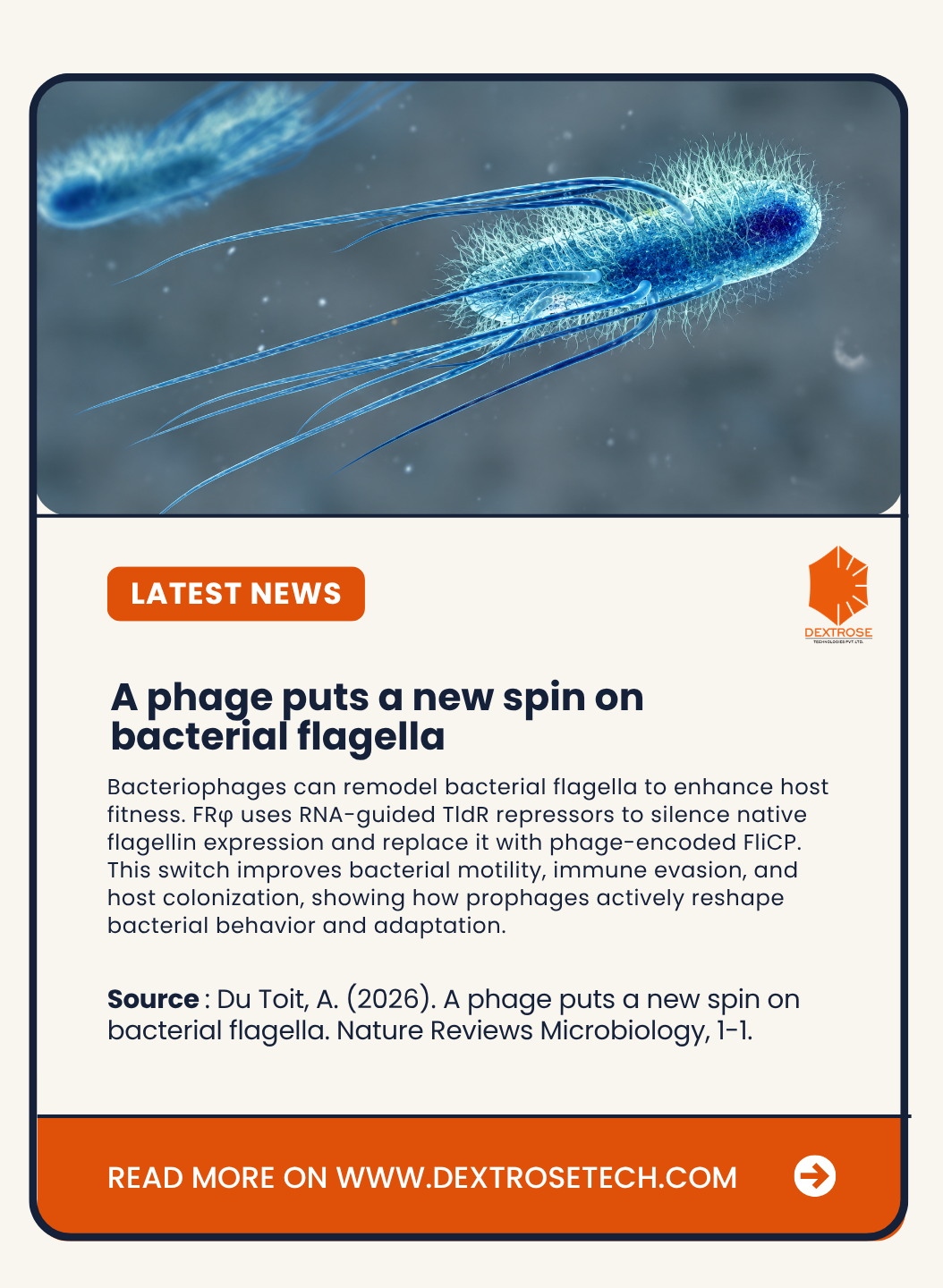
Bacterial flagella help bacteria move, colonize hosts, and interact with their environment. Recent research by Walker, Richard et al. shows that a temperate bacteriophage can remodel bacterial flagella by replacing the host’s native flagellin with a phage-encoded flagellin, improving bacterial motility, immune evasion, and host colonization.
>> RNA-Guided Flagellin Regulation
TnpB proteins are RNA-guided nucleases usually involved in transposon maintenance and mobility. However, related nuclease-dead proteins called TnpB-like nuclease-dead repressors, or TldRs, do not cut DNA. Instead, they use guide RNAs to bind promoter or 5′ untranslated regions and repress gene expression.
In this system, the TldR–guide RNA cassette is encoded within a prophage and is associated with a phage-encoded flagellin gene called FliCP. The TldR represses the host flagellin gene, fliCH, allowing the phage-derived FliCP protein to replace the native flagellin in the bacterial flagellar filament.
>> Flagellin Remodeling by FRφ
The Flagellin Remodeling phage, or FRφ, is a temperate phage that produces Siphoviridae-like virions. After infection, it causes a complete switch in flagellar composition from host-derived FliCH to phage-derived FliCP.
This remodeling enhances bacterial movement, reduces mammalian immune recognition, and improves host colonization. Interestingly, FRφ does not require flagella for infection. Instead, it enters bacterial cells through FhuA, a β-barrel outer membrane receptor.
>> Significance
This study shows that prophages can actively reshape bacterial traits rather than simply exist within host genomes. By using RNA-guided repression and a phage-encoded flagellin, FRφ modifies bacterial surface structure and behavior in ways that improve bacterial fitness.
>> Conclusion
Phage-mediated flagellin remodeling reveals a sophisticated strategy by which bacteriophages influence bacterial motility, immune evasion, and colonization. These findings deepen our understanding of phage–bacteria interactions and their role in bacterial adaptation and pathogenesis.