

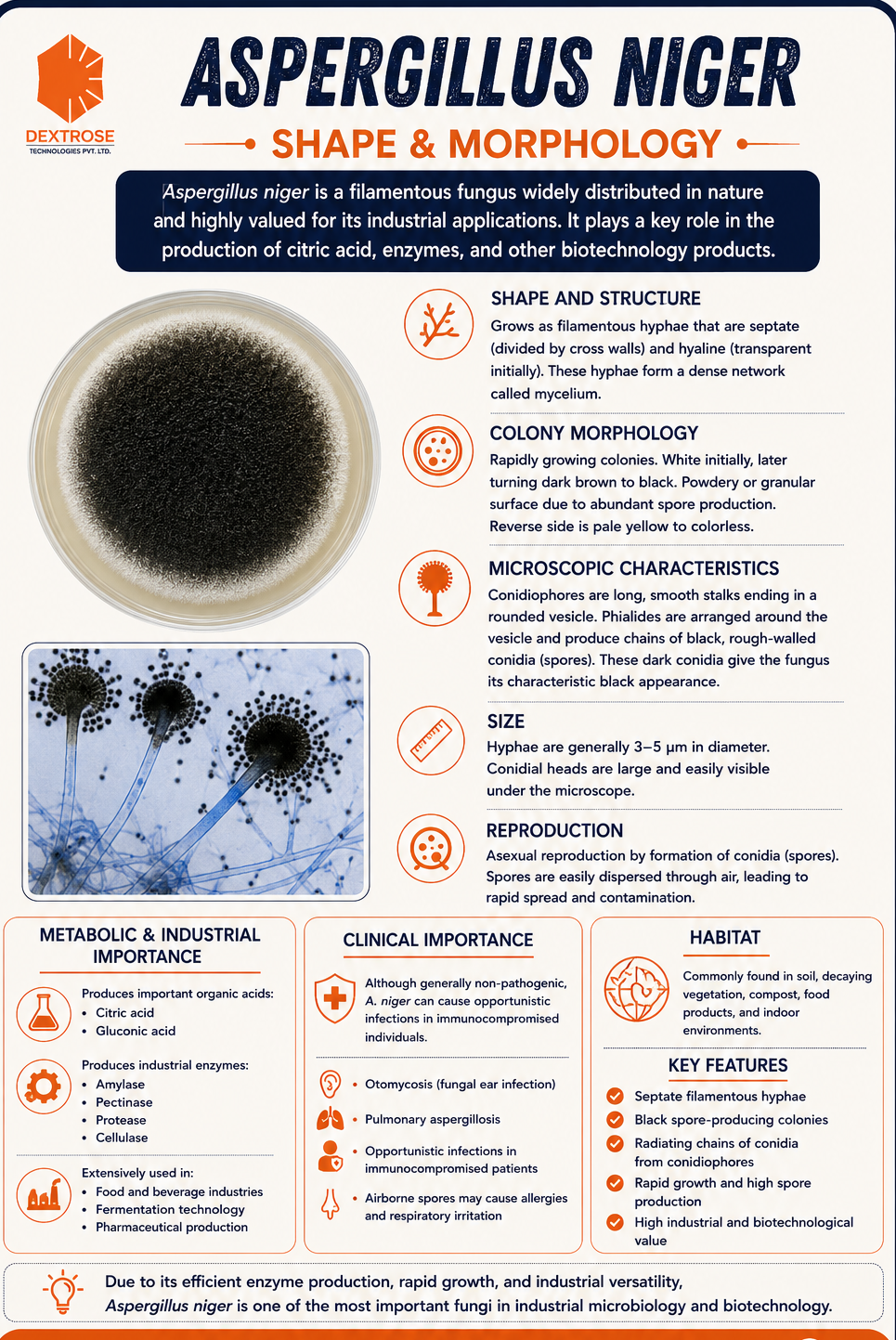
>> Overview
Aspergillus niger is a filamentous fungus widely distributed in soil, decaying vegetation, food products, and indoor environments. It is one of the most industrially important fungi due to its role in the production of citric acid, enzymes, and biotechnology products. Although generally beneficial in industry, it can also act as an opportunistic pathogen in immunocompromised individuals.
>> Shape and Structure
Aspergillus niger grows as:
Filamentous hyphae
Branched fungal threads forming a dense network called mycelium
The hyphae are:
✔️ Septate (divided by cross walls)
✔️ Hyaline (transparent/light-colored initially)
>> Colony Morphology
On culture media, A. niger typically forms:
✔️ Rapidly growing colonies
✔️ White colonies initially that later become dark brown to black
✔️ Powdery or granular surface due to heavy spore production
The reverse side of the colony is usually pale yellow to colorless.
>> Microscopic Characteristics
A distinguishing feature of Aspergillus niger is its specialized spore-producing structure:
🔹 Conidiophore
Long, smooth stalk arising from the hyphae
🔹 Vesicle
Rounded swollen tip of the conidiophore
🔹 Phialides
Arranged around the vesicle and responsible for spore formation
🔹 Conidia (Spores)
Black, rough-walled spherical spores forming radiating chains
These black conidia give the fungus its characteristic dark appearance.
>> Size
The fungal hyphae are generally:
Around 3–5 µm in diameter
Conidial heads may become quite large and visible microscopically due to dense spore arrangement.
>> Reproduction
Aspergillus niger primarily reproduces through:
✔️ Asexual reproduction by formation of conidia (spores)
The spores disperse easily through air, enabling rapid environmental spread and contamination.
>> Metabolic and Industrial Importance
Aspergillus niger is highly valued in biotechnology because it produces:
🧪 Citric acid
🧪 Gluconic acid
🧪 Industrial enzymes such as:
Amylase
Pectinase
Protease
Cellulase
It is extensively used in:
🍋 Food and beverage industries
🧬 Fermentation technology
💊 Pharmaceutical production
>> Clinical Importance
Although usually non-pathogenic, A. niger may cause:
⚠️ Otomycosis (fungal ear infection)
⚠️ Pulmonary aspergillosis
⚠️ Opportunistic infections in immunocompromised patients
Exposure to airborne spores may also trigger allergies and respiratory irritation.