

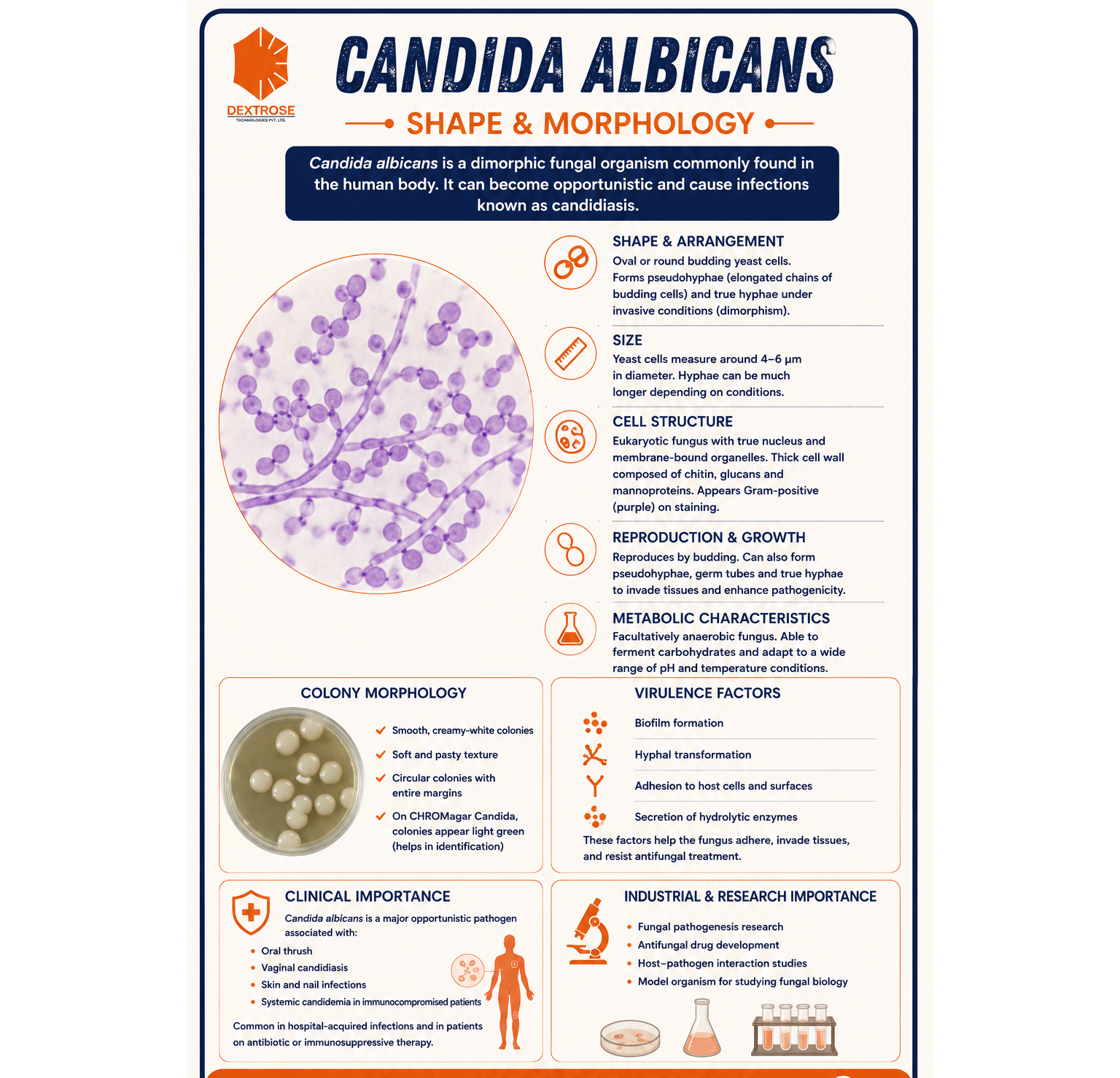
>> Overview
Candida albicans is a dimorphic fungal organism commonly found as part of the normal microbiota in the human body, especially in the oral cavity, gastrointestinal tract, and vaginal mucosa. Although usually harmless, it can become opportunistic under weakened immune conditions and cause infections known as candidiasis.
>> Shape and Arrangement
Candida albicans typically appears as:
Oval or round budding yeast cells
Pseudohyphae (elongated chains of budding cells)
True hyphae under invasive conditions
This ability to switch between yeast and filamentous forms is called dimorphism, a major virulence feature.
>> Size
The yeast cells generally measure around:
4–6 µm in diameter
Hyphal structures can be much longer depending on environmental conditions.
Cell Structure and Staining Characteristics
Candida albicans is a eukaryotic fungus possessing:
A true nucleus
Membrane-bound organelles
A thick fungal cell wall composed mainly of:
Chitin
Glucans
Mannoproteins
Under Gram staining, Candida often appears Gram-positive (purple) due to its thick cell wall.
>> Reproduction and Growth
The organism primarily reproduces through budding, where daughter cells emerge from parent yeast cells. Under favorable conditions, rapid budding leads to colony expansion.
It can also develop:
Pseudohyphae
Germ tubes
True hyphae
These structures are important for tissue invasion and pathogenicity.
>> Metabolic Characteristics
Candida albicans is:
Facultatively anaerobic
Able to ferment carbohydrates
Adaptable to various pH and temperature conditions
Its metabolic flexibility contributes to survival in diverse host environments.
>> Colony Morphology
On culture media, Candida albicans typically forms:
✔️ Smooth, creamy-white colonies
✔️ Soft and pasty texture
✔️ Circular colonies with entire margins
On specialized media like CHROMagar Candida, colonies may appear light green, aiding identification.
>> Virulence Factors
Key pathogenic features include:
🔹 Biofilm formation
🔹 Hyphal transformation
🔹 Adhesion proteins
🔹 Secretion of hydrolytic enzymes
These mechanisms help the fungus adhere to surfaces, invade tissues, and resist antifungal treatment.
>> Clinical Importance
Candida albicans is a major opportunistic pathogen associated with:
Oral thrush
Vaginal candidiasis
Skin infections
Systemic candidemia in immunocompromised patients
It is especially important in hospital-acquired infections and patients undergoing antibiotic or immunosuppressive therapy.
>> Industrial and Research Importance
Beyond clinical significance, Candida species are widely studied in:
🧪 Fungal pathogenesis research
💊 Antifungal drug development
🧬 Host–pathogen interaction studies
>> Key Insight
Due to its dimorphic nature, biofilm formation, and opportunistic pathogenicity, Candida albicans remains one of the most clinically important fungal microorganisms in medical microbiology.