

>> Colony Morphology: A Key Tool for Identifying Microorganisms
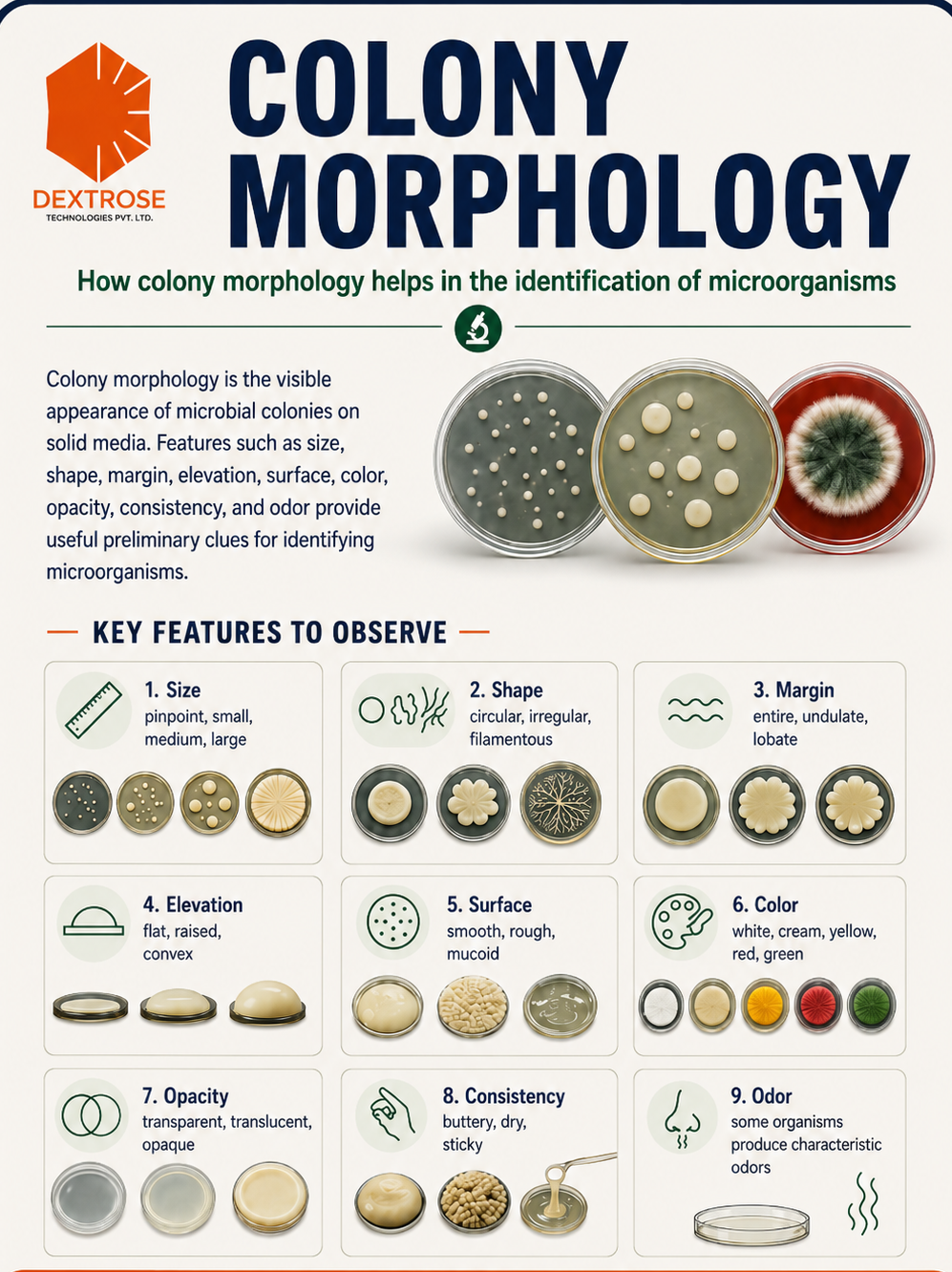
Colony morphology refers to the visible characteristics of microbial colonies growing on solid culture media. When bacteria, fungi, or other microorganisms are grown on agar plates, each colony may show distinct features such as size, shape, margin, elevation, surface texture, color, opacity, consistency, and odor. These features provide important preliminary clues that help microbiologists differentiate and identify microorganisms before advanced confirmatory tests are performed.
>> Why Colony Morphology Is Important
Colony morphology is one of the first observations made during microbial identification. It helps researchers and laboratory professionals understand whether a culture is pure or mixed, recognize possible contaminants, and select colonies for further biochemical, molecular, or microscopic analysis. Although colony morphology alone cannot provide final species-level identification in most cases, it plays a valuable role in narrowing down possibilities and guiding the next steps in diagnosis or research.
>> Key Features Observed in Colony Morphology
> Size of the Colony
The size of a microbial colony is usually described as pinpoint, small, medium, or large. Colony size depends on the type of microorganism, growth rate, incubation period, nutrient availability, and environmental conditions. Fast-growing organisms may form large colonies within 24 hours, while slow-growing microorganisms may produce very small or pinpoint colonies.
> Shape of the Colony
Colony shape describes the overall form of the colony when viewed from above. Common shapes include circular, irregular, filamentous, and rhizoid. Circular colonies are usually uniform and round, while irregular or filamentous colonies may suggest spreading growth patterns. Fungal colonies often show filamentous or fuzzy appearances due to the presence of hyphae.
> Margin of the Colony
The margin refers to the edge or boundary of the colony. It may be entire, undulate, lobate, curled, or filamentous. Smooth, entire margins are often seen in many bacterial colonies, while wavy or lobed margins may indicate different growth behavior or colony spreading. Margin observation is useful when comparing closely related microbial isolates.
> Elevation of the Colony
Colony elevation describes how the colony appears from the side. It may be flat, raised, convex, umbonate, or crateriform. Convex colonies appear dome-shaped, while flat colonies spread evenly across the agar surface. Elevation can help distinguish organisms that otherwise appear similar in size and color.
> Surface Characteristics
The surface of a colony may be smooth, rough, wrinkled, shiny, dull, dry, or mucoid. Smooth and shiny colonies are common in many bacteria, while rough or wrinkled colonies may indicate biofilm-producing or filamentous organisms. Mucoid colonies often suggest capsule-producing bacteria, which may have clinical significance.
> Color or Pigmentation
Microbial colonies can appear white, cream, yellow, red, orange, green, black, or other colors depending on pigment production. Pigmentation may help in preliminary identification. For example, some bacteria and fungi produce characteristic pigments that can be useful diagnostic indicators. However, colony color can vary depending on the growth medium, incubation temperature, and age of the culture.
> Opacity
Opacity describes how much light passes through a colony. Colonies may be transparent, translucent, or opaque. Transparent colonies allow light to pass through clearly, translucent colonies allow partial light transmission, and opaque colonies block light. This feature is especially helpful when comparing colonies on the same plate.
> Consistency
Colony consistency refers to the physical texture of the colony when touched with a sterile loop. It may be buttery, dry, sticky, brittle, mucoid, or viscous. Mucoid or sticky colonies may indicate extracellular polysaccharide production, while dry colonies may suggest certain actinomycetes or fungal growth patterns.
> Odor
Some microorganisms produce characteristic odors due to metabolic by-products. Odor can sometimes provide additional preliminary clues, but it should be assessed carefully and only under proper laboratory safety conditions. Direct smelling of culture plates is not recommended, especially when handling unknown organisms.
>> Factors That Influence Colony Morphology
Colony morphology can be affected by several factors, including the type of culture medium, incubation temperature, incubation time, oxygen availability, humidity, and pH. The same microorganism may show slightly different colony appearances under different laboratory conditions. Therefore, colony morphology should always be interpreted along with culture conditions and additional test results.