

>> Overview
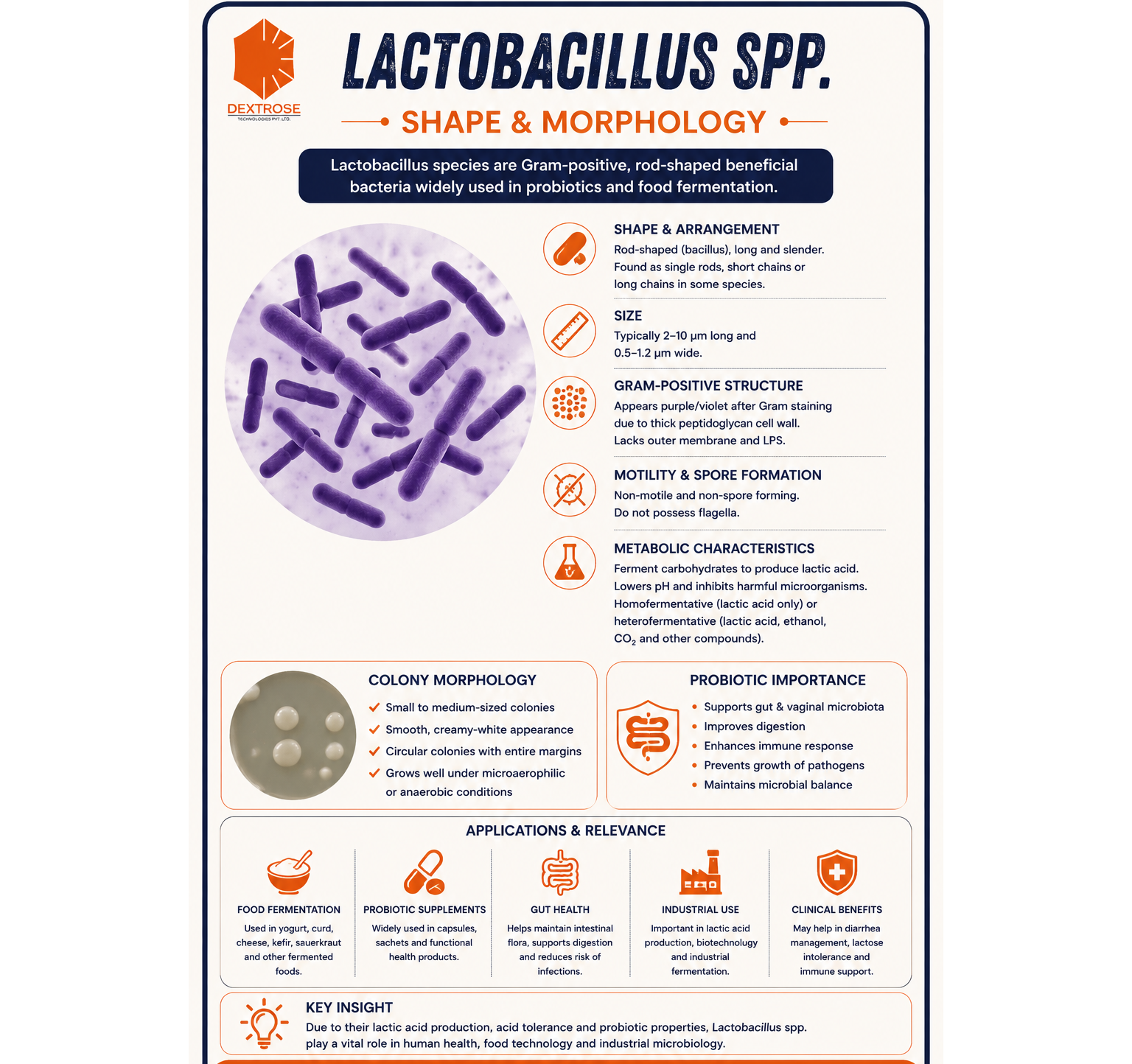
Lactobacillus species are Gram-positive, rod-shaped bacteria widely known for their beneficial role in human health, food fermentation, and probiotic applications. They are naturally found in the human gastrointestinal tract, oral cavity, and female reproductive tract, as well as in fermented foods such as yogurt and curd. These bacteria are important producers of lactic acid, which helps maintain microbial balance and inhibits pathogenic organisms.
>> Shape and Arrangement
Lactobacillus spp. exhibit a bacillus (rod-shaped) morphology. The cells may appear long, slender, or slightly curved, depending on the species and growth conditions. They are commonly found as:
Single rods
Short chains
Long chains in some species
Their arrangement contributes to efficient colonization and biofilm formation in natural habitats.
>> Size
The cells generally measure around 0.5–1.2 µm in width and 2–10 µm in length. Their elongated structure supports nutrient absorption and adaptation within acidic environments.
>> Cell Structure and Staining Characteristics
Lactobacillus species are Gram-positive bacteria, appearing purple/violet after Gram staining due to their thick peptidoglycan cell wall. Unlike Gram-negative bacteria, they lack an outer membrane and lipopolysaccharides (LPS).
Motility and Spore Formation
Most Lactobacillus species are:
Non-motile
Non-spore forming
They do not possess flagella and rely on environmental conditions and host interactions for distribution and colonization.
>> Metabolic Characteristics
A defining feature of Lactobacillus spp. is their ability to ferment carbohydrates into lactic acid. This acid production:
Lowers environmental pH
Prevents growth of harmful microorganisms
Supports gut and vaginal microbial balance
Some species are homofermentative (producing mainly lactic acid), while others are heterofermentative and produce additional compounds like ethanol and carbon dioxide.
>> Colony Morphology
On culture media, Lactobacillus typically forms:
✔️ Small to medium-sized colonies
✔️ Smooth, creamy-white appearance
✔️ Circular colonies with entire margins
Growth is often enhanced in microaerophilic or anaerobic conditions.
>> Probiotic Importance
Lactobacillus spp. are among the most widely used probiotic bacteria. They contribute to:
Improved digestion
Maintenance of gut microbiota
Prevention of pathogenic bacterial growth
Enhancement of immune responses
They are extensively used in:
🥛 Yogurt and dairy fermentation
💊 Probiotic supplements
🌱 Functional foods and nutraceuticals
>> Industrial and Clinical Relevance
These bacteria are important in:
Food preservation and fermentation
Production of lactic acid
Biotechnology and probiotic research
Certain species also play a role in preventing infections by maintaining healthy microbial flora in the body.
>> Key Insight
Due to their beneficial probiotic properties, acid tolerance, and fermentation ability, Lactobacillus spp. are considered essential microorganisms in food science, gut health research, and industrial microbiology.