

>> Overview
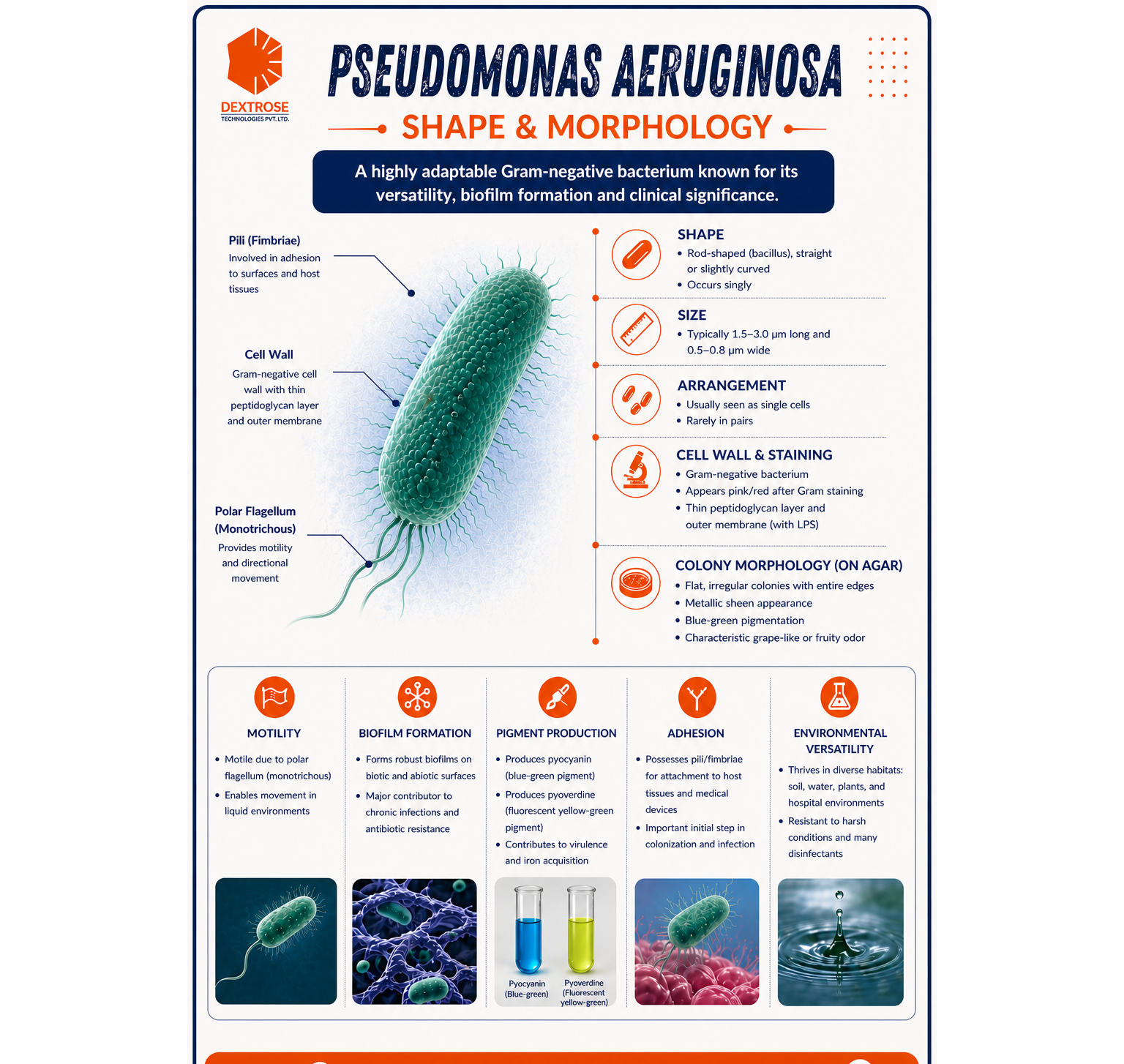
Pseudomonas aeruginosa is a Gram-negative, opportunistic pathogen widely recognized for its remarkable environmental adaptability and intrinsic resistance to antibiotics. It is commonly found in soil, water, and hospital environments, and is a major concern in clinical microbiology due to its role in chronic and hospital-acquired infections. Its ability to survive under diverse conditions makes it a highly resilient and clinically significant organism.
>> Shape and Arrangement
Pseudomonas aeruginosa exhibits a rod-shaped (bacillus) morphology, appearing as slender, straight cells. It is typically observed as single, independent cells, although occasional pairing may occur. This simple arrangement supports efficient nutrient uptake and mobility in various environments.
>> Size
The cells of P. aeruginosa generally measure around 1.5 to 3.0 micrometers in length and 0.5 to 0.8 micrometers in width. These dimensions contribute to its efficient metabolic activity and adaptability in both environmental and host-associated conditions.
>> Cell Structure and Staining Characteristics
Pseudomonas aeruginosa is a Gram-negative bacterium, which means it appears pink or red after Gram staining. This is due to the presence of a thin peptidoglycan layer and an outer membrane containing lipopolysaccharides (LPS). The outer membrane plays a crucial role in protecting the bacterium from harmful substances, including many antibiotics.
>> Motility
This bacterium is motile, possessing a single polar flagellum (monotrichous arrangement). This specialized structure enables directional movement and helps the organism navigate toward favorable environments, enhancing its survival and colonization capabilities.
>> Biofilm Formation
One of the most important features of Pseudomonas aeruginosa is its ability to form robust biofilms. Biofilms are structured communities of bacteria enclosed in a protective matrix, allowing them to adhere to surfaces such as tissues and medical devices. This capability significantly contributes to chronic infections and increased resistance to antibiotics and host immune responses.
>> Pigment Production
P. aeruginosa produces distinctive pigments that are important for its identification and pathogenicity. It synthesizes pyocyanin, a blue-green pigment responsible for its characteristic coloration, and pyoverdine, a fluorescent pigment involved in iron acquisition. These pigments also contribute to its virulence and survival.
>> Colony Morphology
On culture media, Pseudomonas aeruginosa typically forms flat, irregular colonies with a metallic sheen. The colonies often exhibit a blue-green pigmentation due to pyocyanin production. Additionally, they produce a characteristic grape-like or fruity odor, which is a notable diagnostic feature in microbiological laboratories.
>> Clinical Importance
Pseudomonas aeruginosa is an opportunistic pathogen capable of causing a wide range of infections, particularly in immunocompromised individuals. It is commonly associated with burn and wound infections, respiratory tract infections (especially in cystic fibrosis patients), urinary tract infections, and bloodstream infections. Its multidrug resistance (MDR) and ability to persist in hospital environments make it a significant challenge in healthcare settings.
>> Key Insight
Due to its biofilm-forming ability, pigment production, and strong resistance mechanisms, Pseudomonas aeruginosa remains a major focus in studies related to antimicrobial resistance and infection control.