

>> Overview
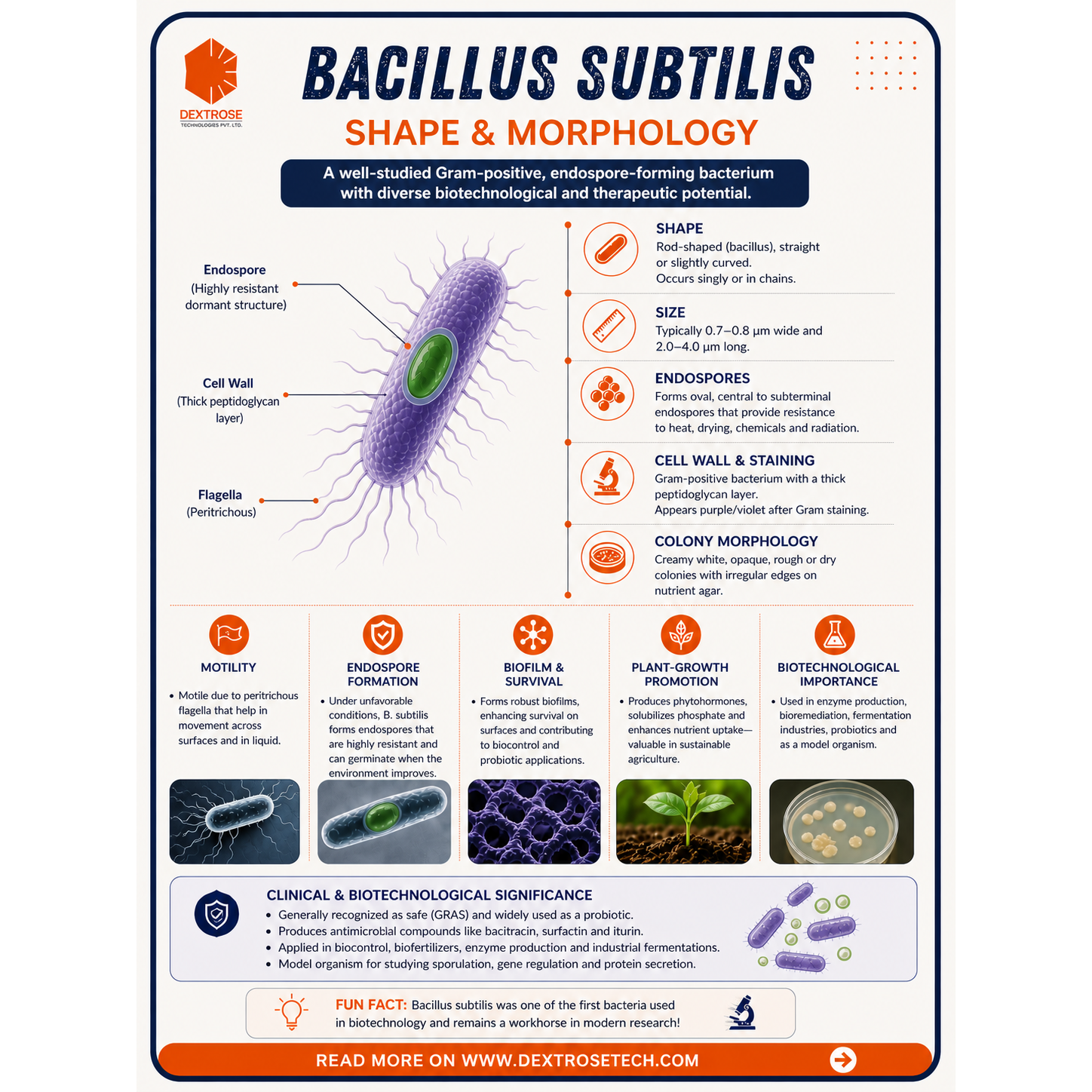
Bacillus subtilis is a Gram-positive, rod-shaped bacterium widely recognized for its ability to form endospores and survive under harsh environmental conditions. It is commonly found in soil and the gastrointestinal tract of animals and is extensively used as a model organism in microbiology and biotechnology due to its well-characterized genetics and safety profile.
>> Shape and Arrangement
Bacillus subtilis exhibits a rod-shaped (bacillus) morphology. The cells are generally straight or slightly curved and may occur singly or in chains, depending on growth conditions. This structural form enhances nutrient uptake and supports efficient cellular processes.
>> Size
The cells of B. subtilis typically measure around 2.0–4.0 µm in length and 0.7–0.8 µm in width. This relatively larger size compared to many bacteria allows for efficient metabolic activity and cellular differentiation, particularly during spore formation.
>> Endospore Formation
A defining feature of Bacillus subtilis is its ability to produce endospores, which are highly resistant, dormant structures formed under unfavorable environmental conditions. These endospores can withstand extreme heat, desiccation, radiation, and chemical exposure, allowing the bacterium to survive for extended periods. When conditions become favorable, the spores can germinate back into active vegetative cells.
>> Cell Wall and Staining Characteristics
Bacillus subtilis is a Gram-positive bacterium, meaning it retains the crystal violet stain and appears purple under a microscope. This is due to its thick peptidoglycan layer, which provides structural integrity and protection. Unlike Gram-negative bacteria, it lacks an outer membrane.
>> Motility
This bacterium is motile, possessing peritrichous flagella distributed around the cell surface. These flagella enable active movement in liquid environments and across surfaces, aiding in colonization and environmental adaptation.
>> Colony Morphology
On nutrient agar, Bacillus subtilis typically forms large, irregular, rough, and opaque colonies. The colonies often have dry or wrinkled surfaces with uneven edges, which helps distinguish them from smoother bacterial colonies.
>> Biofilm Formation and Survival
Bacillus subtilis has the ability to form biofilms, which are structured communities of bacteria attached to surfaces. Biofilm formation enhances survival by providing protection against environmental stress, antimicrobial agents, and host defenses. This feature is particularly important in both natural ecosystems and industrial applications.
>> Biotechnological Importance
Bacillus subtilis is widely used in biotechnology and industrial microbiology. It plays a key role in:
Enzyme production (proteases, amylases)
Bioremediation
Fermentation industries
Probiotic formulations
It also produces antimicrobial compounds such as bacitracin, surfactin, and iturin, making it valuable in research and agriculture.
>> Key Insight
Due to its endospore-forming ability, safety (GRAS status), and versatility, Bacillus subtilis is considered one of the most important organisms in microbiology, bridging fundamental research and real-world applications.