Bioinformatics
INR 6000
 08048047765
 Chat with us
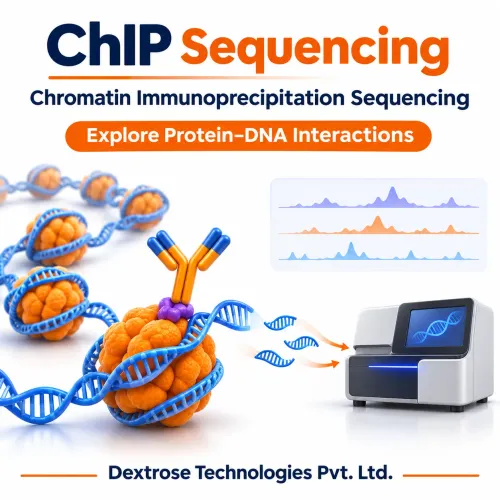
ChIP Sequencing — Chromatin Immunoprecipitation Sequencing Explore protein-associated DNA regions with Dextrose Technologies Pvt. Ltd. Our ChIP sequencing service generates sequencing data from chromatin immunoprecipitation-enriched DNA to support research into protein–DNA interactions, transcriptional regulation, and histone modifications. ChIP-Seq combines enrichment of DNA associated with a selected protein or histone mark with next-generation sequencing. Downstream analysis identifies regions of enrichment across the genome and supports investigation of their potential regulatory significance. Service Overview Submitted ChIP DNA is used to prepare a sequencing library, followed by 2 × 150 bp paired-end sequencing using the Illumina HiSeq platform specified in our service catalogue. The catalogue specifies 20 million reads per sample, counted as R1 + R2. The listed service begins with prepared ChIP DNA. Cell processing, chromatin preparation, antibody selection, and immunoprecipitation should be discussed separately if required. Applications • Mapping transcription factor-associated genomic regions. • Profiling selected histone modifications. • Investigation of gene regulatory regions. • Comparison of protein-associated DNA enrichment across experimental conditions. • Identification of candidate regulatory sequences for further validation. • Support for epigenetics, molecular biology, and functional genomics research. Sample Requirements • Sample type: Prepared ChIP DNA. • Required quantity: 5–10 ng per sample. • DNA fragment size: 200–500 bp. The catalogue does not specify DNA concentration, submission volume, or purity thresholds. Confirm acceptance criteria and transport conditions with our team before dispatch. Submission Information Clearly label each sample and provide the organism, sample source, target protein or histone mark, antibody details, ChIP protocol, DNA quantity, and available fragment-size assessment. Provide the study design, biological replicate information, and suitable control details. Discuss submission of matched input DNA or other appropriate controls, as control-based peak detection is included in the separately listed analysis workflow. Share the reference genome and annotation preference where available. Sequencing Deliverables • ChIP-Seq library preparation. • 2 × 150 bp paired-end Illumina HiSeq sequencing. • 20 million reads per sample, counted as R1 + R2. This represents 20 million individual reads across R1 and R2, rather than 20 million read pairs. Confirm data formats and whether controls require separate sequencing libraries during project planning. Additional Bioinformatics Analysis The catalogue lists ChIP-Seq bioinformatics as a separate service. When included in the agreed scope, it covers: • Alignment of quality-filtered reads to a reference genome. • Peak detection using control samples. • Annotation of peaks and nearby genes. • Gene Ontology and pathway enrichment analysis. • Motif identification. Confirm the peak-calling approach, comparison groups, and output formats before analysis begins. Requirements differ between sharply localised binding sites and broadly distributed histone marks. Interpretation Results depend on antibody specificity, ChIP enrichment, sample quality, sequencing depth, and experimental controls. A peak indicates enrichment under the analysis conditions; further evidence may be needed to establish its regulatory function. Turnaround Time Sequencing: 3–4 weeks. Bioinformatics analysis: Enquire for the applicable timeline.