Thank you for writing to us. One of our executive will reach back to you through your submitted medium. In case there’s an urgency, feel free to connect over WhatsApp for faster response.
Prefer calling? Dial +918042753298 (International callers) or 08042753298 (Indian callers).
At Dextrose Technologies Pvt. Ltd., we provide Plagiarism/Similarity and AI-content screening to help researchers and organizations ensure documents are submission-ready, original, and compliant with journal/university expectations. Our service focuses on identifying risk areas early and improving writing quality through ethical corrections—without compromising scientific meaning.
What we do
Plagiarism / Similarity Screening: Identify high-similarity sections, source overlap patterns, and citation gaps.
AI-Content Screening (as applicable): Flag sections that may be interpreted as AI-generated or overly generic, and recommend improvements for authenticity and clarity.
Citation & Paraphrasing Review: Improve attribution, strengthen paraphrasing, and reduce accidental similarity while preserving technical accuracy.
Submission-Readiness Guidance: Provide a clear action list to align with your target journal/university policies.
What you receive
* Similarity screening summary (overall + section-wise risk highlights)
* Marked-up document notes (problem paragraphs and recommended fixes)
* Ethical rewrite guidance (clarity + originality improvements)
* Final readiness checklist for submission
Compliance note
This service is intended for academic and publishing integrity. We do not support bypassing detection systems or misrepresenting authorship.
At Dextrose Technologies Pvt. Ltd., we provide Thesis-to-Paper Conversion Assistance to help researchers transform thesis work into journal-ready research papers. We restructure thesis chapters into a concise manuscript format, tighten the scientific narrative, and align the content to journal expectations—so you can publish faster without losing technical depth.
What we support
Journal-style restructuring (IMRaD): converting thesis content into Introduction, Methods, Results, Discussion
Storyline and scope refinement: selecting publishable objectives and building a focused narrative
Figure/table conversion: redesigning thesis tables/figures into journal-ready formats (captions, numbering, clarity)
Results summarization: prioritizing key outcomes, removing repetition, improving flow
Reference cleanup and journal formatting: citation style, reference consistency, and formatting compliance
Plagiarism compliance support: ethics-aligned rewriting and proper citation practices
Target journal alignment: scope matching, word limits, section limits, and submission-readiness checks
Cover letter support (if required)
What you receive
* A submission-ready manuscript draft derived from your thesis
* Reformatted figures/tables and cleaned references
* Journal alignment checklist and final review notes
Get started
Share your thesis PDF/chapters, target journal (or subject area), and which chapters/results you want to publish. We’ll propose the best paper structure and conversion plan.
At Dextrose Technologies Pvt. Ltd., we provide thesis writing assistance to help students and researchers convert their work into a well-structured, academically compliant thesis. Whether you are at proposal stage, mid-draft, or final submission, we support chapter structuring, technical writing, editing, formatting, and data presentation—so your thesis is clear, consistent, and ready for review.
What we support
Thesis structure and chapter planning (Introduction, Literature Review, Methods, Results, Discussion, Conclusion)
Drafting and rewriting support based on your data, notes, and supervisor requirements
Scientific editing and language refinement for clarity, flow, and technical accuracy
Tables, figures, and result presentation (captions, consistency, layout)
Reference management and formatting (university style guidelines)
Plagiarism compliance support (ethics-aligned rewriting and citation best practices)
Final submission formatting (templates, pagination, headings, annexures)
What you receive
* Chapter-wise drafts or edits with clear academic tone
* Consistent formatting aligned to your university template
* Final submission checklist and readiness review notes
Get started
Share your thesis topic, degree level, university format/template, and what you already have (outline, draft chapters, data, references). We’ll recommend the fastest path to a submission-ready thesis.
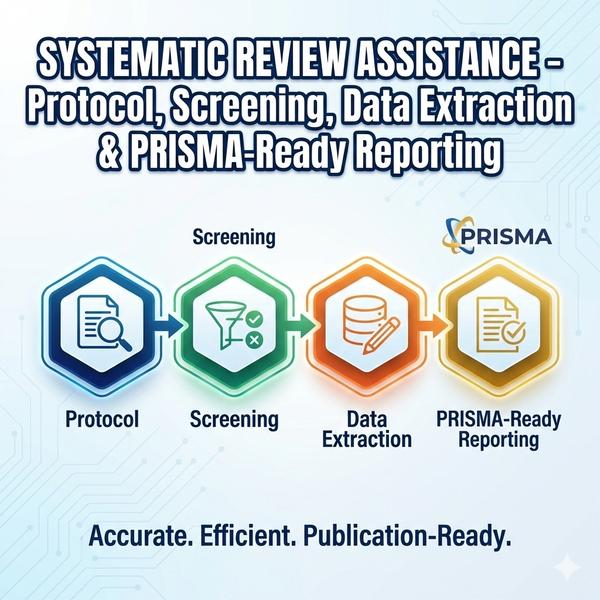
At Dextrose Technologies Pvt. Ltd., we provide systematic review assistance to help research teams plan, execute, and report systematic reviews with strong methodology and PRISMA-aligned structure. We support the end-to-end workflow—from protocol development to screening, data extraction, synthesis, and manuscript preparation—so your review is transparent, reproducible, and submission-ready.
What we support
Research question framing (PICO/PEO) and eligibility criteria
Protocol development (methods, outcomes, search strategy structure)
Search strategy support (keywords, Boolean strings, databases to include—client-led access)
Screening support (title/abstract and full-text screening workflows, tracking reasons for exclusion)
PRISMA flow diagram inputs and documentation structure
Data extraction templates and consistency checks
Quality appraisal support (tool selection and structured reporting, scope-dependent)
Evidence synthesis (narrative synthesis; meta-analysis support if data permits and scope is agreed)
PRISMA-style manuscript drafting, tables, and formatting
What you receive
* Systematic review protocol + structured screening workflow
* Data extraction sheets and evidence tables
* PRISMA-ready reporting components (flow inputs, summary tables)
* Manuscript draft with transparent methods and clear conclusions
Get started
Share your topic, population/intervention/outcomes (or equivalent), databases you plan to use, and whether you need meta-analysis or narrative synthesis only.
At Dextrose Technologies Pvt. Ltd., we provide review article writing assistance to help you build a clear, well-structured, and publication-ready review paper. We support the full workflow—from outlining the review and organizing themes to drafting, editing, and formatting—so your manuscript reads coherently, stays focused, and aligns with journal expectations.
What we support
Topic refinement and review scope definition (narrative review / mini-review / systematic-style structure as required)
Literature organization and thematic structuring (concept map, key sections, gaps, and future directions)
Review manuscript drafting with strong scientific flow and logical transitions
Critical synthesis support (evidence comparison, limitations, and research gap framing)
Figures and tables support (summary tables, comparison matrices, concept diagrams—scope dependent)
Reference management and journal formatting (citation style, headings, word limits)
Plagiarism compliance support (ethics-aligned rewriting and citation best practices)
Cover letter and response-to-reviewers support (if required)
What you receive
* A structured review article draft with clear sectioning and narrative flow
* Summary tables/figure captions (if applicable)
* Journal-ready formatting and a submission-readiness checklist
Get started
Share your topic area, preferred review type (narrative/systematic-style), target journal (if any), and any key papers you want included. We’ll create the outline and draft plan accordingly.
At Dextrose Technologies Pvt. Ltd., we provide research article writing assistance to help you convert your study data into a clear, publication-ready manuscript. Whether you have only results and notes or an existing draft, we support end-to-end writing and refinement—aligned to your target journal’s scope and formatting requirements.
What we support
Manuscript drafting (IMRaD): Introduction, Methods, Results, Discussion, Conclusion
Abstract and keywords creation aligned to journal style
Scientific editing: clarity, flow, technical accuracy, and language polishing
Results presentation: tables, figure captions, and structured reporting of findings
Reference management and formatting: journal-specific citation style
Journal formatting support: layout, headings, word limits, and submission checks
Plagiarism compliance support: best-practice rewriting and similarity reduction (ethics-aligned)
Cover letter and response-to-reviewers support (if needed)
What you receive
* A structured, submission-ready manuscript draft
* Edited tables/figures captions and consistent formatting
* Final review notes and next-step guidance for submission
Get started
Share your study title/topic, target journal (if any), and what you already have (data, draft, or outline). We’ll structure the paper and move it to a submission-ready format.
At Dextrose Technologies Pvt. Ltd., we provide Professional Writing Assistance to help individuals and organizations communicate complex work with clarity and credibility. We support scientific, technical, academic, and business writing with structured drafting, editing, and formatting—so your documents are ready for review, submission, or stakeholder communication.
What we support
Scientific and technical writing: protocols, technical notes, method write-ups, study summaries
Academic writing support: thesis/dissertation structuring, research summaries, abstracts, SOP-style documentation
Business and corporate writing: proposals, capability statements, presentations, reports, emails, and documentation
Editing and rewriting: clarity improvement, language refinement, tone alignment, and consistency
Formatting and submission readiness: references, tables/figures, templates, and style compliance (scope-dependent)
What you receive
* Clean, structured drafts tailored to your purpose and audience
* Editing with improved readability and technical accuracy (based on provided inputs)
* Consistent formatting and a final, submission-ready document
Get started
Share the document type, target audience, required format (if any), and your current draft or inputs. We’ll recommend the fastest path to a high-quality final version.
At Dextrose Technologies Pvt. Ltd., we provide end-to-end publication support to help researchers convert study outputs into a submission-ready manuscript with clear structure, strong scientific language, and journal-compliant formatting. We support the full workflow—from planning the manuscript to final checks—so you can reduce delays, improve presentation quality, and submit with confidence.
What we support
Manuscript writing support (IMRaD structure: Introduction, Methods, Results, Discussion) based on your data and study notes
Scientific editing and language refinement for clarity, flow, and technical accuracy
Journal selection support (scope-based recommendations aligned to your domain and indexing preferences)
Formatting as per journal guidelines (references, figures, tables, word limits, style)
Plagiarism compliance support (best-practice checks and rewriting guidance)
Figures, tables, and graphical abstract support (as required)
Cover letter and response-to-reviewers drafting support (when needed)
Submission-readiness checklist to reduce avoidable rejections
What you receive
* A structured, submission-ready manuscript draft
* Edited figures/tables with consistent formatting
* Reference manager-ready bibliography formatting (as applicable)
* Final review notes and next-step guidance for submission
Who it’s for
Academic researchers, PhD scholars, clinicians, and R&D teams working in life sciences, biotech, pharma, materials, and healthcare research.
Get started
Share your manuscript stage (data only / draft / near-final), target journal (if any), and your study type. We’ll recommend the most efficient publication support plan
At Dextrose Technologies Pvt. Ltd., we provide Scientific Support Services that combine professional consultation, technical guidance, and documentation support for projects in life sciences, pharmaceuticals, and healthcare research. Our goal is to help teams plan better studies, choose the right methods, generate high-quality data, and present results clearly for review, publication, or internal decision-making.
Technical Consultation
Research planning and experimental design aligned to your objective and constraints
Feasibility assessment and method selection (analytical and biological workflows)
Workflow optimization to improve turnaround, reproducibility, and data quality
End-to-end project guidance from planning to reporting
Scientific Writing & Documentation Support
Research manuscript writing and editing (structure, clarity, journal readiness)
Thesis and dissertation support (technical refinement and formatting)
Grant proposals and technical documentation for academic and industry needs
Journal formatting and plagiarism compliance support (tools/format alignment as required)
Medical & Dental Research Support
Dental product testing support (scope-dependent)
Medical research design and analytical assistance for research-driven projects
Exploratory and preclinical study support (research scope; not clinical decision-making)
Statistical & Data Analysis
Statistical analysis of experimental datasets based on study design
Graphs, tables, and result visualization for clear communication
Interpretation support for publications, technical reports, and presentations
Applications
Academic research projects, pharma and biotech R&D, healthcare research studies, product testing projects, and publication-focused documentation.
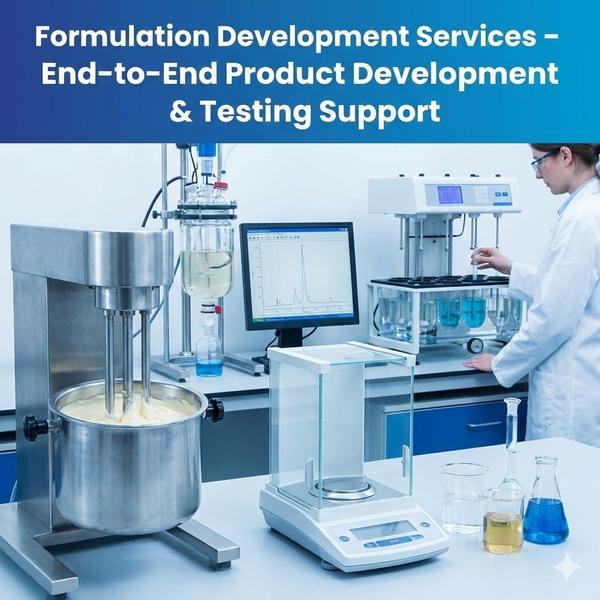
At Dextrose Technologies Pvt. Ltd., we provide end-to-end formulation and product development support for pharmaceuticals, nutraceuticals, cosmetics, and research-driven products. Our services are built for early-stage R&D, proof-of-concept development, and pilot-scale readiness, helping you move from concept to a stable, testable prototype with clear documentation.
Our Formulation Capabilities
Custom formulation development based on client requirements and target product profile
Excipient selection and compatibility assessment to reduce instability and performance risk
Lab-scale prototype development for rapid iteration and proof-of-concept
Optimization of composition, stability, and performance through structured experiments
Product Testing & Evaluation
Physicochemical characterization of formulations (as applicable to product type)
Stability and compatibility studies for shelf-life and robustness insight
Performance and comparative testing across formulations/batches
Analytical testing support using advanced instrumentation (HPLC/GC/LCMS, particle sizing, thermal, etc. – scope dependent)
Documentation & Reporting
Technical and development reports with clear conclusions
Data interpretation and result summaries for faster decision-making
Client-specific report formats for internal R&D and QA review
Support documentation for regulatory-style and academic use (scope dependent)
Applications
Pharmaceutical formulations, nutraceutical products, cosmetic formulations, research prototypes, and specialty chemical products.
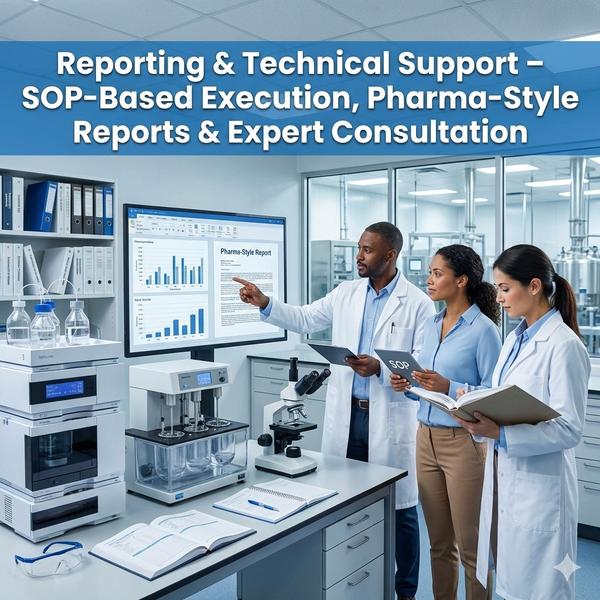
At Dextrose Technologies Pvt. Ltd., our Reporting & Technical Support ensures your experiments translate into clear conclusions, usable documentation, and faster decisions. We follow SOP-based execution, maintain traceable records, and deliver structured reports that match research and pharma expectations. Along with reporting, we provide interpretation and consultation support so your team can confidently plan next steps and reduce trial-and-error.
SOP-Based Experimental Execution
We execute studies using standardized workflows with documented sample handling, experimental conditions, and run notes to improve repeatability and data quality.
Research and Pharma-Style Reports
You receive clean, review-ready reports including objective, method summary, results tables, calculations basis (as applicable), observations, and clear conclusions—aligned to internal QA or client documentation needs.
Data Interpretation and Consultation Support
We explain what the data means, highlight risks or anomalies, and recommend practical next experiments or confirmations to strengthen your development pathway.
Deliverables
* SOP-style execution notes and conditions
* Results tables and supporting plots/images (as applicable)
* Final report in research/pharma-style format
* Interpretation summary and consultation notes
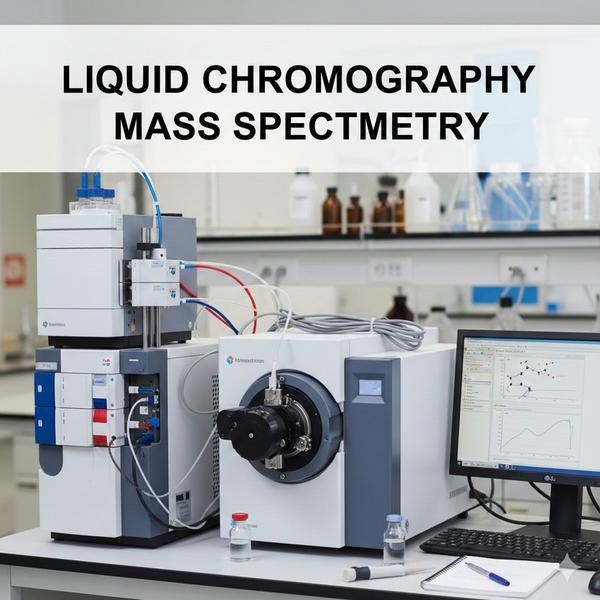
At Dextrose Technologies Pvt. Ltd., we provide Rotary Evaporator (Rotavap) concentration to efficiently remove solvents and concentrate extracts under controlled conditions. Rotary evaporation is ideal for natural product research, bioactive fraction preparation, and pre-analytical workflows where you need gentle, efficient solvent removal before downstream testing (GCMS, LCMS, HPLC) or formulation steps.
What we support
Solvent removal from extracts and reaction mixtures
Concentration of plant/microbial extracts and bioactive fractions
Reduction of volume to improve handling, storage, and analytical readiness
Support for solvent exchange (scope-dependent)
Why rotary evaporation
Concentration under reduced pressure helps lower effective boiling temperature
Suitable for heat-sensitive samples when parameters are controlled
Produces cleaner, manageable concentrates for repeat analysis
Deliverables
Concentrated extract (volume/format as agreed)
Process notes (solvent, temperature range, vacuum conditions as applicable)
Optional: guidance for storage and next-step analysis
Get started
Share your solvent type, starting volume, sample sensitivity, and target final volume/consistency. We’ll recommend the best rotavap settings and handover format.
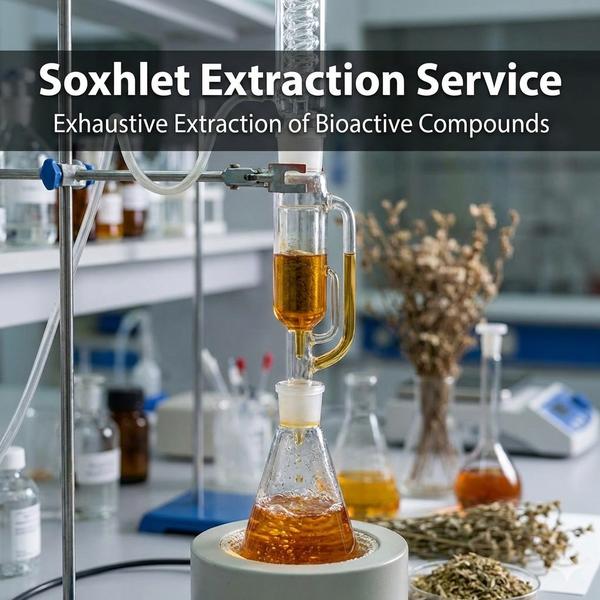
At Dextrose Technologies Pvt. Ltd., we offer Soxhlet Extraction for exhaustive extraction of bioactive compounds from solid matrices such as plant materials, powders, biomass, and formulated solids. Soxhlet enables continuous solvent reflux and repeated washing of the sample, delivering efficient recovery of solvent-soluble constituents for natural product research, fraction preparation, and downstream analytical testing.
What Soxhlet extraction is used for
Recovery of bioactive fractions from herbs, botanicals, and biomass
Extraction of lipids, oils, and non-polar to mid-polar compounds (solvent-dependent)
Preparation of concentrated extracts for GCMS, LCMS, HPLC, or bioactivity screening
Comparative extraction studies across batches or raw materials
How we execute
Solvent selection and extraction conditions are set based on your target (non-polar/polar fraction)
Controlled extraction time to ensure exhaustive recovery
Filtration and solvent removal/concentration support (scope-dependent)
Clear labeling and sample traceability
Deliverables
Extract (concentrated or crude, as agreed)
Process notes (solvent used, duration, sample weight, yield %)
Optional: guidance for storage and next-step analysis (GCMS/LCMS/HPLC)
Get started
Share your sample type, target compound class (oil/alkaloids/phenolics etc.), preferred solvent (if any), and the intended downstream analysis.
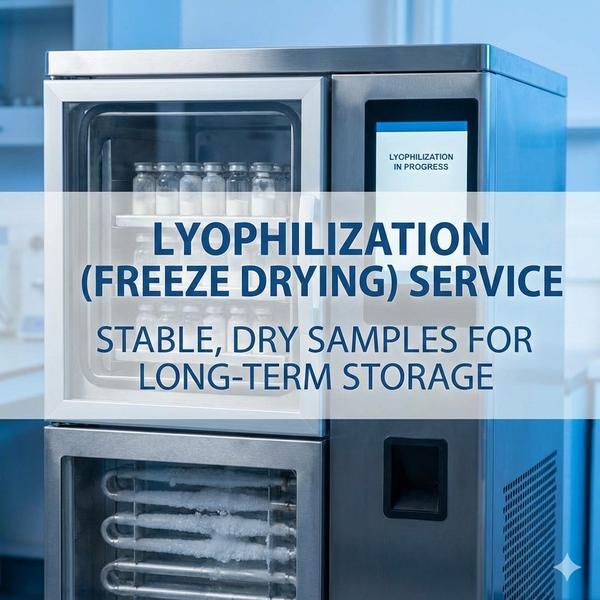
At Dextrose Technologies Pvt. Ltd., we offer Lyophilization (Freeze Drying) to convert liquid or moisture-rich samples into a stable, dry format for long-term storage, improved shelf-life, and easier transport. Lyophilization is ideal for sensitive biological and natural-product samples where heat-based drying can damage bioactivity or alter composition.
What we support
Freeze drying of biological samples (research-grade)
Natural product extracts and bioactive fractions requiring gentle drying
Moisture reduction for stability, storage, and downstream testing
Pre-analytical preparation for GCMS, LCMS, and HPLC (sample stabilization and concentration support)
Why lyophilization helps
Preserves sensitive components by avoiding high-temperature drying
Reduces degradation risk during storage
Enables consistent reconstitution for repeat testing and comparisons
Deliverables
Lyophilized sample output (dry powder/cake as applicable)
Process notes (basic run details as applicable)
Optional: guidance for reconstitution and storage handling
Get started
Share your sample type (liquid/extract/broth), approximate volume, and storage goal. We’ll recommend the best lyophilization approach and handover format.
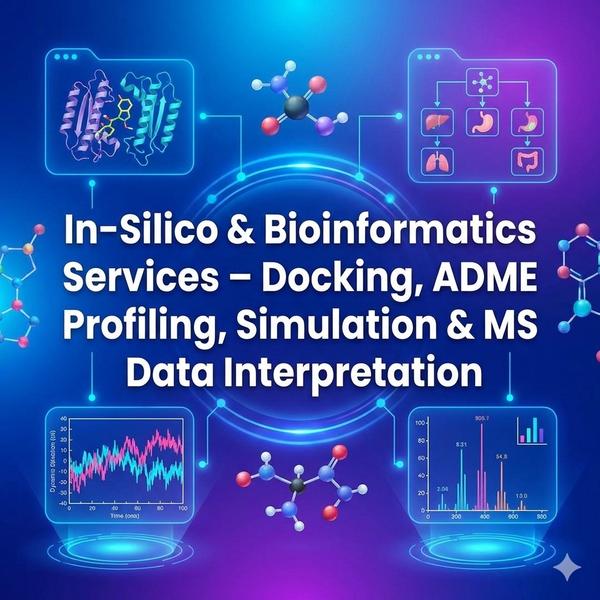
At Dextrose Technologies Pvt. Ltd., we provide in-silico and bioinformatics support to accelerate research decisions through computational analysis and structured interpretation. Our services cover molecular docking, in-silico ADME profiling, ligand–protein interaction simulations, and MS data interpretation for proteomics/metabolomics workflows—delivered with clear documentation and actionable insights.
Molecular Docking Studies
We perform docking studies to predict binding orientation and interaction patterns between ligands and target proteins, supporting hit prioritization and hypothesis building.
ADME Profiling (In-silico)
We generate in-silico ADME profiles to support early screening of drug-likeness and development risk (absorption, distribution, metabolism, excretion—scope dependent on project needs).
Simulation Studies (Ligand–Protein Interaction)
We support simulation-based evaluation of ligand–protein interactions (project scope dependent) to assess interaction stability and key binding drivers beyond docking snapshots.
MS Data Interpretation (Proteomics / Metabolomics Support)
We support interpretation of mass spectrometry datasets for proteomics/metabolomics projects by structuring outputs, summarizing key findings, and providing interpretation notes aligned to your research objective (dependent on the data format and workflow).
Deliverables
* Study summary and inputs used (structures, parameters, databases/tools)
* Docking outputs and interaction summaries (poses, key residues)
* In-silico ADME summary tables (as applicable)
* Simulation summary metrics and interpretation (as applicable)
* MS data interpretation summary and structured report (as applicable)
Get started
Share your target protein (PDB ID if available), ligand list (SMILES/SDF), and study goal (screening, lead optimization, or mechanism insight). For MS interpretation, share the data type (proteomics/metabolomics) and file formats.
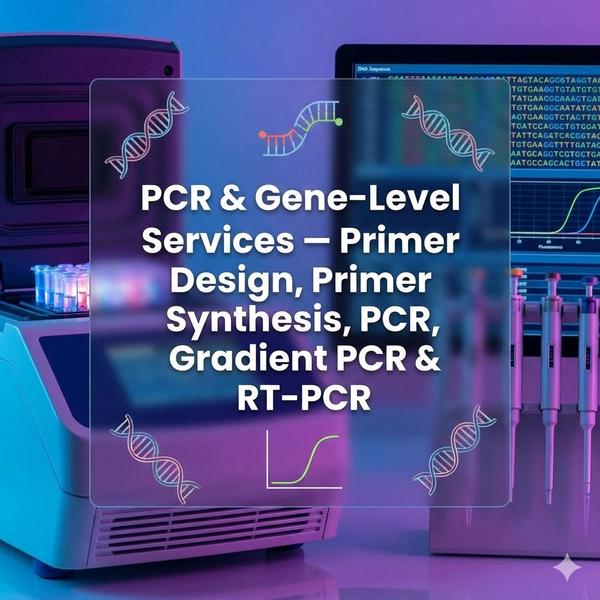
At Dextrose Technologies Pvt. Ltd., we provide PCR and gene-level services to support rapid detection, target confirmation, and research workflows. From target-specific primer design to PCR execution and reporting, we deliver clear, reproducible outputs for academic, industrial, and R&D applications.
Primer Design (Target-Specific)
We design primers based on your target gene/region and intended application (detection, confirmation, or expression studies). Designs are optimized for specificity, amplicon size, and assay conditions.
Primer Synthesis (Research Grade)
We support research-grade primer synthesis and coordinate delivery based on your required scale and format.
PCR Services
Conventional PCR: Target amplification for detection, confirmation, and downstream sequencing.
Gradient PCR: Optimization of annealing temperature to improve specificity and yield, especially for new primer sets or challenging templates.
RT-PCR (Gene Expression / Detection Studies)
We support RT-PCR workflows for gene expression and detection studies (scope dependent on sample type and experimental design), with structured reporting aligned to your objective.
Deliverables
* Primer details and assay conditions (as applicable)
* PCR/RT-PCR results summary with interpretation notes
* Gel images (for conventional PCR) and run documentation
* Recommendations for sequencing confirmation when required
Get started
Share your target gene/organism, sample type (DNA/cDNA), expected amplicon size, and objective (detection/confirmation/expression). We’ll recommend the most suitable workflow.
At Dextrose Technologies Pvt. Ltd., we provide advanced genomics services to support deeper genetic characterization, variant analysis, and sequencing-based insights for research and applied projects. From microbial whole genome sequencing to targeted DNA sequencing, we deliver structured outputs with interpretation-focused reporting.
Whole Genome Sequencing (WGS) – Microbial genome characterization
We support microbial WGS to enable genome-level characterization, strain comparison, and genetic feature discovery (project scope dependent), with deliverables designed for research workflows.
Whole Exome Sequencing (WES) – Coding-region variant analysis
We support WES for coding-region variant analysis with defined study goals and reporting scope (research use; clinical interpretation requires appropriate clinical oversight).
DNA Sequencing (Sanger / NGS-based applications)
We support Sanger sequencing for targeted confirmation and NGS-based applications for broader sequencing needs. Approach is selected based on target region size, sample count, and required resolution.
Deliverables
* Raw data files (as applicable) + processed outputs
* QC summary (read quality/coverage metrics as applicable)
* Variant/annotation outputs (as per scope)
* Clear interpretation notes and limitations aligned to intended use
Get started
Share organism/sample type, number of samples, study objective (strain typing/variant analysis/target confirmation), and whether you need Sanger, targeted NGS, WGS, or WES. We’ll recommend the right workflow and reporting format.
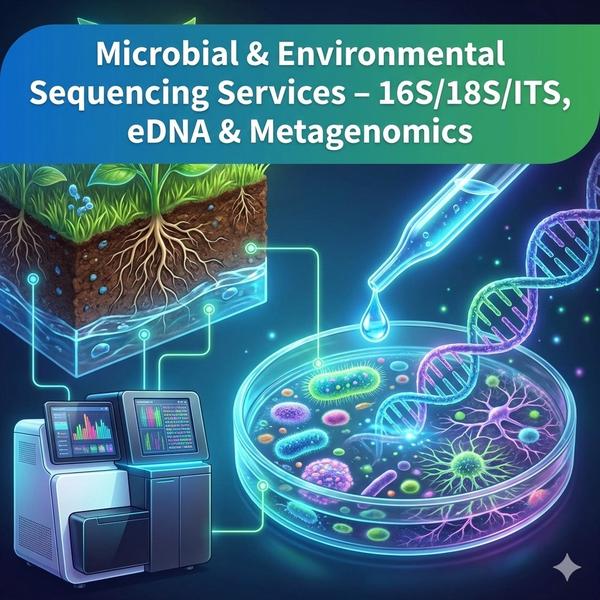
At Dextrose Technologies Pvt. Ltd., we provide microbial and environmental sequencing services to support accurate organism identification, taxonomy, and community profiling for research, ecology, and industrial monitoring. From single-isolate identification to complex mixed-community analysis, we deliver clear, interpretation-focused outputs that help you move from sequence data to actionable insight.
16S rRNA Sequencing (Bacterial identification & phylogeny)
We use 16S rRNA sequencing to identify bacteria and support phylogenetic analysis for isolates or sample-derived bacterial DNA.
18S rRNA Sequencing (Eukaryotes & protozoa)
18S rRNA sequencing supports identification of eukaryotic organisms including protozoa and broader eukaryotic diversity assessments.
Fungal Sequencing (ITS/18S) – Fungal taxonomy
We support accurate fungal identification using ITS and/or 18S targets depending on your sample type and taxonomic resolution needs.
Algae Sequencing – Species ID and diversity
We support algae identification and diversity studies using suitable marker targets based on your project objective.
Environmental DNA (eDNA) Analysis
We analyze eDNA from environmental samples to support biodiversity assessment and environmental monitoring without requiring organism isolation.
Metagenomic Sequencing (Bacteria & Fungi)
We support community profiling of bacteria and fungi from mixed samples using metagenomic/amplicon-based approaches (scope-dependent), enabling insights without culturing.
Deliverables
* Raw sequencing files + processed outputs (as per scope)
* Taxonomic identification/profile summary
* Basic diversity outputs (where applicable)
* Clear interpretation notes and limitations (so results are used correctly)
Get started
Share sample type (isolate/swab/soil/water), number of samples, expected organisms, and whether you need ID (single organism) or community profiling (metagenomics). We’ll recommend the right marker and workflow.
At Dextrose Technologies Pvt. Ltd., our Technical Reporting & Failure Analysis Support ensures you don’t just receive raw outputs—you receive clear conclusions, high-quality visuals, and documentation that stands up to review. We combine SOP-driven execution with expert interpretation to support R&D decisions, QC investigations, and client submissions.
SOP-Driven Testing
All testing is performed using standardized workflows with traceable sample handling and documented instrument/test conditions.
High-Resolution Images and Data Interpretation
We provide high-resolution images and structured interpretation to highlight critical observations, anomalies, and trends—so your team can act quickly and confidently.
Client-Specific, Regulatory-Style Reports
We deliver clean, review-ready reports aligned to your format needs, including results tables, images/plots, method notes, and clear conclusions.
Comparative and Failure Analysis Studies
We support comparative studies across batches/conditions and root-cause investigations for defects, contamination, and performance issues—linking evidence to actionable insights.
At Dextrose Technologies Pvt. Ltd., we provide UTM (Universal Testing Machine) services for mechanical characterization of materials through tensile, compression, and flexural testing. UTM testing helps quantify strength, stiffness, ductility, and durability, enabling material selection, batch comparison, product validation, and failure investigations across polymers, composites, metals, and engineered materials (test feasibility depends on specimen geometry and standard followed).
Tensile Testing
We measure tensile properties such as ultimate tensile strength, yield behavior, elongation, and modulus, supporting performance benchmarking and quality checks.
Compression Testing
We evaluate compressive strength and deformation behavior for materials used in structural, packaging, and functional applications.
Flexural (Bending) Testing
We assess flexural strength and flexural modulus to understand resistance to bending loads, especially relevant for plastics, composites, and brittle materials.
Mechanical strength and durability assessment
We support comparative testing across batches and conditions to evaluate durability trends and performance consistency.
Deliverables
* Force–displacement and/or stress–strain data (as applicable)
* Key mechanical parameters (strength, modulus, elongation, etc.)
* Test conditions and specimen details (as provided/standardized)
* Summary interpretation for material performance evaluation
Get started
Share your material type, specimen dimensions/standard (if any), number of samples, and required test (tensile/compression/flexural). We’ll recommend the right setup and reporting format.
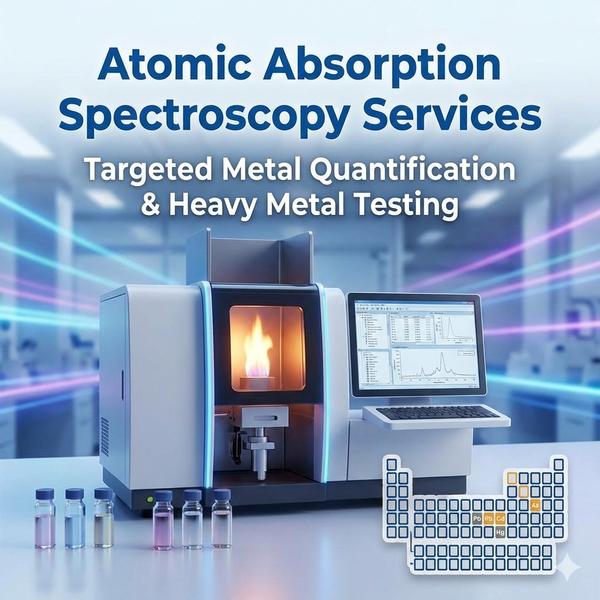
At Dextrose Technologies Pvt. Ltd., we offer Atomic Absorption Spectroscopy (AAS) for accurate, targeted metal quantification in APIs, excipients, formulations, and raw materials. AAS is well suited when you need focused testing of specific metals with dependable calibration-based reporting. We support heavy metal testing and routine elemental checks for quality, troubleshooting, and compliance-focused workflows (scope and limits defined by your requirement).
Targeted metal quantification
We quantify selected metals based on your target list and matrix, with results reported in clear units (ppm/ppb or mg/L as required).
Heavy metal testing in APIs, excipients, and formulations
We test for heavy metals in pharmaceutical and formulation samples to support QC decisions and risk evaluation, with clean documentation and structured reporting.
Deliverables
* Metal-wise concentration results with units
* Method notes and sample preparation basis (as applicable)
* Calibration approach and QC checks (as agreed)
* Summary interpretation highlighting any outliers
Get started
Share your sample type, target metal list, required limits, and reporting units. We’ll recommend the most suitable AAS workflow.
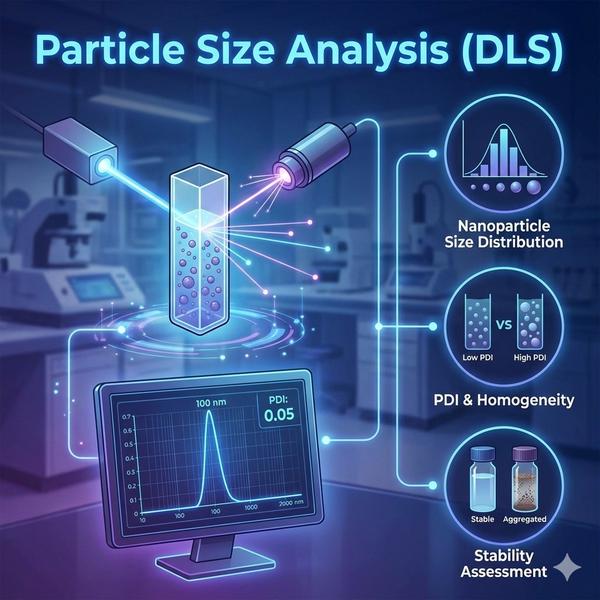
At Dextrose Technologies Pvt. Ltd., we offer Particle Size Analysis using Dynamic Light Scattering (DLS) to measure nanoparticle size distribution, polydispersity index (PDI), and dispersion stability. DLS is a fast, reliable method for characterizing nanoformulations, colloids, emulsions, and particle dispersions, helping you confirm batch consistency and detect aggregation early.
Nanoparticle size distribution
We measure hydrodynamic particle size in the nanometer range and provide distribution outputs suited to your sample type and objective.
Polydispersity and stability assessment
We report PDI and support stability screening by comparing size/PDI across timepoints or conditions (pH, ionic strength, dilution, storage), enabling quick decisions on formulation robustness.
Deliverables
* Particle size distribution and key size metrics (as applicable)
* PDI values with measurement conditions
* Comparative summary across batches/conditions
* Interpretation notes focused on stability and optimization actions
Get started
Share your sample type, medium (solvent/buffer), expected size range, and concentration. We’ll recommend the right DLS measurement plan and reporting format.
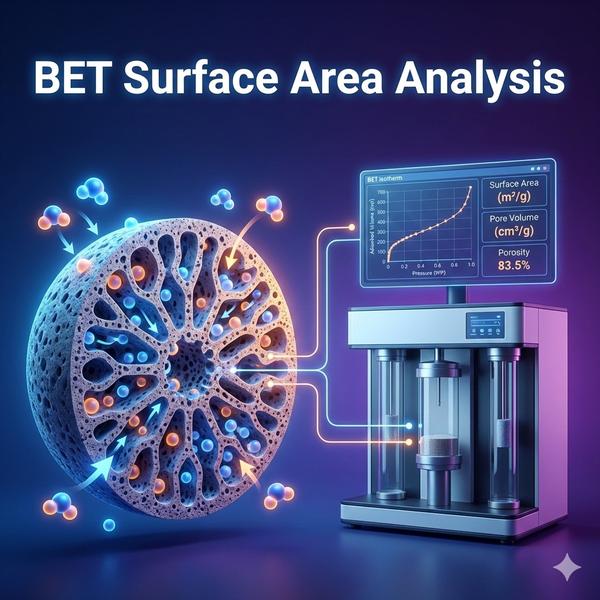
At Dextrose Technologies Pvt. Ltd., we provide BET (Brunauer–Emmett–Teller) surface area analysis to quantify specific surface area and evaluate porosity-related properties of powders and porous materials. BET testing is widely used for catalysts, adsorbents, carbon materials, metal oxides, ceramics, and porous solids, helping you correlate surface area and pore structure with performance and batch consistency.
Surface area determination
We determine specific surface area (m²/g) using gas adsorption methods and provide comparative summaries across batches or processing conditions.
Pore size and volume analysis
We support pore characterization by reporting pore volume and pore size distribution (as per method scope), useful for adsorption performance, filtration behavior, and material selection.
Catalyst, adsorbent, and material evaluation
BET helps evaluate catalysts and adsorbents for surface activity, and supports material QC by tracking porosity changes due to synthesis, activation, milling, or heat treatment.
Deliverables
* BET surface area (m²/g)
* Pore volume and pore size distribution (as applicable)
* Isotherm plots/data summary and key parameters
* Interpretation notes for batch comparison and performance relevance
Get started
Share your material type, expected surface area range, degassing conditions (if known), and objective (QC, R&D, catalyst/adsorbent evaluation). We’ll recommend the right BET scope and reporting format.
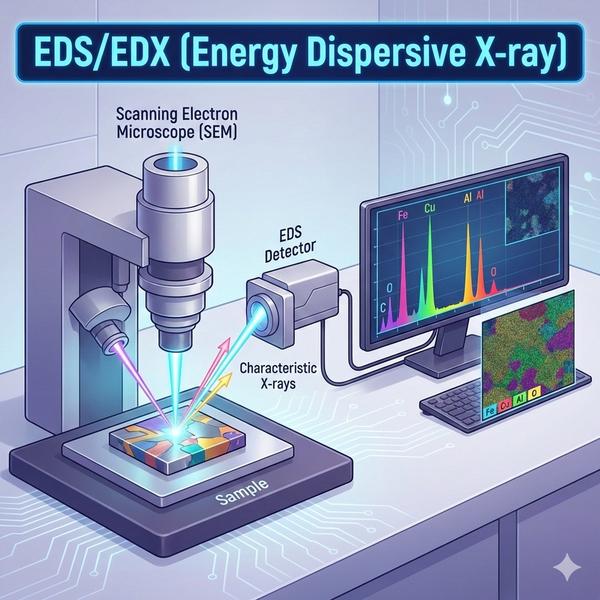
At Dextrose Technologies Pvt. Ltd., we provide EDS/EDX (Energy Dispersive X-ray Analysis)—typically integrated with SEM—to deliver elemental composition and spatial mapping of materials. EDX helps identify what elements are present, where they are located, and how they are distributed, making it highly effective for contamination investigations, impurity localization, and surface/cross-sectional studies.
Elemental composition and mapping
We perform spot/area analysis and elemental mapping to understand composition and distribution trends across regions of interest.
Contaminant and impurity localization
EDX is ideal for identifying foreign particles, inclusions, deposits, corrosion products, and process contaminants by pinpointing elemental signatures at the defect site.
Surface and cross-sectional analysis
We support surface and cross-sectional evaluation (sample-prep dependent) to assess coatings, layers, diffusion regions, and interface contamination.
Deliverables
* Elemental spectra with identified peaks
* Quant summary (wt%/at% as applicable)
* Elemental maps and/or line scans (as required)
* Clear observations and interpretation notes linked to images
Get started
Share your sample type, suspected contaminant (if any), and whether you need spot analysis, mapping, or cross-section review. We’ll recommend the best SEM-EDX workflow.
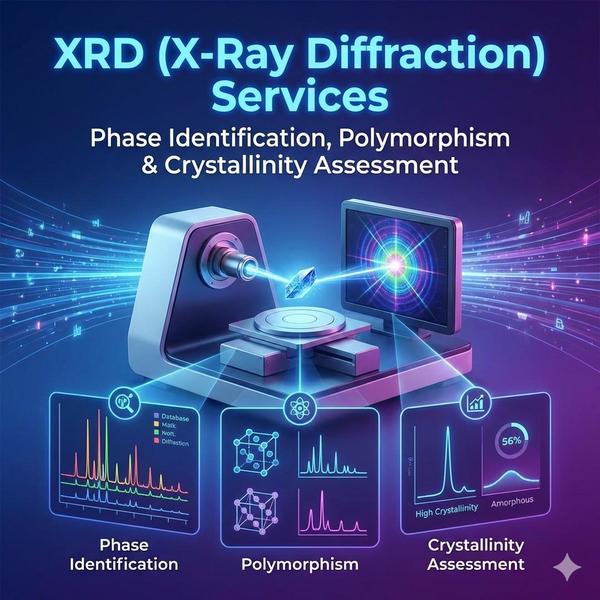
At Dextrose Technologies Pvt. Ltd., we provide XRD (X-Ray Diffraction) for reliable crystalline phase identification and solid-state characterization. XRD is the gold-standard technique to identify crystalline materials, differentiate polymorphs, and assess crystallinity trends—supporting materials science, pharmaceuticals, chemicals, and R&D/QC investigations.
Crystalline phase identification
We match diffraction patterns to identify crystalline phases and support material verification, contamination checks, and batch comparison.
Polymorphism and solid-state characterization
We evaluate polymorphic differences and solid-state changes that can impact stability and performance, supporting formulation development and material selection.
Crystallinity assessment
We assess overall crystallinity trends (semi-quantitative/quantitative as per scope and data quality), useful for comparing processing conditions, heat treatment, or formulation effects.
Deliverables
* XRD diffractograms with peak list (2θ/intensity)
* Phase identification summary (where applicable)
* Crystallinity/trend assessment (as applicable)
* Interpretation notes and recommendations for follow-up confirmation if required
Get started
Share your sample type (powder/film/solid), expected phases (if any), and objective (phase ID, polymorph, crystallinity). We’ll recommend the right scan parameters and reporting format.
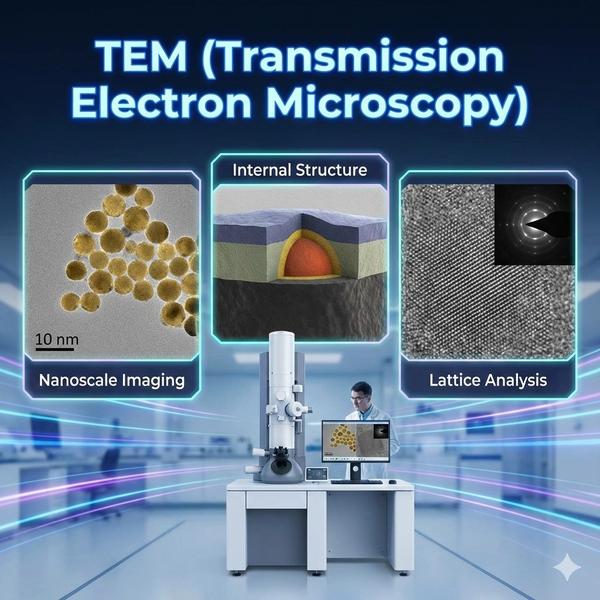
At Dextrose Technologies Pvt. Ltd., we provide TEM (Transmission Electron Microscopy) to visualize internal structure at the nanoscale, enabling detailed analysis of nanoparticles, fine particulates, thin films, and advanced materials. TEM is ideal when SEM is not sufficient and you need high-resolution insight into particle dispersion, internal morphology, and lattice-level features (scope dependent on sample and preparation feasibility).
Internal structure and nanoscale imaging
TEM allows direct imaging of internal morphology, particle boundaries, and nanoscale features that drive material performance. We support comparative analysis across batches and processing conditions.
Particle dispersion and lattice structure analysis
We assess particle dispersion and aggregation trends, and support lattice-level analysis where applicable (e.g., lattice fringes / crystallographic features), helping you understand crystallinity and structural uniformity.
Deliverables
* TEM images at multiple magnifications
* Dispersion/aggregation observations (image-based)
* Lattice/structural notes where applicable
* Report-ready documentation for R&D and characterization
Get started
Share your sample type (nanoparticles/thin film/powder), expected size range, and objective (dispersion, internal structure, lattice). We’ll recommend feasibility, sample prep approach, and deliverables.
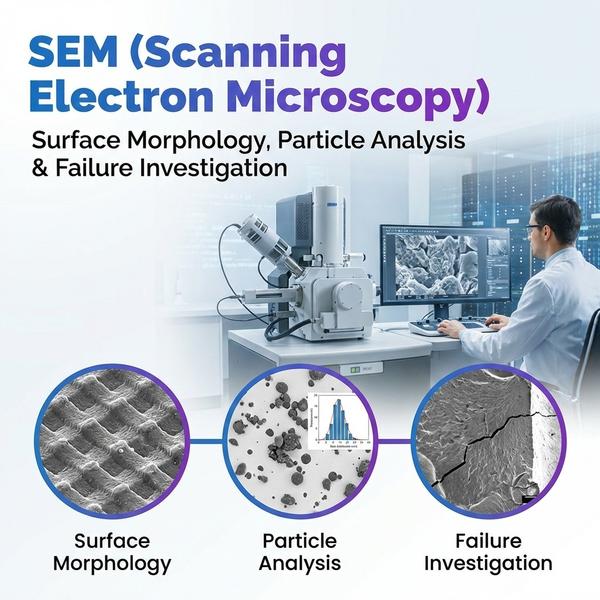
At Dextrose Technologies Pvt. Ltd., we provide SEM (Scanning Electron Microscopy) for high-resolution imaging and detailed surface characterization of materials and biological samples (as applicable). SEM helps you visualize surface morphology, topography, particles, and defects with clarity—supporting R&D, quality investigations, and failure analysis.
Surface morphology and topographical analysis
We capture high-magnification images to evaluate surface texture, porosity, cracks, coatings, and microstructural features. SEM is ideal for comparing batches, processing conditions, and material finishes.
Particle shape and size evaluation
We image particles to assess shape, agglomeration, and size distribution trends (image-based), supporting powders, pigments, fillers, nanomaterials (where applicable), and formulation studies.
Failure and defect analysis
We support root-cause investigations for defects such as fractures, delamination, inclusions, corrosion features, and surface contamination—providing image evidence and interpretation notes to guide corrective actions.
Deliverables
* High-resolution SEM images (multiple magnifications)
* Observation summary highlighting key morphological features
* Optional: EDX elemental mapping/spot analysis (if required)
* Report-ready documentation for R&D or QC investigations
Get started
Share your sample type, objective (morphology/particles/failure), and preferred magnification range. We’ll recommend the best SEM imaging plan and deliverables.
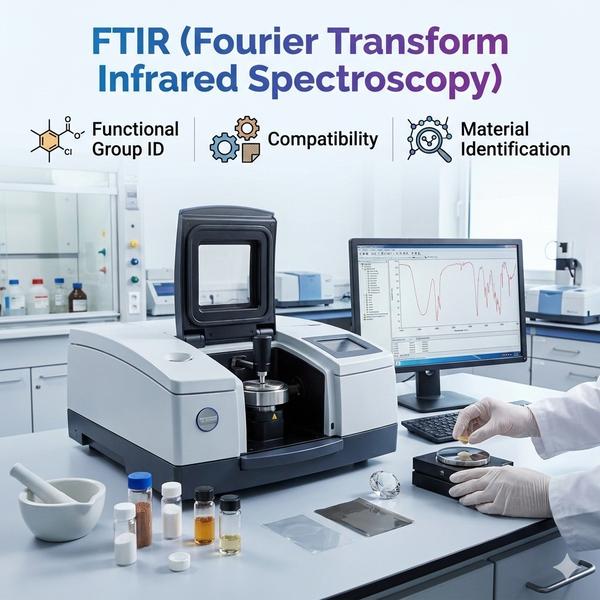
At Dextrose Technologies Pvt. Ltd., we offer FTIR (Fourier Transform Infrared Spectroscopy) for rapid functional group identification and material fingerprinting. FTIR is a reliable first-line tool for confirming raw materials, comparing formulations, and investigating unknowns by identifying characteristic IR absorption bands. It is widely used for polymers, excipients, organics, and contaminant screening, with clear interpretation and documentation.
Functional Group Identification
We identify key functional groups (e.g., O–H, N–H, C=O, C–O, C–H, aromatic bands) to support compound confirmation, comparison, and troubleshooting.
Raw Material and Formulation Compatibility Studies
We compare spectra of raw materials, excipients, APIs, and blends to detect spectral changes that may indicate interaction or incompatibility—useful during formulation development and material selection.
Polymer, Excipient, and Contaminant Identification
FTIR is effective for polymer and excipient fingerprinting and for initial contaminant identification (e.g., unknown residues, particles, films), supporting root-cause investigations and corrective actions.
Deliverables
* FTIR spectra with peak highlights
* Sample-to-sample comparison summary (overlay interpretation)
* Identification/interpretation notes aligned to your objective
* Recommendations for confirmatory testing if required (e.g., GCMS/LCMS/SEM-EDX)
Get started
Share your sample type (solid/liquid/powder/film), objective (ID/compatibility/contaminant), and sample count. We’ll recommend the best FTIR approach and reporting format.
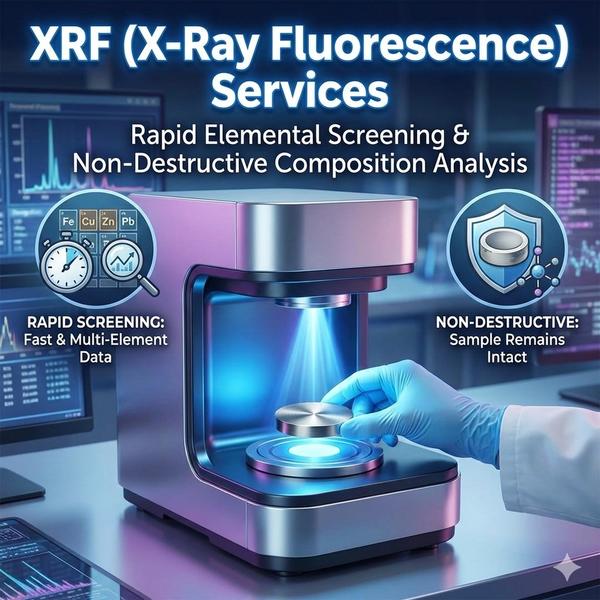
At Dextrose Technologies Pvt. Ltd., we offer XRF (X-Ray Fluorescence Spectroscopy) for fast, non-destructive elemental screening and material composition evaluation. XRF is ideal for solid and powder samples where you need quick elemental insight without complex wet chemistry. It supports raw material verification, contamination checks, and batch comparison through clear, report-ready elemental profiles.
Rapid elemental screening
We screen for major and minor elements and provide an elemental overview to support quick decisions and follow-up testing plans.
Non-destructive material composition analysis
XRF analyzes samples without dissolving or destroying them, making it useful for routine checks and investigations where sample preservation matters.
Solid and powder sample evaluation
We evaluate powders, pellets, solids, and other compatible materials (scope-dependent) and report results in a structured format.
Deliverables
* Elemental composition summary (as applicable to method and matrix)
* Spectra/measurement notes and sample identifiers
* Comparative summary across samples/batches
* Recommendations for confirmatory testing when required (e.g., ICP-OES/ICP-MS)
Get started
Share your sample type (powder/solid), expected elements of interest, and whether you need screening or quantitative reporting. We’ll recommend the right XRF workflow.
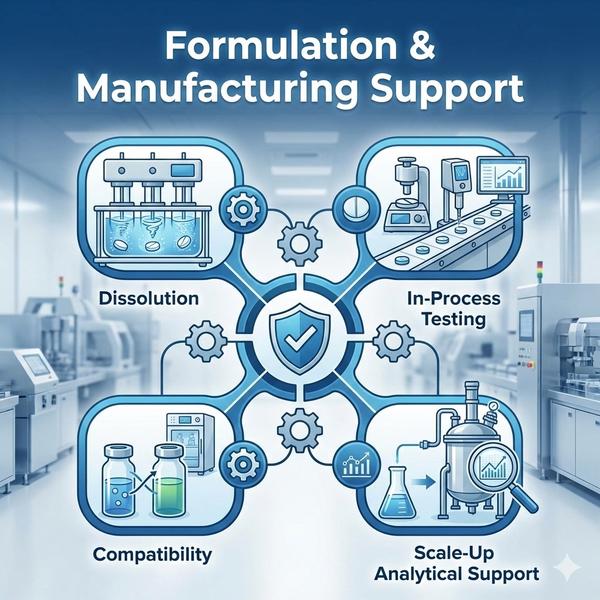
At Dextrose Technologies Pvt. Ltd., we provide Formulation & Manufacturing Support to strengthen process control and improve formulation robustness. Our chromatography-led testing helps teams monitor in-process quality, compare batches, identify variability early, and support smoother scale-up and technology transfer with clear, trend-ready reporting.
Dissolution Sample Analysis (HPLC)
We analyze dissolution samples by HPLC to quantify release profiles across timepoints, supporting formulation optimization and batch-to-batch comparison.
In-Process Sample Testing
We test in-process samples to support process control—helping teams catch deviations early and maintain consistent quality during manufacturing.
Excipient Compatibility Studies
We evaluate compatibility between APIs and excipients to flag potential interactions or instability risks and guide formulation decisions.
Batch Comparison and Trend Analysis
We generate structured data for batch comparison and trending (assay, impurities, key markers), enabling faster root-cause analysis and more confident release decisions.
Scale-Up and Tech Transfer Analytical Support
We support scale-up and method transfer activities by aligning analytical conditions, confirming method performance, and packaging results into clean, review-ready reports.
Outcome you can expect
* Stronger process consistency and reduced variability
* Faster troubleshooting with trend-ready outputs
* Smoother scale-up and technology transfer
Get started
Share your product type, sampling points, analytes, expected ranges, and timeline. We’ll propose an efficient testing plan and reporting format.
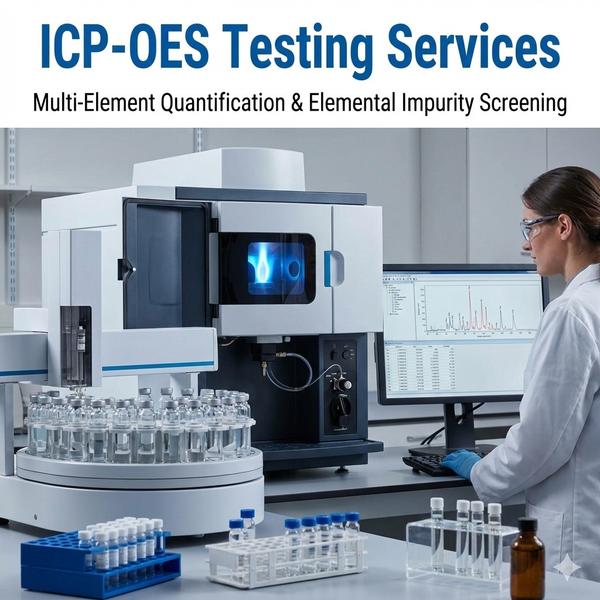
At Dextrose Technologies Pvt. Ltd., we provide ICP-OES (Inductively Coupled Plasma – Optical Emission Spectroscopy) for reliable multi-element quantitative analysis across raw materials, intermediates, and finished products. ICP-OES is well suited for routine elemental profiling and screening where you need accurate concentrations across multiple metals and minerals in a single run (scope depends on matrix and required limits).
Multi-Element Quantitative Analysis
We quantify multiple elements in one method, generating concentration results in clear units (ppm/ppb or mg/L as required) with calibration-based reporting.
Heavy Metal and Elemental Impurity Screening
We support screening for heavy metals and elemental impurities to help identify contamination risks, support QC decisions, and enable batch comparison. (For ICH Q3D-aligned programs, scope and limits are finalized based on your requirements and standards provided.)
Raw Material and Finished Product Analysis
We analyze a wide range of matrices—raw materials, powders, liquids, digests, and finished products—based on suitable sample preparation and digestion approach.
Deliverables
* Results table with element-wise concentrations
* Method notes (sample prep/digestion basis as applicable)
* Calibration approach and QC checks (as agreed)
* Summary interpretation and flags for outliers/trends
Get started
Share your sample type, target element list, required limits, and reporting units. We’ll recommend the right ICP-OES workflow and sample preparation plan.
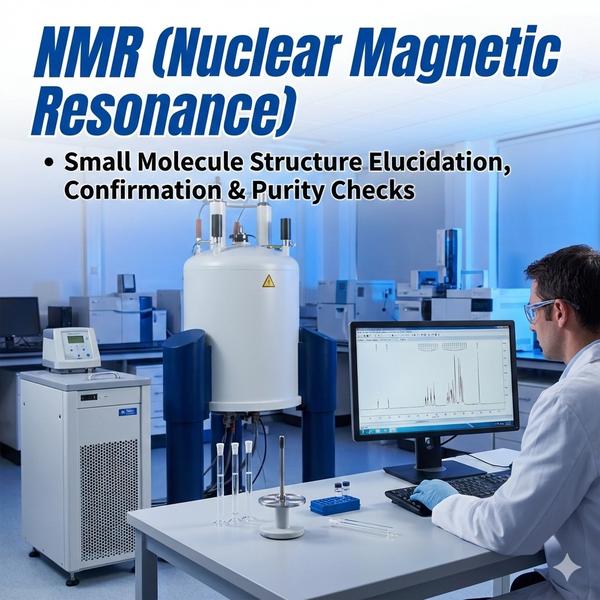
At Dextrose Technologies Pvt. Ltd., we provide NMR (Nuclear Magnetic Resonance) spectroscopy support for structural elucidation and confirmation of small molecules, helping R&D teams validate synthesis outcomes and verify compound identity with high confidence. NMR is widely used for structure verification, purity assessment, and reaction monitoring by confirming key functional environments and structural connectivity (scope dependent on sample and experiment type).
Structural Elucidation of Small Molecules
We support structure elucidation using NMR data interpretation to assign key signals and confirm molecular framework, supporting research, synthesis, and impurity investigations.
Compound Confirmation and Purity Assessment
We use NMR to confirm compound identity and assess purity trends by checking for unexpected signals and comparing against expected spectral patterns.
Reaction Monitoring and Structural Verification
We support reaction progress and structural verification by comparing NMR profiles across stages or fractions, helping you confirm completion and product formation.
Deliverables
* NMR spectra files and key peak/signal summary
* Interpretation notes and assignments (scope-dependent)
* Purity/impurity observations based on spectral review
* Clear conclusion and recommendations for follow-up confirmation if needed
Get started
Share the compound type, expected molecular weight, solvent preference, sample amount/concentration, and whether you need ¹H, ¹³C, or 2D experiments. We’ll recommend the most suitable NMR plan and reporting format.
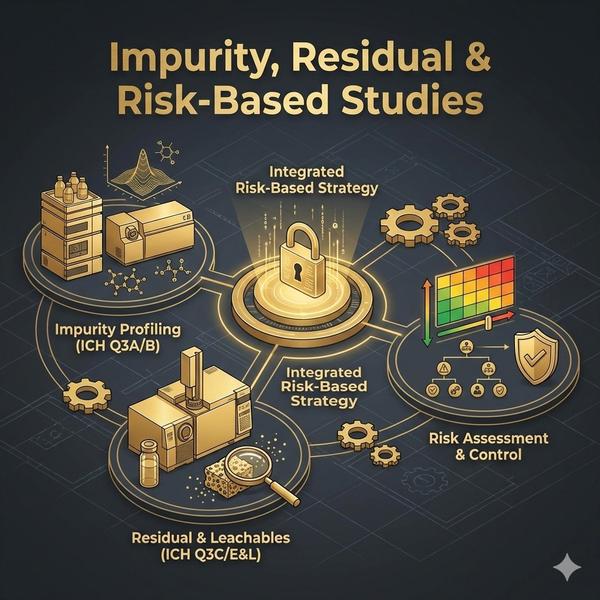
At Dextrose Technologies Pvt. Ltd., we provide impurity, residual, and risk-based analytical studies to help teams mitigate regulatory risk and build a clear control strategy. Our work supports ICH-oriented impurity profiling and residual solvent analysis, unknown impurity identification using MS tools, and screening studies that strengthen development decisions and documentation.
ICH Q3A/Q3B-Oriented Impurity Profiling
We support impurity and related substances profiling aligned to ICH Q3A/Q3B intent, using HPLC/RP-HPLC (and LCMS where required) to generate clear impurity visibility and trend-ready outputs.
ICH Q3C-Oriented Residual Solvent Analysis
We perform residual solvent testing using GC-FID or Headspace GCMS with an ICH Q3C-oriented approach, reporting results in clear units and against the target solvent list/limits you define.
Unknown Impurity Identification (LCMS / GCMS)
We investigate unknown peaks using LCMS (non-volatile/polar) and GCMS (volatile/semi-volatile) to support impurity identification, root-cause analysis, and next-step planning.
Extractables & Leachables Screening (GCMS)
We offer screening-level extractables/leachables (E&L) studies by GCMS to evaluate potential risks from packaging or contact materials (scope-dependent, intended for early risk assessment unless a specific standard is agreed).
Cross-contamination Risk Assessment Support
We provide analytical inputs that support cross-contamination risk assessments—such as targeted carryover checks, comparative profiling, and data packaging for internal QA review (scope-dependent).
Outcome you can expect
* Reduced regulatory risk through early impurity/residual visibility
* Clear impurity control strategy supported by structured analytical data
Get started
Share your product type, target analytes/solvents, reporting limits, and whether you need profiling only or profiling + unknown ID. We’ll recommend the most efficient plan.
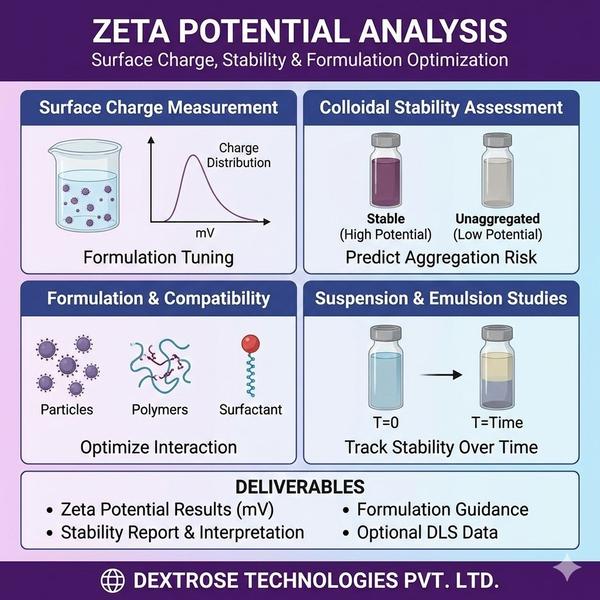
At Dextrose Technologies Pvt. Ltd., we provide Zeta Potential Analysis to measure surface charge and assess colloidal stability of dispersions, suspensions, emulsions, and nanoformulations. Zeta potential helps predict electrostatic repulsion/attraction between particles, supporting decisions on formulation robustness, aggregation risk, and stability under different conditions.
Surface Charge Measurement
We measure zeta potential to understand particle surface charge behavior in the selected medium (buffer/solvent), supporting formulation tuning and batch comparison.
Colloidal Stability Assessment
We evaluate stability risk by correlating zeta potential with aggregation tendencies and comparing results across formulations, pH, ionic strength, or storage conditions.
Suspension and Emulsion Stability Studies
We support stability screening of suspensions and emulsions by tracking zeta potential changes across timepoints or stress conditions, helping you select more stable compositions.
Electrostatic Interaction Evaluation
We assess electrostatic interaction trends between particles and additives (surfactants, polymers, salts) to guide formulation optimization and compatibility decisions.
Deliverables
* Zeta potential results (mV) with measurement conditions
* Comparative summary across samples/conditions
* Interpretation notes focused on stability and optimization actions
* Optional pairing with DLS size/PDI for complete dispersion characterization
Get started
Share your sample type, medium (solvent/buffer), pH range, and objective (stability, compatibility, optimization). We’ll recommend the right measurement plan.
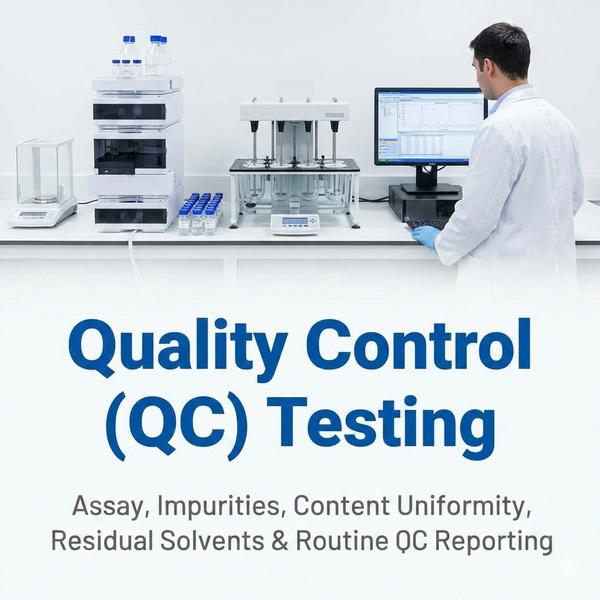
At Dextrose Technologies Pvt. Ltd., we provide Quality Control (QC) Testing to support batch release, routine compliance, and in-process control. Our chromatography-based QC services deliver consistent, calibration-based results with clear documentation and regulatory-aligned reporting. We help you reduce batch risk, maintain trendable quality metrics, and move faster through internal QA review.
Assay Testing (HPLC / RP-HPLC)
Accurate content estimation for APIs, intermediates, and formulations using validated/optimized chromatographic methods and standards-based quantification.
Related Substances / Impurity Profiling
Separation and monitoring of related substances and impurities to support batch comparison, process control, and product quality assessment.
Content Uniformity Testing
Testing to evaluate dosage consistency across units with structured reporting for easy review and trending.
Residual Solvent Analysis (GC-FID / HS-GCMS)
Residual solvent quantification using GC-FID or Headspace GCMS, based on target solvent list, matrix, and required limits (ICH Q3C-oriented where applicable).
Volatile Impurity Testing
Volatile impurity profiling for troubleshooting and routine QC checks using GC techniques suited to your sample type.
System Suitability & Routine QC Analysis
System suitability testing (SST) and routine batch analysis with documented acceptance checks and clean reporting.
Cleaning Validation Sample Analysis
HPLC/GC-based analysis of swab/rinse samples for trace residues to support cleaning validation programs (scope-dependent).
Outcome you can expect
* Batch release readiness with consistent analytical outputs
* Ongoing quality monitoring with trend-ready results
* Clear, regulatory-aligned reporting for internal QA and client documentation
Get started
Share your product type, analyte list, specifications/limits, and sample count. We’ll recommend the most efficient QC
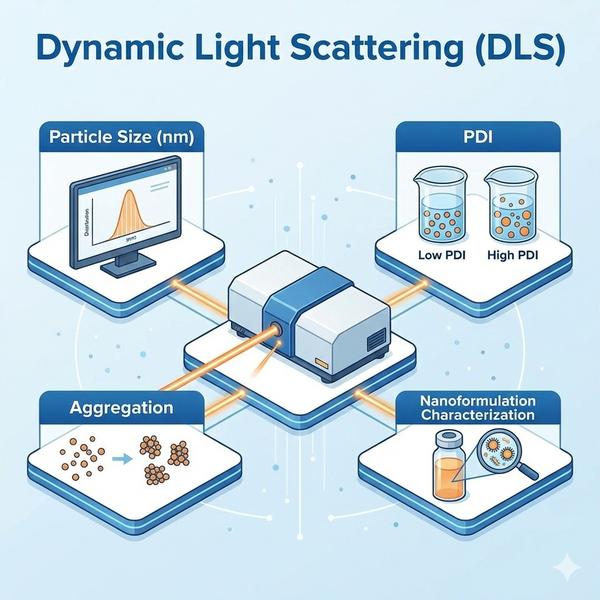
At Dextrose Technologies Pvt. Ltd., we provide Dynamic Light Scattering (DLS) for rapid characterization of nanometer-range particle size distribution, polydispersity index (PDI), and dispersion stability. DLS is ideal for routine screening and development work in nanomaterials, nanoformulations, colloids, emulsions, and polymer/biomolecule dispersions, helping you confirm size consistency and detect aggregation early.
Particle Size Distribution (Nanometer Range)
We measure hydrodynamic particle size in the nm range and provide distribution outputs aligned to your sample type and objective.
Polydispersity Index (PDI) Determination
We report PDI to indicate dispersion uniformity and batch-to-batch consistency—useful for formulation control and stability screening.
Aggregation and Stability Studies
We evaluate aggregation trends by comparing size/PDI across conditions or timepoints (e.g., pH, ionic strength, dilution, storage), supporting stability decisions.
Nanoformulation Characterization
We support nanoformulation development by providing size and PDI benchmarks for optimization and comparative studies.
Deliverables
* Particle size distribution (Z-average and distribution outputs as applicable)
* PDI values with measurement notes
* Comparative summary across batches/conditions
* Interpretation notes and recommendations for improving stability (scope-dependent)
Get started
Share your sample type (nanoparticles/emulsion/dispersion), solvent/buffer, expected size range, and concentration. We’ll recommend the right measurement plan and reporting format.
At Dextrose Technologies Pvt. Ltd., our R&D Analytical Support helps teams move faster from idea to data with the right analytical strategy and clear, decision-ready reporting. We support method development, compound understanding, reaction tracking, and early impurity/degradation visibility—so you can shorten development cycles and reduce trial-and-error.
HPLC / RP-HPLC Method Development & Optimization
We develop and optimize chromatography methods (column, mobile phase, gradient, flow, detection) to achieve strong resolution, repeatability, and robustness for your sample type.
Assay Method Development for APIs & Formulations
Calibration-based assay methods for APIs, intermediates, and formulations with clear reporting units and suitability checks as applicable.
LCMS-Based Molecular Weight Confirmation
Mass confirmation for non-volatile compounds to support identity verification, batch comparison, and early-stage characterization.
Structural Elucidation (Small Molecules)
Support for small-molecule structural understanding using MS-based interpretation (scope-dependent), with clear notes and next-step recommendations when needed.
Impurity and Degradation Product Identification
We profile impurities and degradation products to provide early visibility into risks and to guide method refinement and process decisions.
Reaction Monitoring (HPLC / TLC)
Fast reaction tracking to support endpoint decisions and process optimization, reported in a structured and easy-to-interpret format.
Peptide & Small Molecule LCMS Analysis
LCMS analysis for peptides and small molecules (scope-dependent), supporting mass confirmation and profiling.
Exploratory Bioanalytical LCMS (Non-GLP)
Exploratory analysis for R&D (non-GLP) with workflows tailored to matrix complexity and required sensitivity.
Outcome you can expect
* Robust analytical methods suitable for R&D progression
* Early impurity and degradation visibility
* Faster development cycles with clearer decisions
Get started
Share your compound class, sample matrix, development stage, and goal (method development, impurity ID, reaction monitoring). We’ll propose the fastest, most reliable plan.
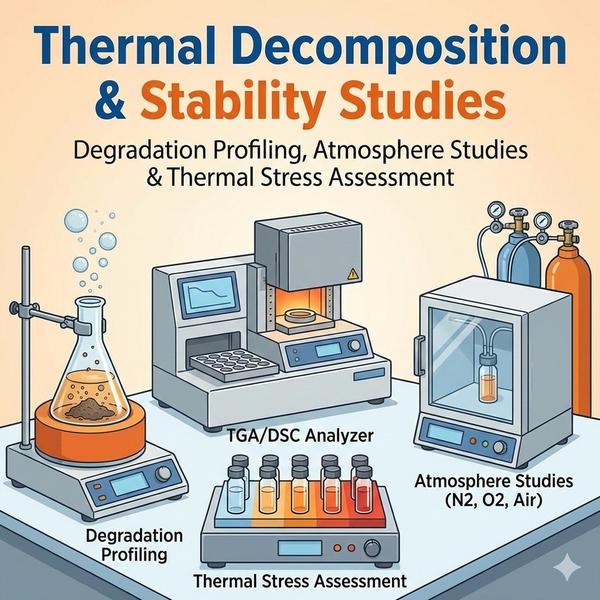
At Dextrose Technologies Pvt. Ltd., we provide thermal decomposition and stability studies to help you understand how materials behave under heat, evaluate degradation pathways, and compare stability across storage or processing conditions. Using thermal analysis approaches (typically TGA/DTG and DSC, as applicable), we generate structured data on decomposition stages, onset temperatures, and thermal stability trends under different atmospheres.
Thermal Degradation Profiling
We profile degradation behavior across a defined temperature program to identify mass-loss stages, key transition points, and comparative stability across batches or formulations.
Oxidative and Inert Atmosphere Studies
We perform studies under oxidative (air/oxygen) and inert (nitrogen/argon) atmospheres to understand oxidation-driven changes versus intrinsic thermal decomposition—useful for materials selection and process risk assessment.
Shelf-Life and Storage Condition Assessment (Thermal Stress)
We support thermal-stress studies to compare stability under heat exposure and generate insights relevant to storage, packaging, and process conditions. Outputs are designed to support R&D decision-making and risk mitigation.
Deliverables
Degradation/stability curves (TGA/DTG and/or DSC as applicable)
Key temperatures (onset/peaks) and % mass-loss stages (where applicable)
Comparative summary across samples/conditions
Interpretation notes and practical recommendations for next-step confirmation if needed
Get started
Share your material type, target temperature range, atmosphere requirement (oxidative/inert), and the decision you’re trying to make. We’ll propose the most suitable thermal study plan.
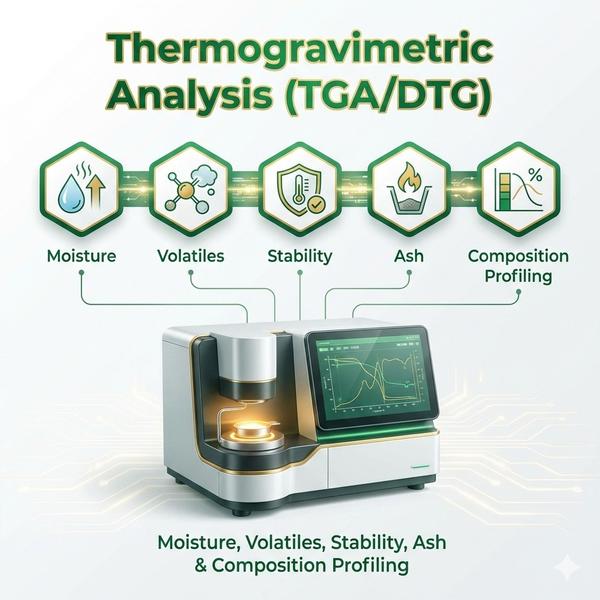
At Dextrose Technologies Pvt. Ltd., we provide Thermogravimetric Analysis (TGA) and Derivative Thermogravimetric Analysis (DTG) for thermal and physicochemical characterization of materials. TGA measures weight change vs temperature/time, while DTG highlights rate of mass loss, helping you evaluate moisture/volatile content, thermal stability, decomposition stages, ash/residue, and composition trends in multi-component systems.
Thermogravimetric Analysis (TGA)
We generate TGA curves to quantify mass loss steps and residual mass under defined heating programs and atmospheres (as per scope).
Derivative Thermogravimetric Analysis (DTG)
DTG profiles help separate overlapping events and identify key decomposition temperatures by showing the mass-loss rate peaks.
Moisture and Volatile Content Determination
We quantify early-stage mass loss attributed to moisture and low-boiling volatiles, useful for raw material control and process optimization.
Thermal Stability and Decomposition Profiling
We assess onset temperatures and decomposition stages to compare batches, evaluate stability, and understand thermal behavior under heating.
Ash Content and Residue Analysis
We report final residue/ash percentage to support inorganic content assessment and compositional comparison.
Composition Analysis of Multi-Component Systems
We interpret multi-step mass-loss behavior to provide composition insights (e.g., binder/filler/organic fraction trends), with recommendations for confirmatory techniques if required.
Deliverables
* TGA and DTG curves with key temperatures (onset/peaks)
* % mass loss by stage + final residue/ash %
* Comparative summary across samples/batches
* Interpretation notes aligned to your objective
Get started
Share your material type, expected temperature range, sample form, and objective (moisture, stability, ash, composition). We’ll recommend the right TGA/DTG program and reporting format.
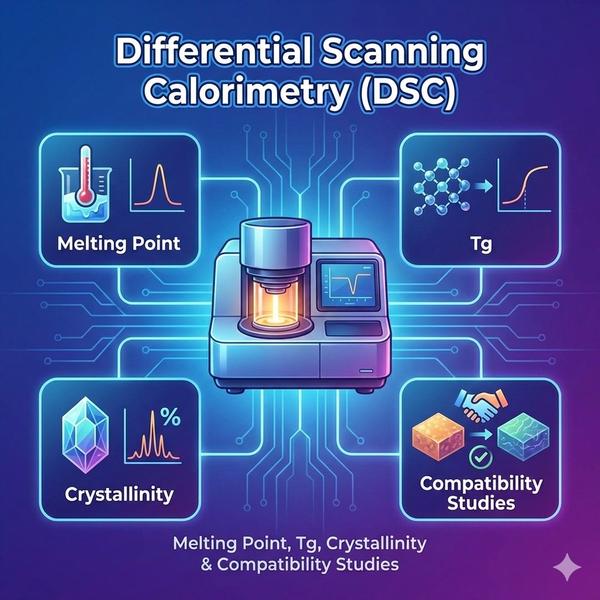
At Dextrose Technologies Pvt. Ltd., we provide Differential Scanning Calorimetry (DSC) for thermal and physicochemical characterization of solids and liquids. DSC measures heat flow associated with thermal transitions, enabling you to evaluate melting behavior, glass transition (Tg), crystallinity/polymorphism trends, and compatibility—useful for R&D, formulation work, and quality investigations.
Differential Scanning Calorimetry – Solids & Liquids
We analyze a wide range of materials to understand thermal transitions and compare batches, formulations, or processing conditions.
Melting Point Determination
We determine melting onset/peak behavior and compare thermal profiles to support identity checks, batch consistency, and impurity indications.
Glass Transition Temperature (Tg) Analysis
We identify Tg for amorphous or semi-amorphous materials and evaluate changes due to moisture, formulation, or processing.
Crystallinity and Polymorphism Assessment
We assess thermal signatures to support crystallinity trends and polymorphic differences (DSC-supported assessment; confirmatory tools may be recommended if needed).
Drug–Excipient Compatibility Studies
We compare DSC thermograms of APIs, excipients, and blends to flag potential interactions and compatibility risks during formulation development.
Purity Assessment (Thermal Behavior)
We use thermal behavior as a supportive indicator of purity and consistency (e.g., peak broadening/shift), aligned to project needs.
Deliverables
* DSC thermograms with key transition temperatures (onset/peak/Tg)
* Comparative summary across samples/batches
* Interpretation notes and recommendations for follow-up testing if required
Get started
Share your material type (solid/liquid), expected transition range, sample count, and objective (Tg, melting, compatibility, crystallinity). We’ll recommend the right DSC conditions and reporting format.
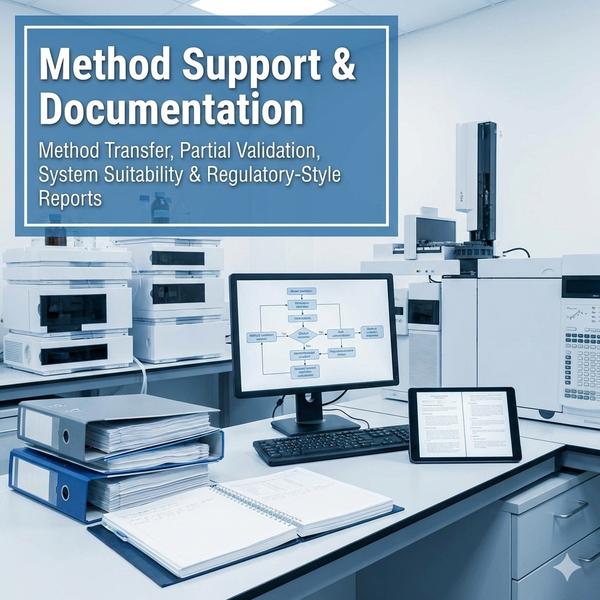
At Dextrose Technologies Pvt. Ltd., we provide method support and documentation to help teams generate reliable analytical results with clean, audit-ready reporting. We support analytical method transfer, partial method validation, system suitability checks, and stability sample analysis across chromatography platforms (HPLC/RP-HPLC, GC-FID, GCMS, HS-GCMS, LCMS—scope dependent). Our focus is on clear documentation, traceability, and decision-ready outputs.
Analytical Method Transfer Support
We help implement and verify your existing method by aligning instrument settings, sample prep, standards, and acceptance criteria. This supports consistent results when transitioning methods between teams, sites, or projects.
Partial Method Validation (Accuracy, Precision, Linearity)
We perform partial validation studies to demonstrate method performance for defined scopes, typically covering:
* Accuracy (recovery)
* Precision (repeatability / intermediate precision as applicable)
* Linearity (calibration range and fit)
Additional parameters can be added based on need.
System Suitability Testing (SST)
We run system suitability checks prior to sample batches to confirm method readiness and instrument performance, and document results against predefined criteria.
Stability Sample Analysis
We analyze stability samples across timepoints and provide trend-ready results to support R&D and product decisions.
Regulatory-Style Test Reports
We deliver structured reports with method details, sample identifiers, results tables, chromatograms, calculations basis, and clear conclusions—formatted for internal QA review and client documentation needs.
Deliverables
* Transfer/validation plan summary (scope + acceptance criteria)
* Raw data summary + results tables + calculations basis
* Chromatograms/spectra and SST outputs (as applicable)
* Final report in a clean, regulatory-style format
Get started
Share the method, analyte list, matrix, target limits, and required parameters (accuracy/precision/linearity). We’ll propose a practical study plan and documentation package.
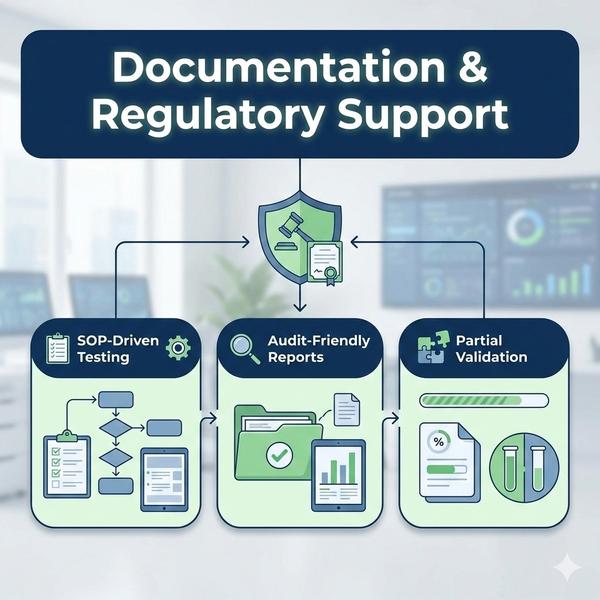
At Dextrose Technologies Pvt. Ltd., we provide Documentation & Regulatory Support to deliver inspection-ready analytical outputs for R&D and QC programs. Our focus is SOP-driven execution, clean data presentation, and structured reporting that speeds up internal QA review and client submissions. We support chromatography and mass spectrometry workflows (HPLC/RP-HPLC, GC-FID, HS-GCMS, GCMS, LCMS—scope dependent) with consistent documentation and clear interpretation.
SOP-Driven Testing
Testing is performed using controlled workflows with documented sample handling, instrument conditions, and batch execution notes for traceability.
Regulatory-Style Analytical Reports
We provide structured reports with sample identifiers, method conditions, chromatograms/spectra (as applicable), results tables, calculation basis, and clear conclusions—formatted for review and submission support.
Partial Method Validation Support
We support partial validation for defined scope parameters such as accuracy, precision, and linearity, with summary tables and acceptance criteria where agreed.
Data Review & Interpretation
We review chromatograms/spectra to highlight key findings, trends, and anomalies, and provide practical interpretation notes aligned to your decision goal.
Client-Specific Reporting Formats
If you have internal templates or required sections, we can align reporting to your preferred format for smoother approvals and submissions.
Outcome you can expect
* Audit-friendly documentation with clear traceability
* Faster client submissions supported by structured reporting
Get started
Share your method, analytes, sample count, and preferred report template. We’ll propose the best documentation package for your workflow.
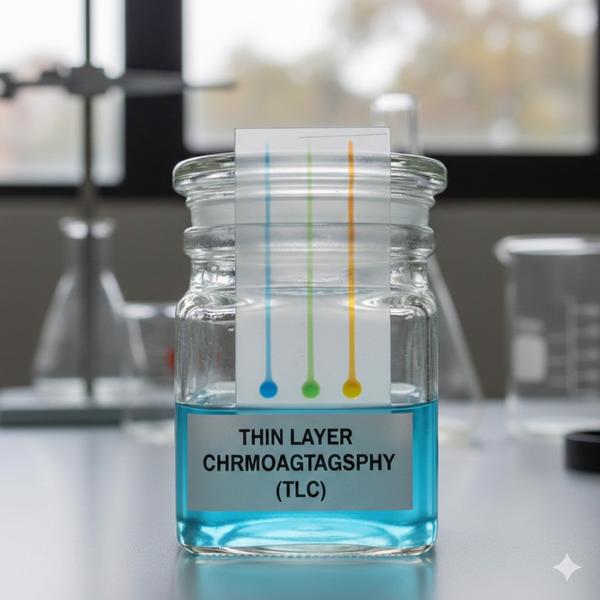
At Dextrose Technologies Pvt. Ltd., we offer Thin Layer Chromatography (TLC) services for rapid, cost-effective qualitative analysis of compounds and mixtures. TLC is ideal for reaction monitoring, quick purity checks, and herbal/phytochemical screening before moving to advanced techniques like HPLC, LCMS, or GCMS. We deliver clear plate documentation and interpretation to support fast decisions in R&D and QC workflows.
Qualitative Compound Identification
We support qualitative identification using Rf values and spot visualization under appropriate detection conditions, enabling quick comparison against references or known samples (when provided).
Reaction Monitoring
We monitor chemical reactions and process steps by tracking the appearance/disappearance of spots over time, helping you decide end-point completion and optimize conditions.
Purity Checks
We perform quick purity checks to detect major impurities or multiple components in a sample, supporting batch comparison and early-stage QC screening.
Herbal and Phytochemical Screening
We use TLC for preliminary screening of herbal extracts and phytochemical fractions to guide fractionation, method development, or targeted analysis.
Deliverables
* TLC plate images/documentation
* Rf values and observation summary
* Interpretation notes aligned to your objective
* Optional recommendation for confirmatory HPLC/LCMS/GCMS when needed
Get started
Share your sample type, solvent system preference (if any), and objective (ID/reaction monitoring/purity/herbal screening). We’ll recommend an efficient TLC workflow.
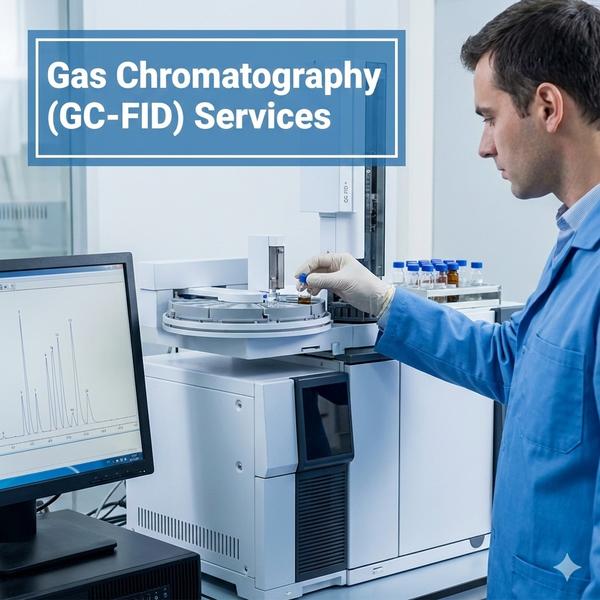
At Dextrose Technologies Pvt. Ltd., we provide Gas Chromatography with Flame Ionization Detection (GC-FID) for accurate, repeatable quantification of volatile organic compounds (VOCs) and residual solvents. GC-FID is ideal for routine QC and batch comparisons where calibration-based quantification, stable detector response, and clear peak reporting are required.
Residual Solvent Analysis
We quantify residual solvents in raw materials, intermediates, and finished products using method conditions aligned to your target solvents and required limits.
Volatile Organic Compound (VOC) Analysis
We perform VOC quantification for industrial, R&D, and quality investigations, generating clean chromatograms and concentration outputs for decision-making.
Alcohol and Solvent Quantification
We quantify common alcohols and solvents (as per scope) with suitable calibration and reporting formats (ppm, %, mg/L—based on requirement).
PURITY Assessment of Volatile Compounds
We support purity assessment by reporting chromatographic peak profiles, area%, and impurity trends for volatile samples and solvent blends.
Deliverables
* Chromatograms + peak table (RT/area/area%)
* Quantitative results with calibration approach (as applicable)
* Method notes and observation summary
* Optional: recommendation for confirmatory GCMS when identity confirmation is required
Get started
Share your sample type, target solvent/VOC list, and required reporting units. We’ll recommend the best GC-FID workflow and turnaround plan.
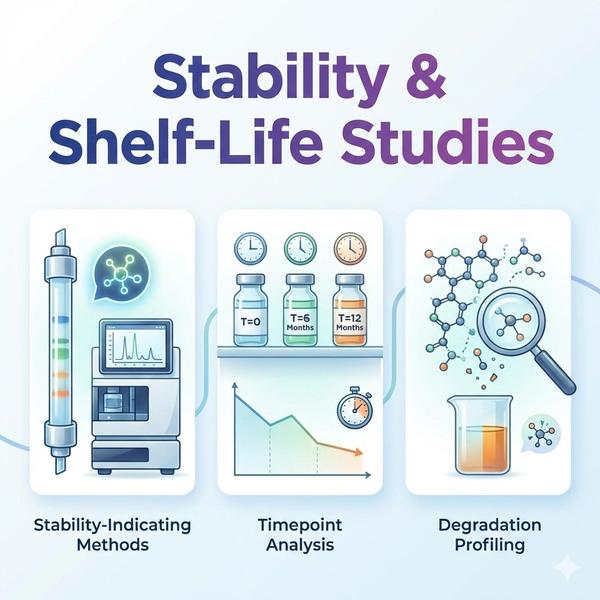
At Dextrose Technologies Pvt. Ltd., we support Stability & Shelf-Life Studies to help you justify shelf-life, understand degradation pathways, and generate clear, trend-ready data for internal QA and development decisions. Our services cover stability-indicating method development, long-term and accelerated timepoint analysis, degradation profiling, and packaging interaction screening using chromatography and mass spectrometry.
Stability-Indicating Method Development
We develop methods that can clearly separate the main compound from degradation products, enabling accurate stability assessment and cleaner decision-making.
Long-Term & Accelerated Stability Sample Analysis
We analyze stability samples across planned timepoints for long-term and accelerated studies, reporting assay/impurity trends in structured formats.
Degradation Product Profiling (HPLC / LCMS)
We profile degradation products using HPLC and support identification/confirmation with LCMS where required (scope-dependent), helping you understand what is forming and when.
Volatile Degradation Monitoring (HS-GCMS)
For volatile components or residual solvents, we monitor changes over time using Headspace GCMS, enabling sensitive tracking with reduced matrix interference.
Packaging Interaction Screening
Screening studies to evaluate potential packaging-contact interactions that may impact product quality, supporting packaging selection and early risk assessment.
Trend Analysis Across Stability Time Points
We provide trend-ready tables and summaries across timepoints to support faster reviews and clearer shelf-life justification.
Outcome you can expect
* Strong stability-indicating methods and timepoint-ready workflows
* Clear degradation visibility (non-volatile and volatile)
* Structured trend data to support shelf-life justification
Get started
Share your product type, analyte(s), planned timepoints, storage conditions, and reporting expectations. We’ll recommend the most efficient stability workflow.
At Dextrose Technologies Pvt. Ltd., we provide antimicrobial susceptibility and efficacy testing to help researchers and product teams evaluate how bacteria and fungi respond to antimicrobial agents. Our testing supports R&D, comparative screening, formulation development, and quality investigations with controlled study conditions, clear documentation, and decision-ready reporting.
Antimicrobial Susceptibility Testing (AST)
Disc Diffusion Method: Zone-of-inhibition based screening for comparative susceptibility assessment.
MIC Determination: Minimum Inhibitory Concentration to identify the lowest concentration that inhibits visible growth.
MBC Determination: Minimum Bactericidal Concentration to assess killing endpoints where required.
Time-Kill Assays (Kill Curve Studies)
We evaluate antimicrobial effect over time by measuring viability at defined timepoints, enabling comparison of efficacy kinetics across agents or concentrations.
Antifungal Susceptibility Testing
Susceptibility assessment for fungal isolates against antifungal agents, supporting research and screening objectives.
Synergistic and Combination Studies
We assess combination effects (additive/synergistic/antagonistic trends) to support optimization of multi-agent strategies and formulations.
Deliverables
Results summary (AST/MIC/MBC/time-kill outputs as applicable)
Data tables and interpretation notes aligned to your objective
Clear documentation of test conditions and sample identifiers
Note: Testing is intended for laboratory, research, and quality purposes. Clinical decisions should be made only by qualified healthcare professionals.
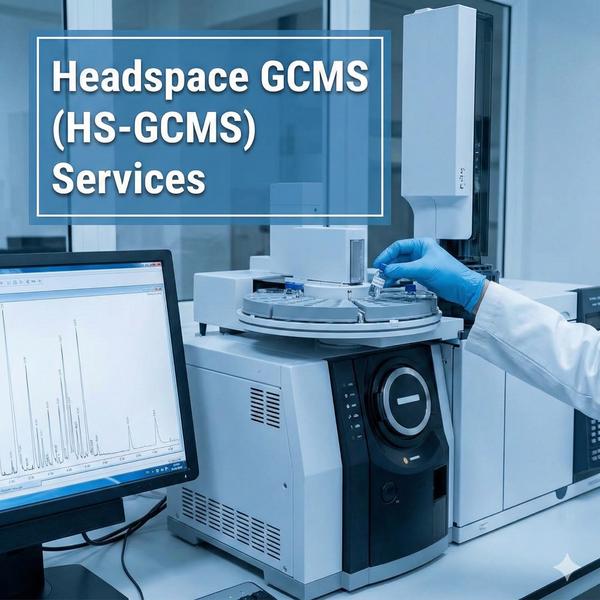
At Dextrose Technologies Pvt. Ltd., we offer Headspace GCMS (HS-GCMS) testing for accurate analysis of volatile compounds with reduced matrix interference. By sampling the vapor phase above the sample, HS-GCMS improves repeatability for residual solvent testing, volatile impurity profiling, and screening studies. Our workflows are designed for R&D and QC support with clean documentation and decision-ready reporting.
Residual Solvent Analysis (ICH Q3C-Oriented)
We support ICH Q3C-oriented residual solvent analysis by targeting relevant solvents, using calibration-based quantification (as applicable), and reporting results in clear units based on your limits and sample type.
Volatile Impurity Profiling
We profile unknown or suspected volatile impurities to support troubleshooting, process optimization, and batch comparison, with MS-based confirmation where possible.
Packaging Interaction Studies (Screening)
We provide screening studies to evaluate potential volatile compounds that may arise from packaging/contact materials interactions (scope-dependent), useful for early risk assessment and comparison between packaging options.
Stability Study Support for Volatile Components
We support stability programs by tracking volatile components across timepoints, enabling trend analysis and comparison between storage conditions or formulations.
Deliverables
* Headspace GCMS chromatograms + peak tables
* Mass spectra and identification summary (where applicable)
* Quantitative results (when standards/targets and reporting limits are defined)
* Method notes and interpretation aligned to your objective
* Optional recommendations for follow-up confirmation or expanded screening
Get started
Share your sample type, target solvent list (if known), required limits/units, and whether you need ID only or ID + quantification. We’ll propose the right HS-GCMS workflow.
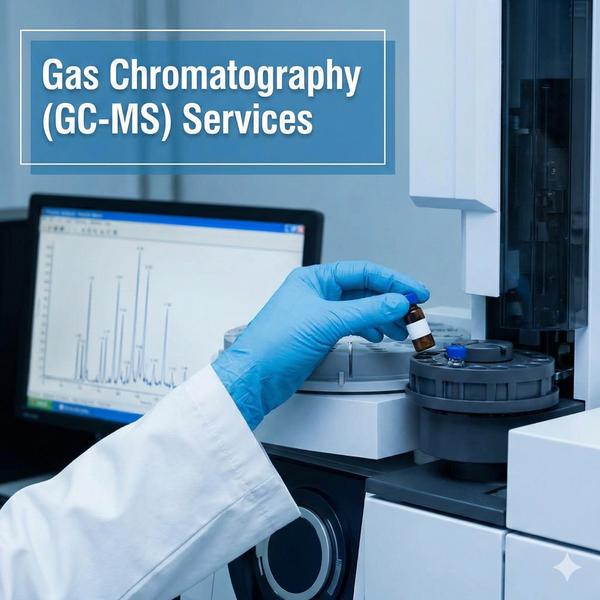
At Dextrose Technologies Pvt. Ltd., we provide Gas Chromatography–Mass Spectrometry (GCMS / GC–MS) services for identification and profiling of volatile and semi-volatile compounds in complex samples. GCMS combines strong chromatographic separation with mass spectral confirmation to support unknown peak identification, impurity profiling, and screening studies for R&D and industrial applications.
Volatile and Semi-Volatile Compound Identification
We identify volatile and semi-volatile compounds using GC separation and MS-based spectral interpretation, supporting troubleshooting, screening, and confirmation workflows.
Impurity Profiling
We detect and profile impurities and unknown peaks to support batch comparison, contamination investigations, and process optimization.
Extractables and Leachables (Screening)
We offer screening-level E&L studies to evaluate potential extractable/leachable compounds from packaging, plastics, tubing, or contact materials (scope-dependent, non-regulatory screening unless specified).
Flavor and Fragrance Component Analysis
We can support fragrance/flavor component analysis only when identification is feasible within our available spectral resources and project scope. (If a dedicated fragrance library is required, we will clarify feasibility upfront.)
Environmental and Industrial Sample Analysis
We analyze VOC/SVOC profiles in environmental and industrial samples (water/soil/air extracts, process samples, materials) for screening, comparison, and investigation needs.
Deliverables
* Chromatograms + peak tables
* Mass spectra and ID summary for identified peaks (where applicable)
* Impurity/profile interpretation notes
* Quantification support when standards and reporting limits are defined
Get started
Share your sample type, target analytes (if known), expected concentration range, and whether you need identification only or identification + quantification.
At Dextrose Technologies Pvt. Ltd., we provide Liquid Chromatography–Mass Spectrometry (LCMS / LC–MS/MS) services for high-confidence molecular weight confirmation, compound identification, and impurity/degradation profiling. LCMS is ideal for non-volatile and thermally sensitive compounds where mass-based confirmation is required. We support R&D and exploratory projects with clear reporting and practical interpretation.
Molecular Weight Confirmation
We confirm molecular mass and assess molecular ions/adducts (as applicable) to support identity verification and batch comparison.
Compound Identification and Characterization
We support compound identification using LC separation plus MS/MS-based fragmentation (scope-dependent), enabling stronger confidence than chromatography alone.
Impurity Identification and Profiling
We detect and profile impurities in complex mixtures and help prioritize unknown peaks for follow-up characterization.
Degradation Product Identification
We support stability investigations by detecting and identifying degradation products formed under storage or stress conditions (as applicable to your study plan).
Metabolite Identification
For exploratory studies, we can support metabolite detection/identification workflows based on the sample type and objective (project-dependent).
Bioanalytical Sample Analysis (non-GLP exploratory)
We handle exploratory bioanalytical analysis for R&D (non-GLP), with method approach finalized based on matrix complexity and target sensitivity.
Peptide and Small Molecule Analysis
We support peptide and small molecule analysis (project scope dependent), including mass confirmation and profiling.
MS Data Interpretation and Reporting
We provide structured reports with chromatograms, key ions, observed masses, and interpretation notes—so teams can act quickly.
Deliverables
* Chromatograms + peak tables
* Observed m/z values and spectra/MSMS details (where applicable)
* Impurity/degradation profiling summary
* Quantitative results (if calibration standards are provided/defined)
* Clear conclusions and next-step recommendations
Get started
Share your sample type, expected mass range, target analytes (if known), and objective (ID/impurities/degradation). We’ll recommend the most reliable LCMS approach.
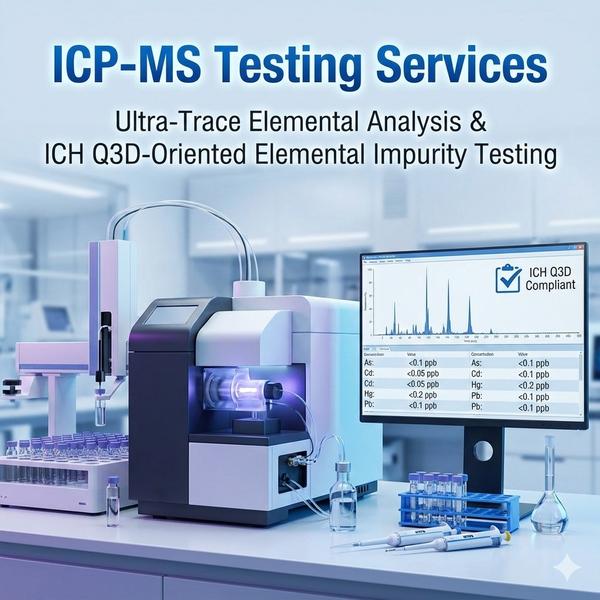

 Chat with us