
Bengaluru
08042753298
+919686928701
Thermal Analysis & Characterization by DEXTROSE TECHNOLOGIES

Thermogravimetric Analysis (TGA/DTG) Services

In stock•cod not available
Phone Number

08042753298

Please keep 0 before dialling the number.

Mon-Thu: 10 AM - 2 PM • Fri: 3 PM - 7AM

Address #1250/15/6B, 1st Cross Road, Behind Kengeri Post Office, Kengeri Satellite Town, Bengaluru

Bengaluru, Karnataka, India, 560060

Description

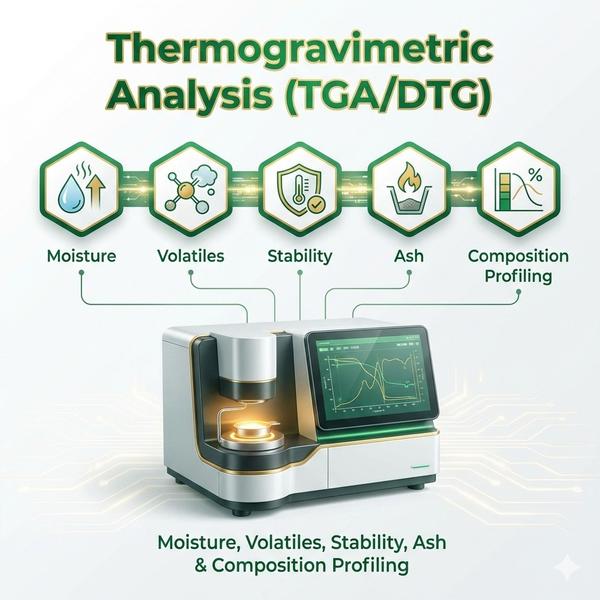
At Dextrose Technologies Pvt. Ltd., we provide Thermogravimetric Analysis (TGA) and Derivative Thermogravimetric Analysis (DTG) for thermal and physicochemical characterization of materials. TGA measures weight change vs temperature/time, while DTG highlights rate of mass loss, helping you evaluate moisture/volatile content, thermal stability, decomposition stages, ash/residue, and composition trends in multi-component systems. Thermogravimetric Analysis (TGA) We generate TGA curves to quantify mass loss steps and residual mass under defined heating programs and atmospheres (as per scope). Derivative Thermogravimetric Analysis (DTG) DTG profiles help separate overlapping events and identify key decomposition temperatures by showing the mass-loss rate peaks. Moisture and Volatile Content Determination We quantify early-stage mass loss attributed to moisture and low-boiling volatiles, useful for raw material control and process optimization. Thermal Stability and Decomposition Profiling We assess onset temperatures and decomposition stages to compare batches, evaluate stability, and understand thermal behavior under heating. Ash Content and Residue Analysis We report final residue/ash percentage to support inorganic content assessment and compositional comparison. Composition Analysis of Multi-Component Systems We interpret multi-step mass-loss behavior to provide composition insights (e.g., binder/filler/organic fraction trends), with recommendations for confirmatory techniques if required. Deliverables * TGA and DTG curves with key temperatures (onset/peaks) * % mass loss by stage + final residue/ash % * Comparative summary across samples/batches * Interpretation notes aligned to your objective Get started Share your material type, expected temperature range, sample form, and objective (moisture, stability, ash, composition). We’ll recommend the right TGA/DTG program and reporting format.

Keywords

Other Services

view all

68179d65be22ee500d53ff54 Card 2

product image
Elemental Analysis

At Dextrose Technologies Pvt. Ltd., we provide ICP-OES (Inductively Coupled Plasma – Optical Emission Spectroscopy) for reliable multi-element quantitative analysis across raw materials, intermediates, and finished products. ICP-OES is well suited for routine elemental profiling and screening where you need accurate concentrations across multiple metals and minerals in a single run (scope depends on matrix and required limits). Multi-Element Quantitative Analysis We quantify multiple elements in one method, generating concentration results in clear units (ppm/ppb or mg/L as required) with calibration-based reporting. Heavy Metal and Elemental Impurity Screening We support screening for heavy metals and elemental impurities to help identify contamination risks, support QC decisions, and enable batch comparison. (For ICH Q3D-aligned programs, scope and limits are finalized based on your requirements and standards provided.) Raw Material and Finished Product Analysis We analyze a wide range of matrices—raw materials, powders, liquids, digests, and finished products—based on suitable sample preparation and digestion approach. Deliverables * Results table with element-wise concentrations * Method notes (sample prep/digestion basis as applicable) * Calibration approach and QC checks (as agreed) * Summary interpretation and flags for outliers/trends Get started Share your sample type, target element list, required limits, and reporting units. We’ll recommend the right ICP-OES workflow and sample preparation plan.

68179d65be22ee500d53ff54 Card 2

product image
Elemental Analysis

At Dextrose Technologies Pvt. Ltd., we offer Atomic Absorption Spectroscopy (AAS) for accurate, targeted metal quantification in APIs, excipients, formulations, and raw materials. AAS is well suited when you need focused testing of specific metals with dependable calibration-based reporting. We support heavy metal testing and routine elemental checks for quality, troubleshooting, and compliance-focused workflows (scope and limits defined by your requirement). Targeted metal quantification We quantify selected metals based on your target list and matrix, with results reported in clear units (ppm/ppb or mg/L as required). Heavy metal testing in APIs, excipients, and formulations We test for heavy metals in pharmaceutical and formulation samples to support QC decisions and risk evaluation, with clean documentation and structured reporting. Deliverables * Metal-wise concentration results with units * Method notes and sample preparation basis (as applicable) * Calibration approach and QC checks (as agreed) * Summary interpretation highlighting any outliers Get started Share your sample type, target metal list, required limits, and reporting units. We’ll recommend the most suitable AAS workflow.

68179d65be22ee500d53ff54 Card 2

product image
Thermal Analysis & Characterization

At Dextrose Technologies Pvt. Ltd., we provide Thermogravimetric Analysis (TGA) and Derivative Thermogravimetric Analysis (DTG) for thermal and physicochemical characterization of materials. TGA measures weight change vs temperature/time, while DTG highlights rate of mass loss, helping you evaluate moisture/volatile content, thermal stability, decomposition stages, ash/residue, and composition trends in multi-component systems. Thermogravimetric Analysis (TGA) We generate TGA curves to quantify mass loss steps and residual mass under defined heating programs and atmospheres (as per scope). Derivative Thermogravimetric Analysis (DTG) DTG profiles help separate overlapping events and identify key decomposition temperatures by showing the mass-loss rate peaks. Moisture and Volatile Content Determination We quantify early-stage mass loss attributed to moisture and low-boiling volatiles, useful for raw material control and process optimization. Thermal Stability and Decomposition Profiling We assess onset temperatures and decomposition stages to compare batches, evaluate stability, and understand thermal behavior under heating. Ash Content and Residue Analysis We report final residue/ash percentage to support inorganic content assessment and compositional comparison. Composition Analysis of Multi-Component Systems We interpret multi-step mass-loss behavior to provide composition insights (e.g., binder/filler/organic fraction trends), with recommendations for confirmatory techniques if required. Deliverables * TGA and DTG curves with key temperatures (onset/peaks) * % mass loss by stage + final residue/ash % * Comparative summary across samples/batches * Interpretation notes aligned to your objective Get started Share your material type, expected temperature range, sample form, and objective (moisture, stability, ash, composition). We’ll recommend the right TGA/DTG program and reporting format.