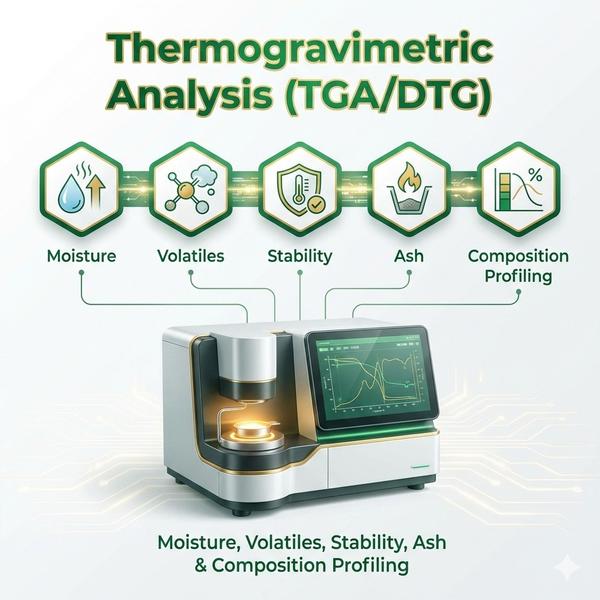
At Dextrose Technologies Pvt. Ltd., we provide Thermogravimetric Analysis (TGA) and Derivative Thermogravimetric Analysis (DTG) for thermal and physicochemical characterization of materials. TGA measures weight change vs temperature/time, while DTG highlights rate of mass loss, helping you evaluate moisture/volatile content, thermal stability, decomposition stages, ash/residue, and composition trends in multi-component systems. Thermogravimetric Analysis (TGA) We generate TGA curves to quantify mass loss steps and residual mass under defined heating programs and atmospheres (as per scope). Derivative Thermogravimetric Analysis (DTG) DTG profiles help separate overlapping events and identify key decomposition temperatures by showing the mass-loss rate peaks. Moisture and Volatile Content Determination We quantify early-stage mass loss attributed to moisture and low-boiling volatiles, useful for raw material control and process optimization. Thermal Stability and Decomposition Profiling We assess onset temperatures and decomposition stages to compare batches, evaluate stability, and understand thermal behavior under heating. Ash Content and Residue Analysis We report final residue/ash percentage to support inorganic content assessment and compositional comparison. Composition Analysis of Multi-Component Systems We interpret multi-step mass-loss behavior to provide composition insights (e.g., binder/filler/organic fraction trends), with recommendations for confirmatory techniques if required. Deliverables * TGA and DTG curves with key temperatures (onset/peaks) * % mass loss by stage + final residue/ash % * Comparative summary across samples/batches * Interpretation notes aligned to your objective Get started Share your material type, expected temperature range, sample form, and objective (moisture, stability, ash, composition). We’ll recommend the right TGA/DTG program and reporting format.

Hyderabad
08048047718
+919686928701
 Chat with us
 Chat with us