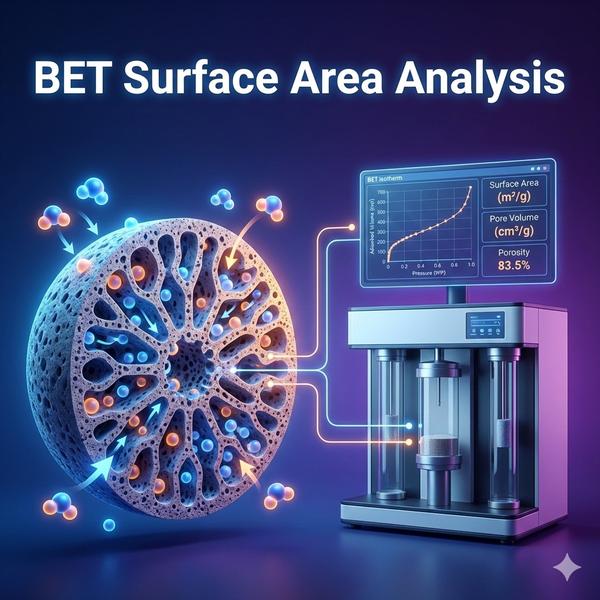
At Dextrose Technologies Pvt. Ltd., we provide BET (Brunauer–Emmett–Teller) surface area analysis to quantify specific surface area and evaluate porosity-related properties of powders and porous materials. BET testing is widely used for catalysts, adsorbents, carbon materials, metal oxides, ceramics, and porous solids, helping you correlate surface area and pore structure with performance and batch consistency. Surface area determination We determine specific surface area (m²/g) using gas adsorption methods and provide comparative summaries across batches or processing conditions. Pore size and volume analysis We support pore characterization by reporting pore volume and pore size distribution (as per method scope), useful for adsorption performance, filtration behavior, and material selection. Catalyst, adsorbent, and material evaluation BET helps evaluate catalysts and adsorbents for surface activity, and supports material QC by tracking porosity changes due to synthesis, activation, milling, or heat treatment. Deliverables * BET surface area (m²/g) * Pore volume and pore size distribution (as applicable) * Isotherm plots/data summary and key parameters * Interpretation notes for batch comparison and performance relevance Get started Share your material type, expected surface area range, degassing conditions (if known), and objective (QC, R&D, catalyst/adsorbent evaluation). We’ll recommend the right BET scope and reporting format.
Hyderabad
08048047718
+919686928701
 Chat with us
 Chat with us