

>> Overview
Escherichia coli (E. coli) is a widely studied Gram-negative bacterium known for its structural adaptability and biological significance. It is commonly found in the intestinal tract of humans and animals, where it plays a role in maintaining gut health. However, certain pathogenic strains are associated with infections such as urinary tract infections, gastroenteritis, and septicemia. Its relatively simple structure and rapid growth make it a key model organism in microbiology and biotechnology.
>> Shape
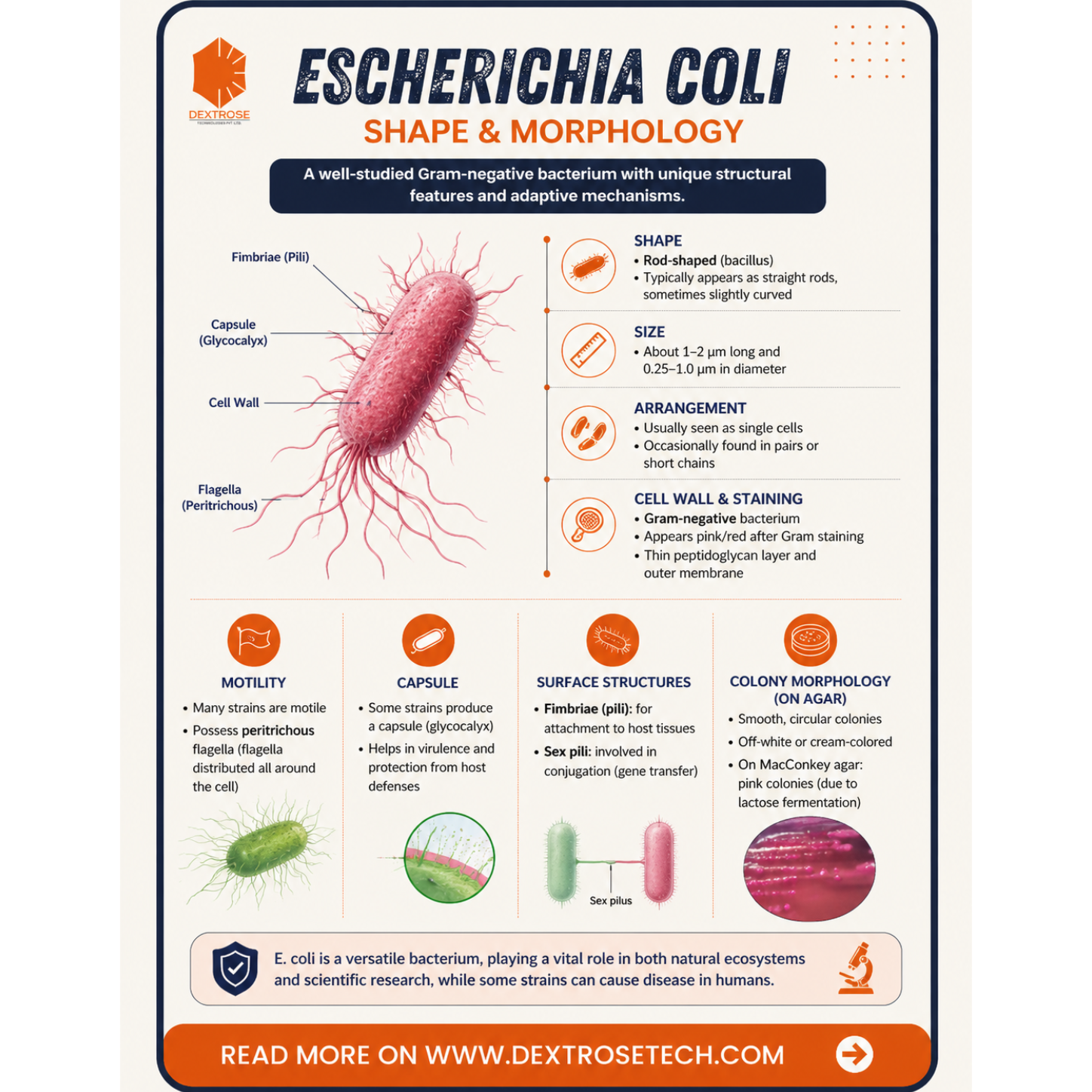
E. coli exhibits a rod-shaped (bacillus) morphology. The cells are typically straight rods, although slight curvature may occasionally be observed depending on growth conditions. This rod-like shape increases the surface-area-to-volume ratio, which enhances nutrient absorption and metabolic efficiency.
>> Size
The size of E. coli cells generally ranges from 1 to 2 micrometers in length and 0.25 to 1.0 micrometers in diameter. These dimensions allow the bacterium to efficiently diffuse nutrients and waste products across its cell membrane, supporting rapid growth under favorable conditions.
>> Arrangement
E. coli cells are most commonly observed as single, independent units. In some cases, they may appear in pairs or short chains, particularly during active division. However, they do not form complex multicellular arrangements like some other bacterial species.
>> Cell Wall and Staining Characteristics
E. coli is classified as a Gram-negative bacterium, meaning it does not retain the crystal violet stain during Gram staining and instead appears pink or red after counterstaining with safranin. Its cell wall structure consists of a thin peptidoglycan layer located between the inner cytoplasmic membrane and an outer membrane.
The outer membrane contains lipopolysaccharides (LPS), which contribute to structural integrity and can act as endotoxins in pathogenic strains. This unique cell wall architecture also provides resistance to certain antibiotics and environmental stresses.
>> Motility
Many strains of E. coli are motile, possessing peritrichous flagella, which are flagella distributed uniformly over the entire surface of the cell. These flagella enable the bacterium to move actively in liquid environments through a series of coordinated rotations, allowing it to respond to chemical gradients (chemotaxis) and locate nutrients or favorable conditions.
>> Capsule (Glycocalyx)
Some strains of E. coli produce a capsule, also known as a glycocalyx. This outer protective layer is composed primarily of polysaccharides and serves several important functions:
Enhances virulence by helping bacteria evade host immune responses
Provides protection against desiccation and phagocytosis
Aids in adhesion to surfaces and host tissues
Capsule presence varies between strains and is often associated with pathogenic variants.
>> Surface Structures
E. coli possesses specialized surface appendages that contribute to its survival and pathogenicity:
Fimbriae (Pili): Short, hair-like structures that facilitate attachment to host tissues, which is crucial for colonization and infection.
Sex Pili: Longer structures involved in bacterial conjugation, a process of genetic material transfer between cells, promoting genetic diversity and the spread of antibiotic resistance.
Colony Morphology (On Agar Media)
>> When cultured on solid media, E. coli forms characteristic colonies:
On general nutrient agar, colonies are typically smooth, circular, moist, and off-white or cream-colored
On MacConkey agar, E. coli produces pink colonies due to its ability to ferment lactose, which lowers the pH and changes the color of the pH indicator
Colony morphology is an important diagnostic feature in microbiology laboratories.
>> Significance
E. coli is a highly versatile bacterium that plays a dual role:
Beneficial role: Contributes to gut health by synthesizing vitamins such as vitamin K and preventing colonization by harmful microbes
Scientific importance: Widely used in genetic engineering, molecular biology, and recombinant DNA technology
Pathogenic potential: Certain strains (e.g., EHEC, ETEC, UPEC) can cause serious diseases in humans