
>> Cyanobacteria: Ancient Architects of Life
Photosynthetic bacteria, particularly Cyanobacteria, played a fundamental role in shaping Earth’s atmosphere. Around 2.5 billion years ago, they triggered the Great Oxygenation Event, enabling the evolution of aerobic and complex life. Even today, they remain vital contributors to global biomass and actively participate in carbon and nitrogen cycles, thriving in diverse and extreme environments.
>> A Model Organism for Multicellularity
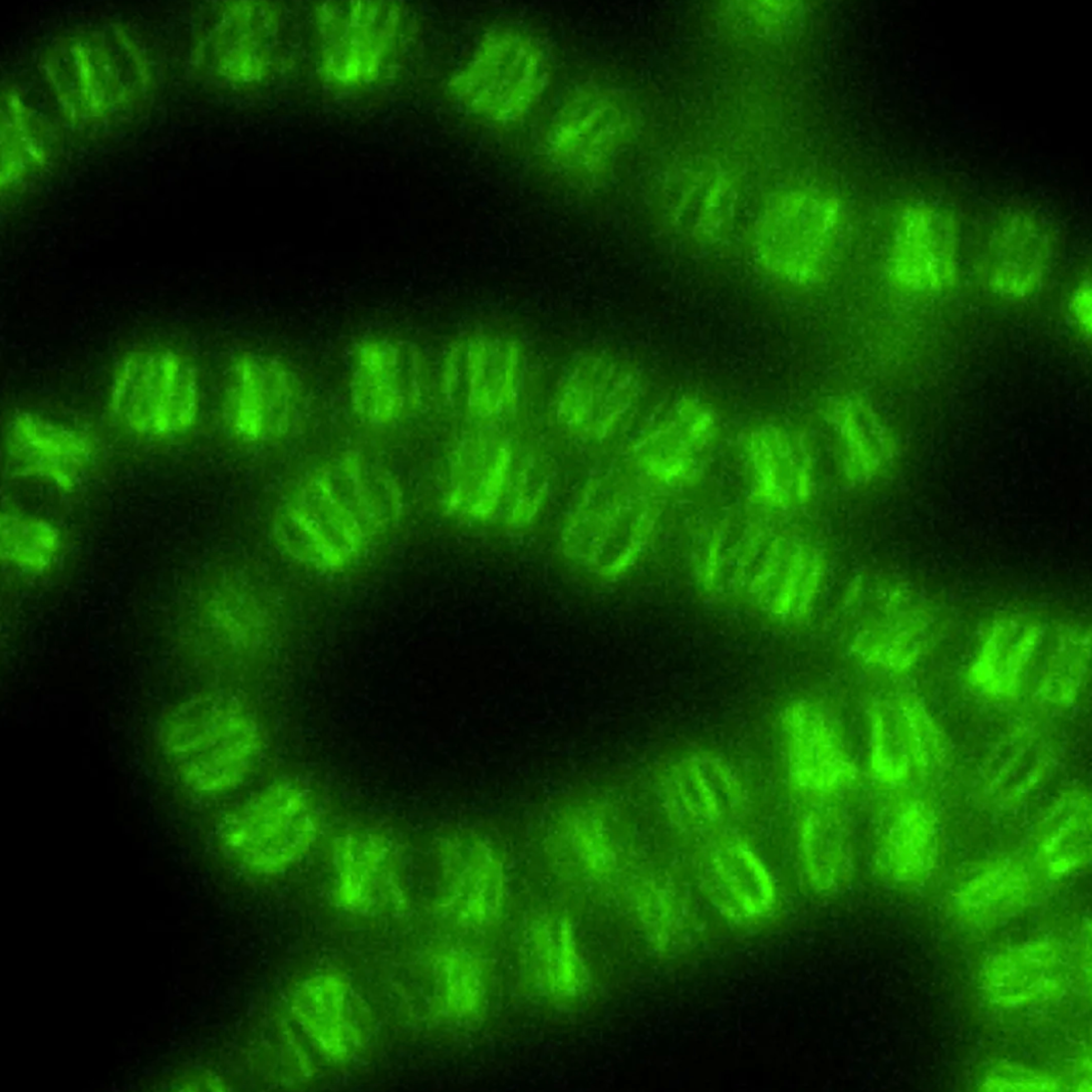
The species Anabaena sp. PCC 7120 has long served as a model to study multicellular behavior in bacteria. Its ability to form filamentous structures makes it ideal for understanding how simple organisms evolve structural complexity.
>> Evolutionary Shift: From DNA Segregation to Cell Structure
Recent research from the Institute of Science and Technology Austria, published in Science, reveals a remarkable evolutionary transformation. A protein system originally responsible for DNA segregation, known as ParMR, has been repurposed into a cytoskeleton-like structure that controls cell shape in multicellular cyanobacteria.
>> How the System Works
Unlike its original role in DNA movement:
*The protein ParR no longer binds DNA but instead attaches to the inner cell membrane.
*ParM forms dynamic filament networks beneath the membrane, creating a cortex-like structure.
These filaments exhibit dynamic instability—growing and collapsing—similar to microtubules in complex cells, and uniquely display bipolar behavior, allowing growth from both ends.
Functional Evidence: Impact on Cell Shape
When this system was experimentally removed, cells lost their characteristic rectangular shape and became round and swollen. This confirmed that its primary role is structural rather than genetic. Reflecting this new function, researchers renamed the system CorMR.
>> Significance of the Discovery
This finding highlights how evolution can repurpose existing biological systems for entirely new functions. It provides key insights into the development of multicellularity and structural organization in bacteria, advancing our understanding of cellular evolution in ecologically critical organisms.
Journal Reference:
Benjamin L. Springstein, Manjunath G. Javoor, Daniela Megrian, Roman Hajdu, Dustin M. Hanke, Bettina Zens, Gregor L. Weiss, Florian K. M. Schur, Martin Loose. Repurposing of a DNA segregation machinery into a cytoskeletal system controlling cell shape. Science, 2026; 392 (6795) DOI: 10.1126/science.aea6343