

>> Introduction
Paramecium caudatum is a unicellular, eukaryotic protozoan commonly found in freshwater habitats such as ponds, lakes, ditches, and slow-moving streams. It is one of the most extensively studied microorganisms in biology due to its complex cellular organization, efficient locomotion, feeding mechanisms, and reproductive strategies. As a representative member of the ciliate protozoa, Paramecium caudatum serves as an important model organism for understanding fundamental cellular processes.
>> Shape and Structure
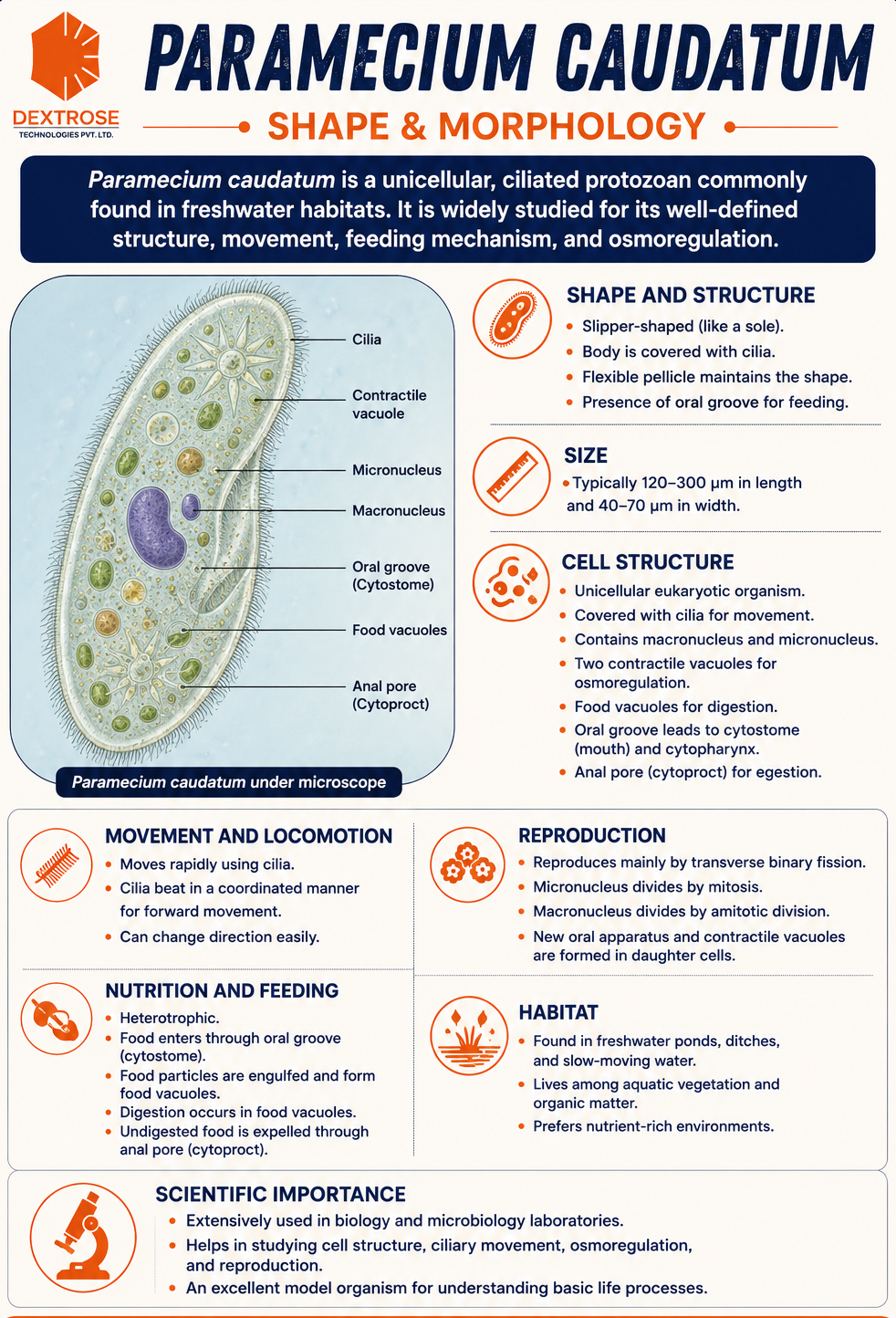
Paramecium caudatum possesses a distinctive slipper-shaped body enclosed by a flexible yet supportive pellicle that helps maintain its shape. The entire cell surface is covered with thousands of tiny hair-like structures called cilia. These cilia play a crucial role in movement, feeding, and environmental sensing.
The organism contains several specialized cellular structures, including:
Macronucleus for controlling metabolic activities
Micronucleus involved in reproduction and genetic exchange
Contractile vacuoles for osmoregulation
Food vacuoles for digestion
Oral groove for food intake
Cytoproct (anal pore) for waste elimination
>> Size
The size of Paramecium caudatum generally ranges between 120–300 µm in length and 40–70 µm in width, making it one of the larger protozoans that can be easily observed under a light microscope.
>> Movement and Locomotion
Movement in Paramecium caudatum is achieved through the coordinated beating of cilia. These microscopic structures propel the organism smoothly through water while allowing rapid changes in direction. The synchronized movement of cilia enables efficient navigation through aquatic environments in search of nutrients.
>> Nutrition and Feeding
Paramecium caudatum is a heterotrophic organism that feeds on bacteria, algae, and organic particles suspended in water. Food particles are swept into the oral groove by ciliary action and transported to the cytostome, where they are enclosed within food vacuoles. Digestion occurs within these vacuoles, and undigested materials are expelled through the cytoproct.
>> Reproduction
The primary mode of reproduction in Paramecium caudatum is transverse binary fission, where one cell divides into two genetically identical daughter cells. Under certain conditions, it can also undergo conjugation, a process involving genetic exchange between two individuals, which enhances genetic diversity within populations.
>> Habitat
This protozoan thrives in freshwater ecosystems rich in organic matter. It is frequently found among aquatic vegetation, decaying plant material, and nutrient-rich water bodies where bacterial populations are abundant.
>> Scientific Importance
Paramecium caudatum has long been used in biological and microbiological research. It plays a vital role in studies related to:
Cell structure and function
Ciliary movement
Osmoregulation
Cellular respiration
Reproduction and genetics
Its relatively large size and transparent body make it an excellent teaching and research organism in laboratories worldwide.
>> Conclusion
With its specialized organelles, efficient ciliary locomotion, and sophisticated feeding mechanisms, Paramecium caudatum represents one of the most fascinating unicellular organisms. Its importance in education and scientific research continues to provide valuable insights into the fundamentals of cell biology and protozoology.