
>> Overview
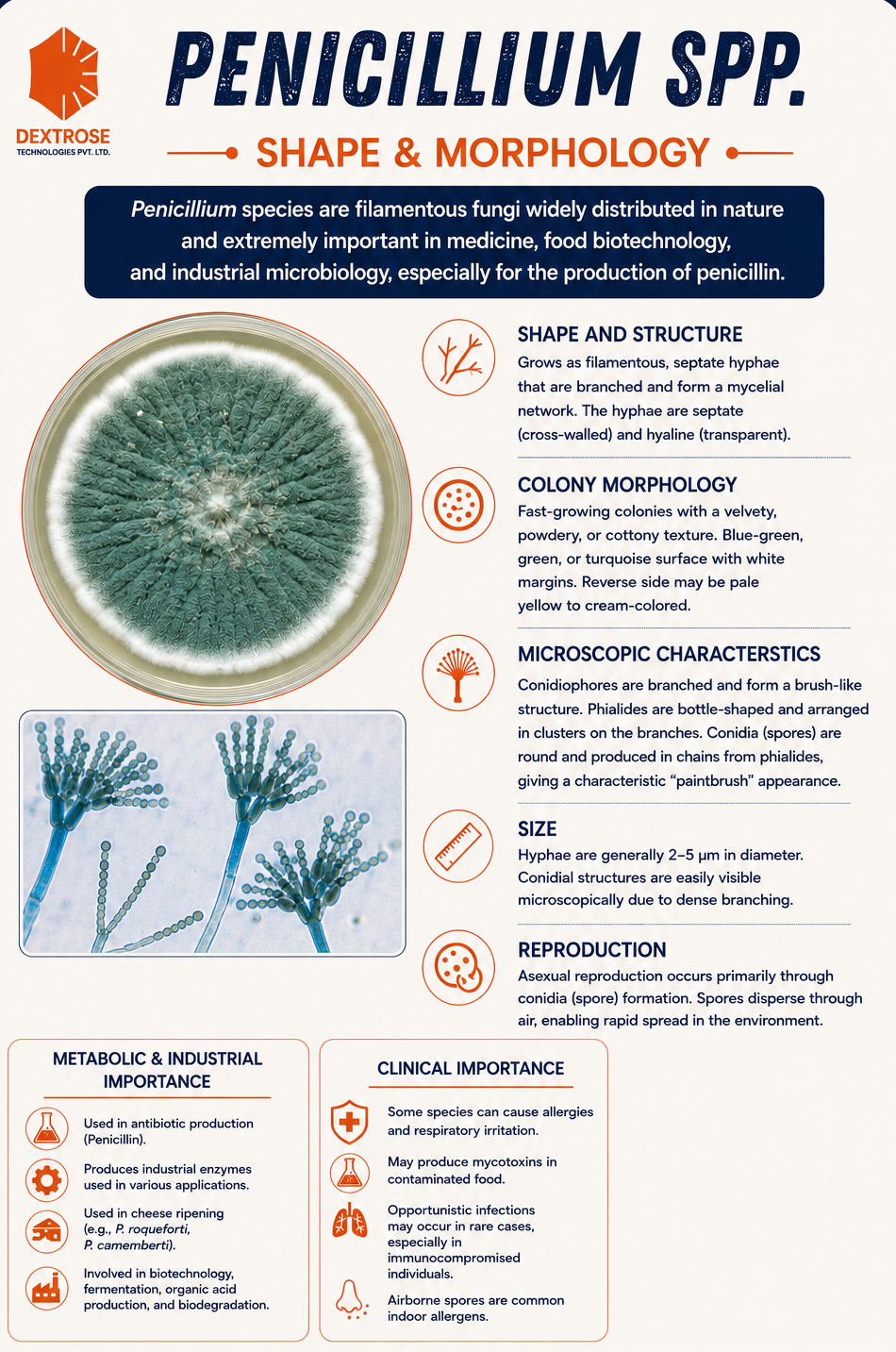
Penicillium species are filamentous fungi widely distributed in soil, decaying organic matter, air, and food products. They are highly important in medicine, food biotechnology, and industrial microbiology, especially for the discovery and production of the antibiotic penicillin. Certain species are also used in cheese production and enzyme manufacturing.
>> Shape and Structure
Penicillium spp. grow as:
Filamentous, septate hyphae
Branched fungal threads forming a mycelial network
The hyphae are:
✔️ Septate (cross-walled)
✔️ Hyaline (transparent/light-colored)
These structures help the fungus efficiently absorb nutrients from its environment.
>> Colony Morphology
On culture media, Penicillium typically forms:
✔️ Fast-growing colonies
✔️ Velvety, powdery, or cottony texture
✔️ Blue-green, green, or turquoise surface coloration
✔️ White margins surrounding colonies
The reverse side of colonies may appear pale yellow to cream-colored depending on the species.
>> Microscopic Characteristics
A major identifying feature of Penicillium is its characteristic brush-like spore-producing structure.
🔹 Conidiophores
Specialized stalks arising from hyphae
🔹 Phialides
Bottle-shaped structures arranged in clusters
🔹 Conidia (Spores)
Chains of round spores produced from phialides
These structures collectively resemble a paintbrush or broom, which gives the genus its name (“penicillus” = brush).
>> Size
The fungal hyphae are generally:
Around 2–5 µm in diameter
Conidial structures are easily visible microscopically due to dense branching.
>> Reproduction
Penicillium spp. mainly reproduce through:
✔️ Asexual reproduction by conidia formation
The spores disperse efficiently through air, enabling rapid environmental spread.
>> Metabolic and Industrial Importance
Penicillium species are widely used in:
🧪 Antibiotic production (Penicillin)
🧪 Enzyme production
🧀 Cheese ripening (P. roqueforti, P. camemberti)
🧬 Biotechnology and fermentation industries
Some species also contribute to organic acid production and biodegradation studies.
>> Clinical Importance
Although many species are beneficial, some may:
⚠️ Cause allergies and respiratory irritation
⚠️ Produce mycotoxins in contaminated food
⚠️ Lead to opportunistic infections in rare cases
Airborne spores are common indoor allergens.
>> Habitat
Penicillium spp. are commonly found in:
🌱 Soil
🍞 Stored food products
🏠 Indoor environments
🍎 Decaying fruits and vegetables
Their rapid growth allows them to colonize diverse environments.
>> Key Insight
Due to their antibiotic-producing ability, industrial importance, and characteristic brush-like morphology, Penicillium species remain among the most significant fungi in microbiology and biotechnology.