

>> Overview
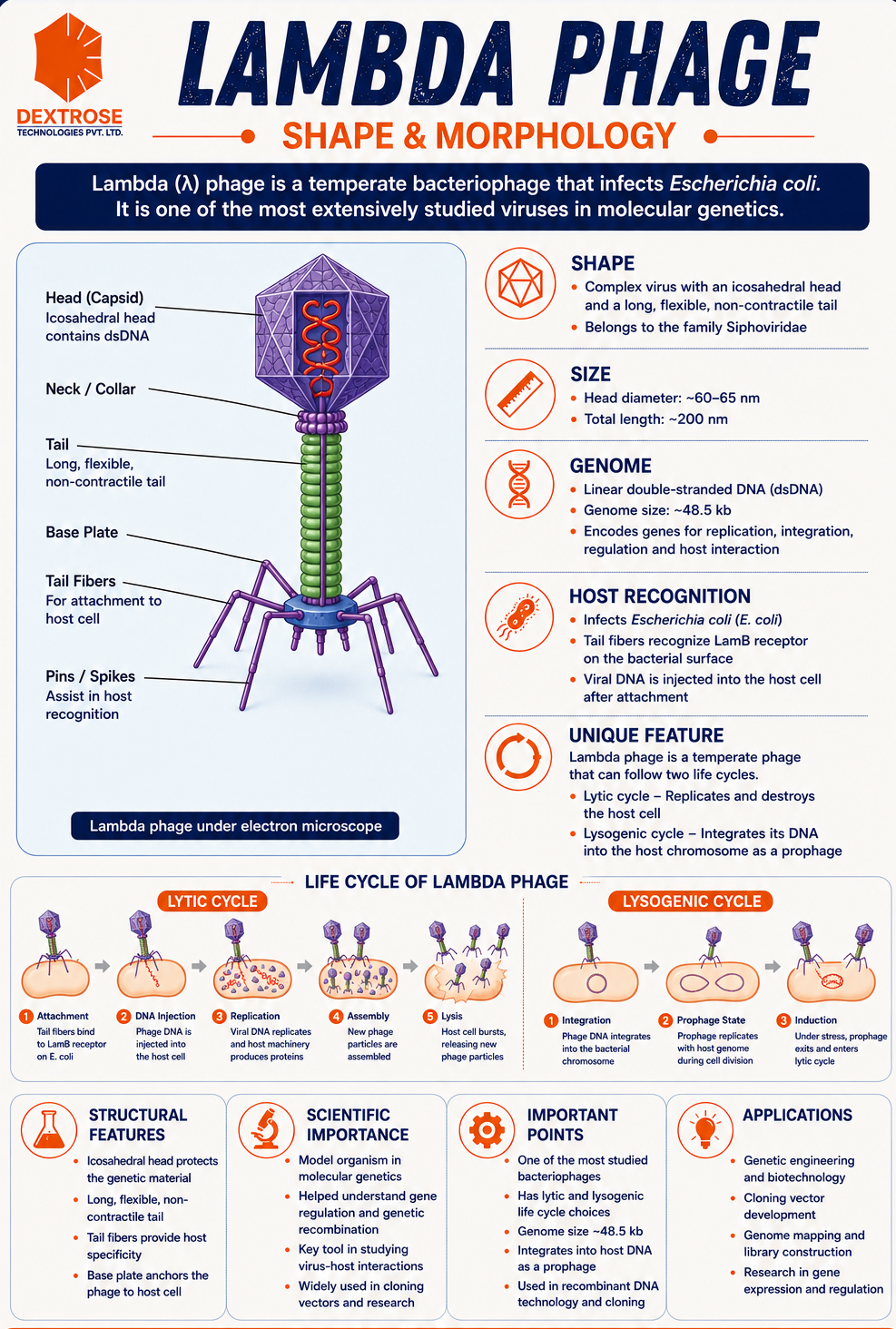
Lambda phage (λ phage) is a temperate bacteriophage that specifically infects Escherichia coli. It is one of the most extensively studied viruses in molecular biology and genetics due to its unique ability to alternate between lytic and lysogenic life cycles. This bacteriophage serves as an important model organism for understanding gene regulation, viral replication, and host-virus interactions.
>> Shape and Structure
Lambda phage possesses a characteristic complex structure consisting of an icosahedral head attached to a long, flexible, non-contractile tail. The head acts as a protective protein shell that encloses the viral genetic material, while the tail functions as a specialized apparatus for attaching to bacterial cells and delivering viral DNA into the host. This combination of a geometric capsid and tail gives the phage its distinctive tadpole-like appearance under electron microscopy.
>> Size
The phage head measures approximately 60–65 nanometers in diameter, while the flexible tail is about 150–170 nanometers long. The total length of the viral particle is roughly 200 nanometers, making it large enough to be clearly visualized using transmission electron microscopy.
>> Genome
Lambda phage contains a linear double-stranded DNA (dsDNA) genome of approximately 48.5 kilobases. The genome carries genes responsible for DNA replication, viral assembly, host recognition, integration into the bacterial chromosome, and regulation of the lytic and lysogenic pathways. This well-organized genome has made Lambda phage a valuable tool for genetic and molecular biology research.
>> Host Recognition and Attachment
The phage specifically infects E. coli by recognizing and binding to the LamB receptor located on the bacterial outer membrane. Once attached, the phage injects its DNA into the bacterial cell through its tail structure. This highly specific interaction ensures efficient infection of suitable host cells.
>> Morphological Characteristics
Lambda phage belongs to the family Siphoviridae, which is characterized by phages possessing long, flexible, non-contractile tails. Unlike bacteriophages such as T4 that have contractile tails, Lambda relies on its flexible tail for DNA transfer. Its structure is optimized for stability, host recognition, and successful genome delivery.
>> Important Features
One of the most remarkable features of Lambda phage is its ability to switch between the lytic cycle, where new phage particles are produced and the host cell is destroyed, and the lysogenic cycle, where the phage genome integrates into the bacterial chromosome and remains dormant as a prophage. This property has made Lambda phage a cornerstone in the study of gene regulation and genetic recombination. Additionally, Lambda phage-derived vectors have been widely used in cloning, recombinant DNA technology, and genome analysis.
>> Conclusion
Lambda phage is a highly specialized bacteriophage with an icosahedral head, flexible tail, and double-stranded DNA genome. Its unique morphology and dual replication strategies have made it one of the most important model systems in microbiology and biotechnology. Studies on Lambda phage continue to contribute significantly to our understanding of genetics, molecular biology, and virus-host interactions.