
>> Introduction
Tetrahymena thermophila is a free-living, unicellular ciliate protozoan commonly found in freshwater environments. It is one of the most important model organisms in molecular biology, genetics, and cell biology due to its rapid growth, well-characterized genome, and ease of laboratory cultivation. This microorganism has significantly contributed to discoveries in telomere biology, gene regulation, and cellular physiology.
>> Shape and Structure
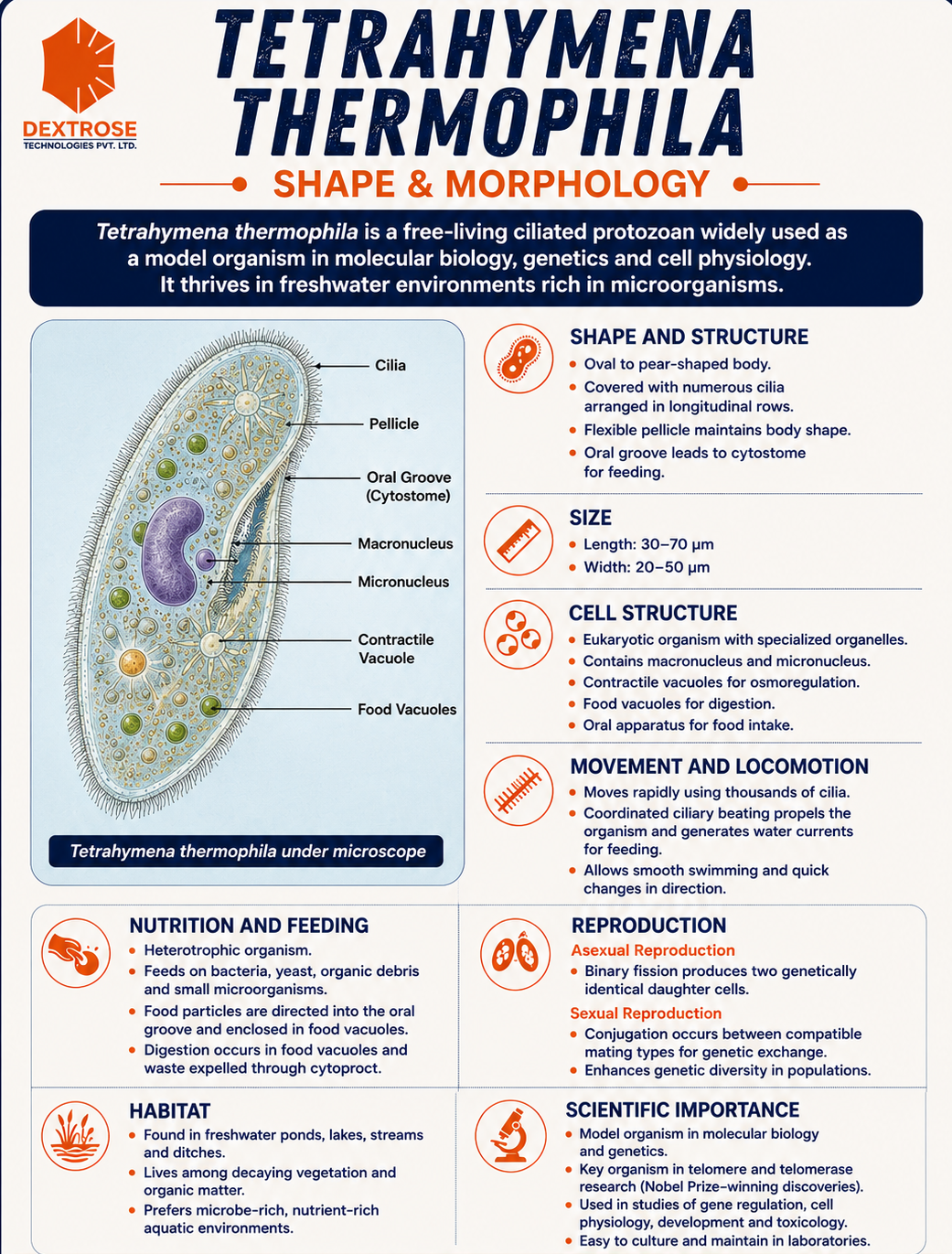
Tetrahymena thermophila possesses an oval to pear-shaped body covered entirely with numerous cilia arranged in longitudinal rows. These cilia enable efficient locomotion and feeding. Unlike many simple protists, Tetrahymena has a highly organized cellular structure containing specialized organelles that perform complex biological functions.
>> Key structural features include:
Pellicle (flexible outer covering)
Macronucleus controlling cellular activities
Micronucleus involved in reproduction and genetic exchange
Oral apparatus (cytostome)
Contractile vacuoles for osmoregulation
Food vacuoles for digestion
Numerous cilia for movement
Size
>> Typical dimensions include:
Length: 30–70 µm
Width: 20–50 µm
Its relatively large size allows easy observation under a light microscope.
>> Cell Structure
Tetrahymena thermophila is a eukaryotic organism containing membrane-bound organelles and two distinct nuclei:
Macronucleus
Controls metabolism, growth, and daily cellular functions.
Micronucleus
Functions primarily during sexual reproduction and genetic recombination.
Contractile Vacuoles
Maintain water balance by expelling excess water from the cell.
Food Vacuoles
Digest ingested bacteria and organic particles.
Movement and Locomotion
Movement occurs through synchronized beating of thousands of cilia covering the cell surface. These cilia propel the organism rapidly through water while allowing precise directional control.
The coordinated ciliary movement also generates water currents that help transport food particles toward the oral groove.
>> Nutrition and Feeding
Tetrahymena thermophila is a heterotrophic microorganism that feeds primarily on:
Bacteria
Yeast cells
Organic debris
Small microorganisms
Food particles are captured through the oral groove and enclosed within food vacuoles where digestion takes place.
>> Reproduction
Tetrahymena thermophila reproduces through:
Asexual Reproduction
Binary fission
Produces genetically identical daughter cells
Sexual Reproduction
Conjugation
Exchange of genetic material between compatible mating types
This dual reproductive strategy contributes to both rapid population growth and genetic diversity.
>> Habitat
Tetrahymena thermophila is commonly found in:
💧 Freshwater ponds
🌱 Lakes and streams
🍂 Decaying vegetation-rich habitats
🦠 Microbe-rich aquatic ecosystems
It thrives in environments containing abundant bacterial populations.
>> Scientific Importance
Tetrahymena thermophila has become a cornerstone of modern biological research and has contributed to major scientific discoveries, including:
🔬 Telomere structure and function
🧬 Telomerase enzyme discovery
⚙️ Gene regulation studies
🦠 Cellular physiology research
🧪 Toxicology and drug screening
Research involving Tetrahymena has contributed to Nobel Prize-winning discoveries in molecular biology.
>> Conclusion
With its complex cellular organization, dual nuclei, rapid growth, and scientific significance, Tetrahymena thermophila remains one of the most valuable model organisms in biological research. Its contributions continue to advance our understanding of genetics, cell biology, and molecular mechanisms.