

>> SHAPE & MORPHOLOGY
A complex virus that specifically infects Escherichia coli and serves as a classic model organism in molecular biology and virology.
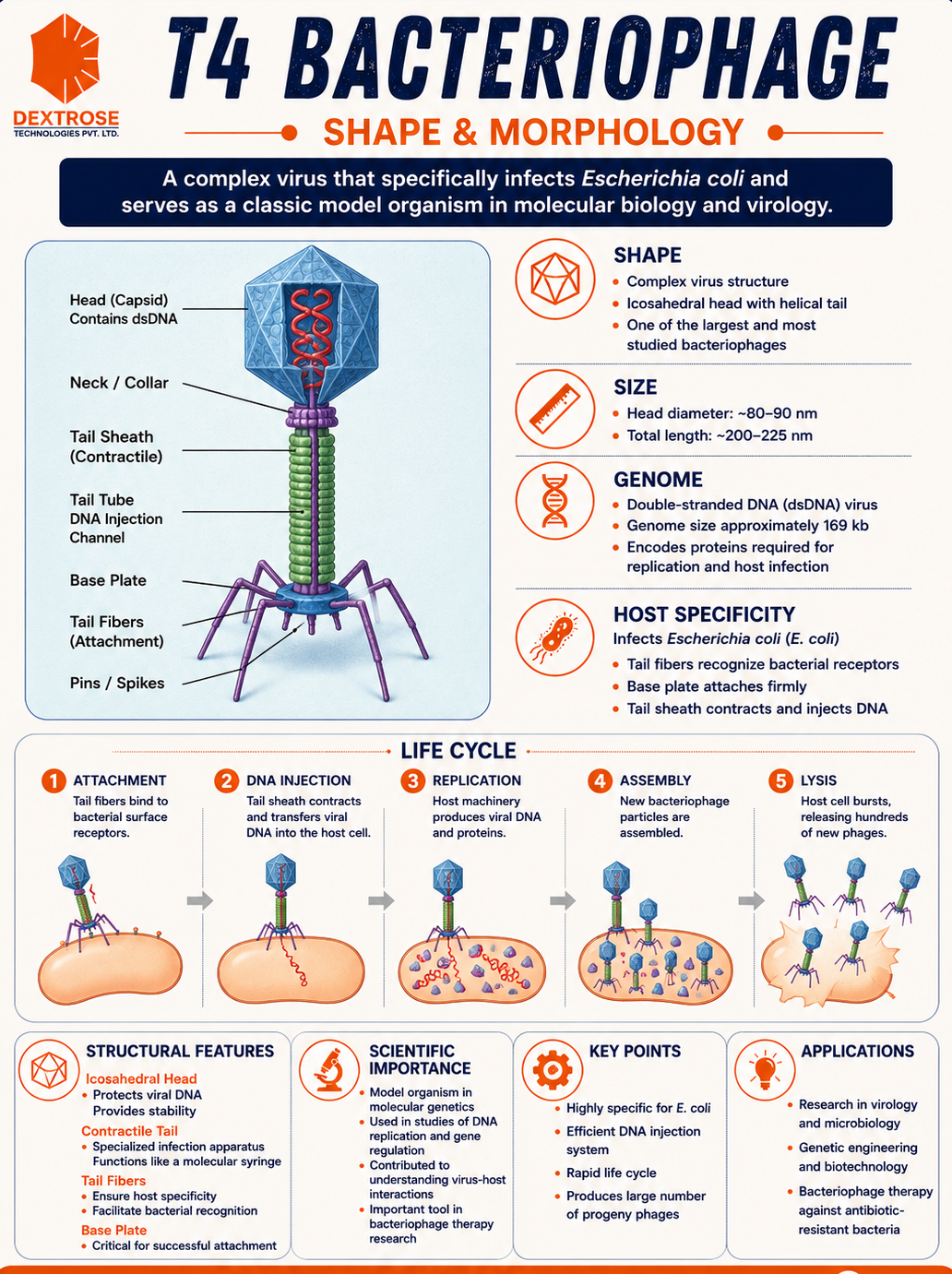
Main Structure (Labelled Diagram Section)
Head (Capsid)
Icosahedral protein shell
Contains double-stranded DNA genome
Neck / Collar
Connects head and tail structures
Tail Sheath
Contractile structure used for DNA injection
Tail Tube
Channel through which viral DNA enters the host cell
Base Plate
Anchors the phage to the bacterial surface
Tail Fibers
Recognize and attach to specific receptors on bacterial cells
Pins / Spikes
Assist in host attachment and penetration
Shape
🔹 Complex virus structure
🔹 Icosahedral head with helical tail
🔹 One of the largest and most studied bacteriophages
>> Size
📏 Head diameter: ~80–90 nm
📏 Total length: ~200–225 nm
>> Genome
🧬 Double-stranded DNA (dsDNA) virus
🧬 Genome size approximately 169 kb
🧬 Encodes proteins required for replication and host infection
>> Host Specificity
🦠 Infects Escherichia coli (E. coli)
Infection begins when:
✔ Tail fibers recognize bacterial receptors
✔ Base plate attaches firmly
✔ Tail sheath contracts and injects DNA
Life Cycle
Attachment
Tail fibers bind to bacterial surface receptors.
DNA Injection
Tail sheath contracts and transfers viral DNA into the host cell.
Replication
Host machinery produces viral DNA and proteins.
Assembly
New bacteriophage particles are assembled.
Lysis
Host cell bursts, releasing hundreds of new phages.
Structural Features
Icosahedral Head
Protects viral DNA
Provides stability
Contractile Tail
Specialized infection apparatus
Functions like a molecular syringe
Tail Fibers
Ensure host specificity
Facilitate bacterial recognition
Base Plate
Critical for successful attachment
Scientific Importance
🔬 Model organism in molecular genetics
🔬 Used in studies of DNA replication and gene regulation
🔬 Contributed to understanding virus-host interactions
🔬 Important tool in bacteriophage therapy research